Buy used Master of Business Administration (MBA) books online in India
Buy Second Hand Books, Used Books Online In India

Strategies management
The science behind the traits and quirks that drive creative geniuses to make spectacular breakthroughs What really distinguishes the people who literally change the world -- those creative geniuses who give us one breakthrough after another? What differentiates Marie Curie or Elon Musk from the merely creative, the many one-hit wonders among us? Melissa Schilling, one of the world's leading experts on innovation, invites us into the lives of eight people -- Albert Einstein, Benjamin Franklin, Elon Musk, Dean Kamen, Nikola Tesla, Marie Curie, Thomas Edison, and Steve Jobs -- to identify the traits and experiences that drove them to make spectacular breakthroughs, over and over again. While all innovators possess incredible intellect, intellect alone, she shows, does not create a breakthrough innovator. It was their personal, social, and emotional quirkiness that enabled true genius to break through--not just once but again and again. Nearly all of the innovators, for example, exhibited high levels of social detachment that enabled them to break with norms, an almost maniacal faith in their ability to overcome obstacles, and a passionate idealism that pushed them to work with intensity even in the face of criticism or failure. While these individual traits would be unlikely to work in isolation -- being unconventional without having high levels of confidence, effort, and goal directedness might, for example, result in rebellious behavior that does not lead to meaningful outcomes -- together they can fuel both the ability and drive to pursue what others deem impossible. Schilling shares the science behind the convergence of traits that increases the likelihood of success. And, as Schilling also reveals, there is much to learn about nurturing breakthrough innovation in our own lives -- in, for example, the way we run organizations, manage people, and even how we raise our children.
Principles of Management
This revised edition of Principles of Management will be updated to incorporate latest trends in management along with new cases and examples The title offers comprehensive discussion on all major areas of principles of management and organizational behavior Emerging topics, recent examples, side bars, schematic diagrams, and integrated cases will also be included for learners and practitioners to stay abreast of the latest happenings in the corporate world Two new chapters on OB will help this book cater to the changing curricula needs in MBA/PGDM market. The book has been designed for students of business management Students pursuing allied courses such as BTech, BBA, MCom and BCom also will find this text useful. Salient Featues: 1) New chapters on Organizational Behaviour and Individual and Group Behaviour 2) New cases on Managerial Roles and Skills, and Primacy of Goals and Resources 3) Enhanced pedagogy with numerous Box sidenotes in all the chapters 4) Exhaustive coverage in an easy language 5) Right balance of theory and practice
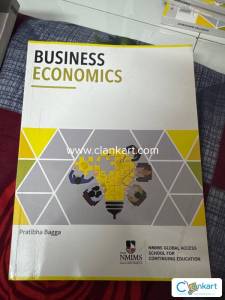
Business economics
This edition is specially revised to cater to the changed syllabi requirements of business economics as per UGC model curriculum, and in the light of the new UGC's Choice Based Credit System (CBCS) syllabus for B.Com and B.Com (Hons.). The book is a recommended text by UGC in its model curriculum.
MBA Books : Contemporary Strategy Analysis
For Human Resource Management (HRM) and Personnel courses. The #1 best-selling HRM book in the market, Dessler's Human Resource Management provides a comprehensive review of personnel management concepts and practices in a highly readable form. This edition focuses on the high-performance organization building better, faster, more competitive organizations through HR; while continuing to offer practical applications that help all managers deal with their personnel-related responsibilities.
Consumer Behaviour for MBA
This text is designed to provide usable managerial understanding of consumer behaviour. It is the most current, relevant, and balanced presentation of the subject matter in the context of building marketing strategy. It presents a comprehensive description of various concepts and theories useful for understanding consumer behaviour and illustrates with the help of examples, how these concepts are used in the development of such strategy. About Author: Del HawkinsUniversity Of OregonAmit MookerjeeIndian Institute of Management ,Lucknow Table Of Contents: Part One: Introduction1. Consumer Behavior and Marketing StrategyPart Two: External Influences2. Cross-Cultural Variations in Consumer Behavior3. The Changing Society: Values4. The Changing Society: Demographics and Social Stratification5. The Changing Society: Subcultures6. The Society: Families and Households7. Group Influences on Consumer BehaviorPart Three: Internal Influences8. Perception9. Learning, Memory, and Product Positioning10. Motivation, Personality, and Emotion11. Attitudes and Influencing Attitudes12. Self-Concept and LifestylePart Four: Consumer Decision Process13. Situational Influences14. Consumer Decision Process and Problem Recognition15. Information Search16. Alternative Evaluation and Selection17. Outlet Selection and Purchase18. Post purchase Processes, Customer Satisfaction, and Customer CommitmentPart Five: Organizations as Consumers19. Organizational Buyer BehaviorPart Six: Consumer Behavior and Marketing Regulation20. Marketing Regulation and Consumer Behavior Special Features: Updated chapters having important emerging trends and concepts such as internet and technology More than half of the ?Opening Vignettes? and ?Consumer Insights? are new or substantially revised Application of consumer behavior concepts and theories to marketing problems Discussion on marketing to ethnic sub-cultures Multiple global examples along with use of data and examples from Indian context 35 cases- 31 cases