Clankart Logo

Buy used Literature & Fiction books online in India

Buy Second Hand Books, Used Books Online In India
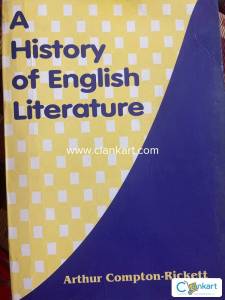
An Outline History Of English Literature

An Outline History Of English Literature

₹130

The Purpose and plan to this little book may easily be gathered from the introductory chapter. Only a few words of preface, therefore, are needed. As i conceive it, a history of English Literature, however brief, should still be a history of English literature in fact as well as in name; and for a history something more is required than a list of author and their books, and even than a chronologically-arranged collection of biographical sketches and critical appreciations. It is true that a nation's literature is made up of the works of individual Writers, and that for the ordinary purposes of study these writers may be detached from their surroundings and treated separately. But we cannot get a history of such literature unless and until each one has been put into his place in the sequence of things and considered with reference to that great body of literature production of which his work must now be regarded as a part. A history of English literature, then must be interested primarily in English literature as a whole. Its chief aim should be to give a clear and systematic account, not of the achievements of successive great writers merely, as such, but of national changes and development. This does not imply neglect of the personal factor. On the contrary, it brings the personal factor into relief; for if each writer is to be considered with reference to literature as a whole, one main subject of enquiry must be the nature and value of his particular contribution to that whole. But it does mean vi that, together with the personal factor, the great general movement of literature from age to age has to be investigated, and that every writer has to be interpreted in his connection with this general movement. To exhibit the interplay of the personal and the impersonal in the making of history is, indeed, one of the fundamentals of the historian's task; and since history, properly understood, is as much concerned with the explanation of facts as with the facts themselves, it follows that a history of English litera

2 months ago
Advertisement
Want to see your books here? Have Used Books?
Make some extra cash by selling your old books for actual money in your UPI/Bank account. Go on, it's quick and easy.
Advertisement
MARK MANSON

MARK MANSON

₹300

From the author of the international mega-bestseller The Subtle Art of Not Giving A F*ck comes a counterintuitive guide to the problems of hope. We live in an interesting time. Materially, everything is the best it’s ever been—we are freer, healthier and wealthier than any people in human history. Yet, somehow everything seems to be irreparably and horribly f*cked—the planet is warming, governments are failing, economies are collapsing, and everyone is perpetually offended on Twitter. At this moment in history, when we have access to technology, education and communication our ancestors couldn’t even dream of, so many of us come back to an overriding feeling of hopelessness.What’s going on? If anyone can put a name to our current malaise and help fix it, it’s Mark Manson. In 2016, Manson published The Subtle Art of Not Giving A F*ck, a book that brilliantly gave shape to the ever-present, low-level hum of anxiety that permeates modern living. He showed us that technology had made it too easy to care about the wrong things, that our culture had convinced us that the world owed us something when it didn’t—and worst of all, that our modern and maddening urge to always find happiness only served to make us unhappier. Instead, the “subtle art” of that title turned out to be a bold challenge: to choose your struggle; to narrow and focus and find the pain you want to sustain. The result was a book that became an international phenomenon, selling millions of copies worldwide while becoming the #1 bestseller in 13 different countries.Now, in Everthing Is F*cked, Manson turns his gaze from the inevitable flaws within each individual self to the endless calamities taking place in the world around us. Drawing from the pool of psychological research on these topics, as well as the timeless wisdom of philosophers such as Plato, Nietzsche, and Tom Waits, he dissects religion and politics and the uncomfortable ways they have come to resemble one another. He looks at our relationships with money, entertainment and the internet, a

3 months ago
Advertisement
Advertisement

Advertisement