Buy used History & Archaeology books online in India
Buy Second Hand Books, Used Books Online In India
KOHINOOR - The Story of worlds most infamous diamond
Please Read Notes: Brand New, International Softcover Edition, Printed in black and white pages, minor self wear on the cover or pages, Sale restriction may be printed on the book, but Book name, contents, and author are exactly same as Hardcover Edition. Fast delivery through DHL/FedEx express.
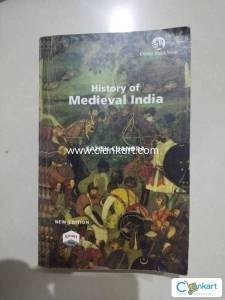
History of Mediaeval India
Satish Chandra's History of Medieval India is a comprehensive overview of the history of the Indian subcontinent during the thousand-year period between the eighth and the eighteenth century. History of Medieval India studies this interesting period in Indian history when the land underwent drastic changes and was deeply influenced by the invading armies, religious movements, and the vicissitudes of the changing political, economic and cultural scene. To tell the history of a land spanning the geographical dimensions and the political divisions of the Indian subcontinent is in itself a formidable task. Satish Chandra executes this difficult mission withthe eye of an enquirer and the pen of a scholar.
History of medieval india
Satish Chandra's History of Medieval India is a comprehensive overview of the history of the Indian subcontinent during the thousand-year period between the eighth and the eighteenth century. History of Medieval India studies this interesting period in Indian history when the land underwent drastic changes and was deeply influenced by the invading armies, religious movements, and the vicissitudes of the changing political, economic and cultural scene. To tell the history of a land spanning the geographical dimensions and the political divisions of the Indian subcontinent is in itself a formidable task. Satish Chandra executes this difficult mission withthe eye of an enquirer and the pen of a scholar.
History of modern india
The SAGE Series in Modern Indian History consists of well-researched volumes with a wider scope and is intended to bring together the growing volume of historical studies that share a broad common historiographic focus. The approach that the authors have tried to evolve looks sympathetically, though critically, at the Indian national liberation struggle and other popular movements such as those of labour, peasants, lower castes, tribal peoples and women. The series also looks at colonialism as a structure and a system, and analyzes changes in economy, society and culture in the colonial context as also in the context of independent India. It focuses on communalism and casteism as major features of modern Indian development. The volumes in the series will tend to reflect this approach as also its changing and developing features. At the broadest plane this approach is committed to the Enlightenment values of rationalism, humanism, democracy and secularism. This set includes: Volume 1: Independence and Partition: The Erosion of Colonial Power in India by Sucheta Mahajan Volume 2: A Narrative of Communal Politics: Uttar Pradesh, 1937–39 by Salil Misra Volume 3: Imperialism, Nationalism and the Making of the Indian Capitalist Class, 1920–1947 by Aditya Mukherjee Volume 4: From Movement to Government: The Congress in the United Provinces, 1937–42 by Visalakshi Menon Volume 5: Peasants in India’s Non-Violent Revolution: Practice and Theory by Mridula Mukherjee Volume 6: Communalism in Bengal: From Famine to Noakhali, 1943–47 by Rakesh Batabyal Volume 7: Political Mobilization and Identity in Western India, 1934–47 by Shri Krishan Volume 8: The Garrison State: Military, Government and Society in Colonial Punjab, 1849–1947 by Tan Tai Yong Volume 9: Colonializing Agriculture: The Myth of Punjab Exceptionalism by Mridula Mukherjee Volume 10: Region, Nation, “Heartland”: Uttar Pradesh in India’s Body-Politic by Gyanesh Kudaisya Volume 11: National Movement and Politics in Orissa, 1920–29 by Pritish Acharya Volume 12: Commun
India's Rise as a Space Power
With the successful launch of indigenous satellites and spacecrafts including Chandryaan-1, India has achieved its stature as a space power. This book describes the journey of space research in India and its evolution from a nascent republic to a respectable name in the field of space science. It documents in detail the development of India’s first spacecraft Aryabhata and the subsequent remote sensing and communications satellites. It also provides an account of the development of Satellite Launch Vehicles (SLVs) and associated technologies, namely propulsion, material sciences, rocket launching stations and cryogenics technology. Written with great lucidity by one of the premier space scientists of India, it is an ideal read for those interested in the history of India’s emergence as a space power.
Answer Book,10001 Fast Facts About our World by National geographic
For anyone who has pondered the vastness of our universe,the rich variety of our planet and the endlessly fascinating world of knowledge that surrounds us,National Geography presents this timely volume,now fully updated and expanded.Exploring a full spectrum of topics ,from the universe to climate and weather,from the human world to science and technology,this meticulously written and extravagantly illustrated book is the ultimate family reference.
Historical References
A portrait of man with an acute scholarly mind and a cheerful socialist heart. Between the years 1929 in September till March 1931 when he was sent to the gallows a day before his actual hanging date, Bhagat Singh wrote extensively. He maintained a diary which was full of notes of daily usage, his own thoughts on freedom, poverty and class struggle and thoughts of varied political thinkers and intellectuals like Lenin, Marx, Ummar Khayyam, Morozov, Rabindranath Tagore, Trotsky, Bertrand Russell, Dostoevsky, Wordsworth, Ghalib and many others. Through the pages of his jail diary, a real Bhagat Singh emerges—one who is without the hat or a gun, one who had an acute scholarly mind and a robust socialist persona.
Careless talk costs lives
During World War II, the British government issued a series of public warnings in the form of witty posters by the brilliant cartoonist Fougasse, a.k.a. Cyril Kenneth Bird. ("Don't forget that walls have ears!” a fashionable woman whispers to a friend, as Hitler's face peers ominously out of the wallpaper.) This illustrated tribute to one of Britain's most popular artists begins with his celebrated WWII posters and continues with his later work for Punch magazine and elsewhere. An important contribution to the history of both cartooning and propaganda, it compares the relative effectiveness of hard-hitting American wartime designs versus Fougasse's light touch.
Modern India
Advent of the Europeans in India and the British consolidation of power in India besides incorporating additional information under several chapters. There are also chapters on the challenges that a newly independent nation faced in the wake of a brutal partition. The Nehruvian era is also briefly discussed. A survey of personalities associated with various movements, peasant and tribal movements, tables and charts are also given for quick reference.
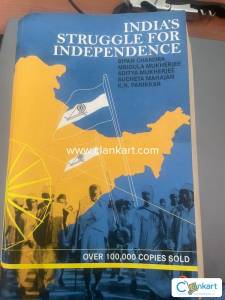
India' struggle for independence ( revised and updated)
This is the first major study to examine every one of the varied strands of the epic struggle individually and collectively and present it in a new and coherent narrative and analytical framework. Basing themselves on oral and other primary sources and years of research, the authors take the reader through every step of the independence struggle from the abortive Revolt of 1857 to the final victory of 1947. More important while incorporating existing historiographical advances, the book evolves a new and lucid view of the history of the period which will endure.
India after Gandhi by Ramachandra Guha
Ramachandra Guha’s India after Gandhi is a magisterial account of the pains, struggles, humiliations and glories of the world’s largest and least likely democracy. A riveting chronicle of the often brutal conflicts that have rocked a giant nation, and of the extraordinary individuals and institutions who held it together, it established itself as a classic when it was first published in 2007.In the last decade, India has witnessed, among other things, two general elections; the fall of the Congress and the rise of Narendra Modi; a major anti-corruption movement; more violence against women, Dalits, and religious minorities; a wave of prosperity for some but the persistence of poverty for others; comparative peace in Nagaland but greater discontent in Kashmir than ever before. This tenth anniversary edition, updated and expanded, brings the narrative up to the present.Published to coincide with seventy years of the country’s independence, this definitive history of modern India is the work of one of the world’s finest scholars at the height of his powers.
novel history
This unusual autobiography "The Story of My Experiments with Truth", is a window to the workings of Mahatma Gandhi's mind - a window to understanding what drove this seemingly ordinary man to the heights of being the father of a nation - India.Starting with his days as a boy, Gandhi takes one through his trials and turmoils and situations that moulded his philosophy of life - going through child marriage, his studies in England, practicing Law in South Africa - and his Satyagraha there - to the early beginnings of the Independence movement in India.He did not aim to write an autobiography but rather share the experience of his various experiments with truth to arrive at what he perceived as Absolute Truth - the ideal of his struggle against racism, violence and colonialism.