Buy used History & Archaeology books online in India
Buy Second Hand Books, Used Books Online In India
THE EPIC OF MOUNT EVEREST
This work has been selected by scholars as being culturally important and is part of the knowledge base of civilization as we know it. This work is in the public domain in the United States of America, and possibly other nations. Within the United States, you may freely copy and distribute this work, as no entity (individual or corporate) has a copyright on the body of the work. Scholars believe, and we concur, that this work is important enough to be preserved, reproduced, and made generally available to the public. To ensure a quality reading experience, this work has been proofread and republished using a format that seamlessly blends the original graphical elements with text in an easy-to-read typeface. We appreciate your support of the preservation process, and thank you for being an important part of keeping this knowledge alive and relevant.
Sapiens:A Brief History of Humankind by Yuval Noah Harari
Earth is 4.5 billion years old. In just a fraction of that time, one species among countless other have conquered it: us.What makes us brilliant?What makes us deadly?What makes us sapiens?In this bold and provocative book, Yuval Noah Harari explores who we are, how we got here, and where we're going. Sapiens is the thrilling account of our history -- from insignificant apes to rulers of the world.(taken from the inside cover)
The Argumentative Indian
In sixteen linked essays, Nobel Prize--winning economist Amartya Sen discusses India's intellectual and political heritage and how its argumentative tradition is vital for the success of its democracy and secular politics. The Argumentative Indian is "a bracing sweep through aspects of Indian history and culture, and a tempered analysis of the highly charged disputes surrounding these subjects--the nature of Hindu traditions, Indian identity, the country's huge social and economic disparities, and its current place in the world" (Sunil Khilnani, Financial Times, U.K.).
India after Gandhi
A magisterial account of the pains, the struggles, the humiliations, and the glories of the world's largest and least likely democracy, Ramachandra Guha's India After Gandhi is a breathtaking chronicle of the brutal conflicts that have rocked a giant nation and the extraordinary factors that have held it together. An intricately researched and elegantly written epic history peopled with larger-than-life characters, it is the work of a major scholar at the peak of his abilities.
Wonder that was India
Indian civilization is among the oldest in the world, and what is unique in that respect is that the culture of the peoples still remains largely unchanged, with a strong thread of continuity through the ages.The Wonder That was India takes a look at the country's history from the time of the Harappan or Indus Valley Civilization. It explores the possible causes for the decline of the Harappan civilization and settlements. The book talks about the possibility of the Harappans having moved towards the south and settled in the peninsular region.The author also discusses the Aryan invasion theory, supporting it with various research papers and findings of that time. The evolution of Hindu religion is also talked about in this book--from the Harappan times, to the coming of the Aryans and the mutual influence that Hinduism and its off shoots Jainism and Buddhism had on each other.This book is comprehensive in its coverage of Indian history. It looks at every aspect of Indian society and culture. The Wonder That was India covers everything from religion, governance, social evolution, literary traditions, philosophy languages, and science.The author explores the significant role the Hindu religion played on the lives of the people. All the literary compositions of ancient times had religious associations. He also puts forward the theory that the European gypsies are of Indian origin.The Wonder That Was India also gives an insight into modern Indian society and culture, how it became a confluence of different influences from many a quarter throughout the many stages of its history.
Alan Turing the Enigma
The official book behind the film, The Imitation Game, this is a dramatic portrayal of the life and work of Alan Turing, one of Britain's most extraordinary unsung heroes, and one of the world's greatest innovators. This is the official story that has inspired the British film, The Imitation Game, a nail-biting race against time following Alan Turing, the pioneer of modern-day computing and credited with cracking the German Enigma code, and his brilliant team at Britain's top-secret code-breaking centre, Bletchley Park, during the darkest days of World War II. Turing, whose contributions and genius significantly shortened the war, saving thousands of lives, was the eventual victim of an unenlightened British establishment, but his work and legacy live on. Prime Minister Gordon Brown released a statement of apology in 2009 on behalf of the British government for the "appalling" treatment of Turing.
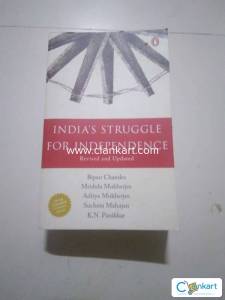
INDIA'S STRUGGLE FOR INDEPENDENCE by BIPAN CHANDRA
India's Struggle for Independence is the first and the most reliable study of the country's epic fight for freedom. This classic work begins with the abortive revolt against the British in 1857 and culminates in India's Independence in 1947. Based on years of research as well as personal interviews with hundreds of freedom fighters, it presents a lucid and enduring view of the history of the period.
INDIA SINCE INDEPENDENCE BY BIPAN CHANDRA FOR UPSC EXAMS
The story of the forging of India, the world's largest democracy, is a rich and inspiring one. This volume, a sequel to the bestselling India's Struggle for Independence, analyses the challenges India has faced the successes it has achieved in the light of its colonial legacy and century-long struggle for freedom. This is a remarkable account of a nation on the move.
INDIA'S ANCIENT PAST BY R.S. SHARMA FOR UPSC AND SSC EXAMS
R.S. Sharma, one of the best-known historians of early India, provides a comprehensive yet accessible text on the ancient period of Indian history. Beginning with topics such as historiography and the importance of Ancient Indian history, he goes on to cover the geographical, econological and linguistic settings, before looking at specific cultures of neolithic, chalcolithic types, the Harappan civilization, the Vedic period, the rise of Jainism and Buddhism, Magadha and the beginning of territorial states, the age of the Mauryas, Satavahanas, Guptas, and Harshavardhana. While taking the reader on this journey through time, he highlights important phenomena such as the beginning of urbanization and monarchy in India, invasions, the Varna system, commerce and trade, developments in philosophy and cultural efflorescence. He ends this insightful volume with a comments on the transition from the Ancient to the Medieval.This book also addresses a number of issues which have become current in discussion on Ancient Inida today, such as the Identity of the Aryan Culture, and Historical Construction. This is a volume meant for all those who want a masterly, lucid, yet eminently readable introduction to and overview on India's early history by one of the master-scholars of Indian history - be it students, tourists, or the interested lay reader
The Innovators by Walter Issacson
Following his blockbuster biography of Steve Jobs, The Innovatorsis Walter Isaacson's story of the people who created the computer and the Internet. It is destined to be the standard history of the digital revolution and a guide to how innovation really works.What talents allowed certain inventors and entrepreneurs to turn their disruptive ideas into realities? What led to their creative leaps? Why did some succeed and others fail?In his exciting saga, Isaacson begins with Ada Lovelace, Lord Byron's daughter, who pioneered computer programming in the 1840s. He then explores the fascinating personalities that created our current digital revolution, such as Vannevar Bush, Alan Turing, John von Neumann, J.C.R. Licklider, Doug Engelbart, Robert Noyce, Bill Gates, Steve Wozniak, Steve Jobs, Tim Berners-Lee and Larry Page.This is the story of how their minds worked and what made them so creative. It's also a narrative of how their ability to collaborate and master the art of teamwork made them even more creative.For an era that seeks to foster innovation, creativity and teamwork, this book shows how they actually happen.
THE IVORY THRONE
In 1498, when Vasco da Gama set foot in Kerala looking for Christians and spices, he unleashed a wave of political fury that would topple local powers like a house of cards. The cosmopolitan fabric of a vibrant trading society—with its Jewish and Arab merchants, Chinese pirate heroes and masterful Hindu Zamorins— was ripped apart, heralding an age of violence and bloodshed. One prince, however, emerged triumphant from this descent into chaos. Shrewdly marrying Western arms to Eastern strategy, Martanda Varma consecrated the dominion of Travancore, destined to become one of the most dutiful pillars of the British Raj. What followed was two centuries of internecine conflict in one of India’s premier princely states, culminating in a dynastic feud between two sisters battling to steer the fortunes of their house on the eve of Independence.Manu S. Pillai’s retelling of this sprawling saga focuses on the remarkable life and work of Sethu Lakshmi Bayi, the last, and forgotten, queen of the House of Travancore. The supporting cast includes the flamboyant painter Raja Ravi Varma and his wrathful wife, scheming matriarchs of ‘violent, profligate and sordid’ character, wife swapping court favourites, vigilant English agents, quarrelling consorts and lustful kings. Extensively researched and vividly rendered, The Ivory Throne conjures up a dramatic world of political intrigues and factions, black magic and conspiracies, crafty ceremonies and splendorous temple treasures, all harnessed in a tragic contest for power and authority in the age of empire.
Famous war speeches
Into Battle" is a collection of Winston S. Churchill's speeches delivered during the early years of World War II, from 1938 to 1940. These speeches, delivered while he was out of power and later as Prime Minister, rallied the British people to face the growing threat of Nazi Germany. The book includes some of his most famous and powerful orations, such as "This was their finest hour," "Never in the field of human conflict was so much owed, by so many, to so few," and "I have nothing to offer but blood, toil, tears and sweat"
COMPLETE HISTORY OF THE WORLD RICHARD OVERY
The Times Complete History of the World has sold over 2,000,000 copies since its first publication in 1978. It is the most exciting, authoritative and accessible work on world history available today. Its exciting visual narrative of the history of the world from the origins of mankind to the 21st century is an unrivalled accomplishment, and its over 600 maps and 300,000 words of text are now accompanied by internet links to allow further research.HUMAN ORIGINSFrom the hunters of the Stone Age to the spread of agriculture.THE FIRST CIVILIZATIONS 2500 BC TO 1000 BCMesopotamia, Egypt, India, China and the Aegean: the earliest cities and empires.THE CLASSICAL CIVILIZATIONS OF EURASIA 1000 BC TO AD 500The civilizations of Greece and Persia, India and China, the Roman empire; the collapse of the Ancient World.THEWORLD OF DIVIDED REGIONS AD 500 TO 1500The rise and expansion of Islam and the formation of modern Europe; the early civilizations of America.THEWORLD OF THE EMERGINGWEST 1500 TO 1815The European voyages of discovery; Mughal India, Ming China and the African empires; the apogee of Iran and Central Asia; the American and French revolutions.THE AGE OF EUROPEAN DOMINANCE 1815 TO 1914The rise of the great European empires; the expansion of Russia and Japan; the making of the United States; the First World War.THE AGE OF GLOBAL CIVILIZATIONFrom the Russian and Chinese revolutions to the Great Depression and the Second World War; superpower rivalry and the Cold War; the collapse of the Soviet Union.Professor Richard Overy is Professor of Modern European History at King's College London and one of Britain's foremost modern historians. He is a scholar of outstanding quality and renown. Richard Overy has written a number of critically acclaimed books. Russia's War (1998) examined the impact of the Second World War on the Soviet Union. He is also the author of the best-selling Battle (2000) an incisive study of the Battle of Britain and Interrogations: the Nazi elite in Allied Hands which brilliantly covers the Nure
Story book
'The first time I saw a train, I was standing on a wooded slope outside a tunnel, not far from Kalka. Suddenly, with a shrill whistle and great burst of steam, a green and black engine came snorting out of the blackness... "A dragon!" I shouted. "There's a dragon coming out of its cave!"' The charm of travelling by a train as it speeds its way out of a tunnel or a jungle and passes through nondescript villages and towns is unmatched. There also exists a joyful curiosity in unfolding the mysterious lives and destinations of its passengers. Ruskin Bond has been writing tales about the hinterland for decades, but this is the first time his stories revolving around trains and railway stations of small-town India have been brought together in a single collection. Classics such as 'The Eyes Have It' and 'The Night Train at Deoli' rub shoulders with tales of big cats taking refuge in railway tunnels and strangers who strike up a friendship while waiting at a platform.