Buy used History & Archaeology books online in India
Buy Second Hand Books, Used Books Online In India
History of medieval india by Satish Chandra (UPSC)
Satish Chandra's History of Medieval India is a comprehensive overview of the history of the Indian subcontinent during the thousand-year period between the eighth and the eighteenth century. History of Medieval India studies this interesting period in Indian history when the land underwent drastic changes and was deeply influenced by the invading armies, religious movements, and the vicissitudes of the changing political, economic and cultural scene. To tell the history of a land spanning the geographical dimensions and the political divisions of the Indian subcontinent is in itself a formidable task. Satish Chandra executes this difficult mission withthe eye of an enquirer and the pen of a scholar.
India that is Bharat J Sai Deepak
India, That Is Bharat, the first book of a comprehensive trilogy, explores the influence of European 'colonial consciousness' (or 'coloniality'), in particular its religious and racial roots, on Bharat as the successor state to the Indic civilisation and the origins of the Indian Constitution. It lays the foundation for its sequels by covering the period between the Age of Discovery, marked by Christopher Columbus' expedition in 1492, and the reshaping of Bharat through a British-made constitution-the Government of India Act of 1919. This includes international developments leading to the founding of the League of Nations by Western powers that tangibly impacted this journey.Further, this work also traces the origins of seemingly universal constructs such as 'toleration', 'secularism' and 'humanism' to Christian political theology. Their subsequent role in subverting the indigenous Indic consciousness through a secularised and universalised Reformation, that is, constitutionalism, is examined. It also puts forth the concept of Middle Eastern coloniality, which preceded its European variant and allies with it in the context of Bharat to advance their shared antipathy towards the Indic worldview. In order to liberate Bharat's distinctive indigeneity, 'decoloniality' is presented as a civilisational imperative in the spheres of nature, religion, culture, history, education, language and, crucially, in the realm of constitutionalism.
The diary of a young girl
Discovered in the attic in which she spent the last years of her life, Anne Frank's remarkable diary has since become a world classic—a powerful reminder of the horrors of war and an eloquent testament to the human spirit.In 1942, with Nazis occupying Holland, a thirteen-year-old Jewish girl and her family fled their home in Amsterdam and went into hiding. For the next two years, until their whereabouts were betrayed to the Gestapo, they and another family lived cloistered in the "Secret Annexe" of an old office building. Cut off from the outside world, they faced hunger, boredom, the constant cruelties of living in confined quarters, and the ever-present threat of discovery and death.In her diary Anne Frank recorded vivid impressions of her experiences during this period. By turns thoughtful, moving, and amusing, her account offers a fascinating commentary on human courage and frailty and a compelling self-portrait of a sensitive and spirited young woman whose promise was tragically cut short.
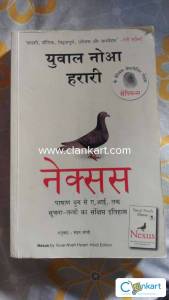
Nexus: A Brief History of Information Networks from Stone Age to AI
From the author of Sapiens comes the groundbreaking story of how information networks have made, and unmade, our world.For the last 100,000 years, we Sapiens have accumulated enormous power. But despite all our discoveries, inventions, and conquests, we now find ourselves in an existential crisis. The world is on the verge of ecological collapse. Misinformation abounds. And we are rushing headlong into the age of AI—a new information network that threatens to annihilate us. For all that we have accomplished, why are we so self-destructive?Nexus looks through the long lens of human history to consider how the flow of information has shaped us, and our world. Taking us from the Stone Age, through the canonization of the Bible, early modern witch-hunts, Stalinism, Nazism, and the resurgence of populism today, Yuval Noah Harari asks us to consider the complex relationship between information and truth, bureaucracy and mythology, wisdom and power. He explores how different societies and political systems throughout history have wielded information to achieve their goals, for good and ill. And he addresses the urgent choices we face as non-human intelligence threatens our very existence. Information is not the raw material of truth; neither is it a mere weapon. Nexus explores the hopeful middle ground between these extremes, and in doing so, rediscovers our shared humanity.
The hippie trail a history
This is the first history of the Hippie Trail. It records the joys and pains of budget travel to Kathmandu, India, Afghanistan and other 'points east' in the 1960s and 1970s. Written in a clear, simple style, it provides detailed analysis of the motivations and the experiences of hundreds of thousands of hippies who travelled eastwards. The book is structured around four key debates: were the travellers simply motivated by a search for drugs? Did they encounter love or sexual freedom on the road? Were they basically just tourists? Did they resemble pilgrims? It also considers how the travellers have been represented in films, novels and autobiographical accounts, and will appeal to those interested in the Trail or the 1960s counterculture, as well as students taking courses relating to the 1960s.
Encyclopedia of Dinosaur and Prehistoric Life
MINI ENCYCLOPEDIA - DINOSAURS & PREHISTORIC LIFE is the mini book crammed with masses of knowledge about the prehistoric world. Interesting bulleted facts for easy understanding. Color-coded sections help children to navigate the book. Brilliantly detailed illustrations and photos support learning. The ultimate dinosaur book for kids, Mini Encyclopedia Dinosaurs and Prehistoric Life is small enough to slot into school bags, making this a fantastic resource for school projects and homework in senior elementary school. This compact, comprehensive children's encyclopedia uses clear, bulleted facts and incredible info panels to present a detailed look at early humans, dinosaurs and prehistoric plants, fish, amphibians, reptiles and mammals. Every topic is supported by photographs, realistic artwork and detailed diagrams, and colour-coded sections make navigation through the topics easy and quick. Chapters and topic examples of Mini Encyclopedia Dinosaurs and Prehistoric Life: Ancient life: Prehistoric time, Anthropods, Sharks, Turtles and tortoises, Snakes, and Mosasaurs Dinosaurs: Ancestors, Tyrannosaurus, Raptors, Herbivores, Triceratops, and the Age of dinosaurs Age of mammals: Ward birds, Marsupials, Carnivores, Rodents, Bats, and Woolly mammoths Humans: Early primates, Apes, Homo erectus, Brains and intelligence, Language, and Hunting Fascinating facts for kids to learn: Dilophosaurus probably weighed over 500 kg as much as the biggest polar bears today. An example of a fossilized egg is one belonging to the extinct elephant bird, Aepyornis. The egg was also huge it could hold 8.5 liters of liquid! Homo habilis used stone tools to crack open animal bones so it could eat the nutritious marrow inside.
The Spy and the Traitor
A thrilling Cold War story about a KGB double agent, by one of Britain's greatest historians - now with a new afterwordOn a warm July evening in 1985, a middle-aged man stood on the pavement of a busy avenue in the heart of Moscow, holding a plastic carrier bag. In his grey suit and tie, he looked like any other Soviet citizen. The bag alone was mildly conspicuous, printed with the red logo of Safeway, the British supermarket.The man was a spy. A senior KGB officer, for more than a decade he had supplied his British spymasters with a stream of priceless secrets from deep within the Soviet intelligence machine. No spy had done more to damage the KGB. The Safeway bag was a signal: to activate his escape plan to be smuggled out of Soviet Russia. So began one of the boldest and most extraordinary episodes in the history of spying. Ben Macintyre reveals a tale of espionage, betrayal and raw courage that changed the course of the Cold War forever...
Bharat ka prchin itihas
Beginning with a discussion on frameworks of writing history, the volume sheds light on the origins and growth of civilizations, empires, and religions. It covers the geographical, ecological, and linguistic backgrounds, and looks at specific cultures of the Neolithic, Chalcolithic, and Vedic periods, as well as the Harappan civilization. The author discussed the rise of Jainism and Buddhism, Magadha, and the beginning of territorial states. The period of Mauryas, Central Asian countries, Satavahanas, Guptas, and Harshvardhana are also analysed. He highlights important phenomena such as the varna system, urbanization, commerce and trade, developments in science and philosophy, and cultural legacy. He also examines the process of transition from ancient to medieval India and addresses topical issues such as the origin of the Aryan culture. This engaging and lucid text, by one of the best-known scholars of ancient India, will be indispensable for students and teachers of ancient Indian history. This book is the Hindi translation of the English edition.
Bhagat Singh ki jail diary
भगत सिंह की जेल डायरी क्रांतिकारी भगत सिंह द्वारा लाहौर सेंट्रल जेल (१९२९ - १९३१ ) में कारावास के दौरान लिखी गई टिप्पणियों और लेखन का संकलन है। यह पारंपरिक अर्थों में एक डायरी नहीं है, बल्कि विभिन्न विषयों पर उनके विचारों का संग्रह है।- जेल डायरी में स्वतंत्रता, क्रांति, समाजवाद, साम्यवाद, धर्म और विश्व इतिहास जैसे विषयों पर भगत सिंह के विचार शामिल हैं।- इसमें जेल में पढ़ी गई पुस्तकों के अंश और सारांश भी शामिल हैं।- जेल डायरी भगत सिंह के बौद्धिक और वैचारिक विकास पर प्रकाश डालती है।यह राजनीतिक दर्शनों के साथ उनके गहन जुड़ाव और भारत की स्वतंत्रता के प्रति उनकी अटूट प्रतिबद्धता को दर्शाता है।
The trial of adolf hitler
The story of the courtroom drama that precipitated the rise of the Nazi party.February 26, 1924, was the first day of the greatly anticipated high treason trial that would galvanize Germany―but few in the courtroom that morning anticipated that leading defendant General Erich Ludendorff, whose risky offensives during World War I doomed Germany to defeat, would soon be eclipsed by the private first class at his side, Adolf Hitler. Hitler was charged with treason after unsuccessfully trying to seize power in the notorious Beer Hall Putsch in Munich in 1923. Before the trial, Hitler was only a minor, if ambitious, local party leader. Yet once the proceedings began, his days of relative obscurity were over. Including never-before-published sources, this richly informed, day-by-day account shows how Hitler metamorphosed into a mesmerizing demagogue and used his trial as a stage for Nazi propaganda. Chilling in the hypothetical questions it raises, The Trial of Adolf Hitler illuminates our understanding of Hitler’s path to power.
Gajapti A king without kingdom
The Gajapati is an institution of seminal significance in Odisha. The dual status of the Gajapati, both as a king and a servant (Adyasebak), makes him distinctly unique. Gajapati kings have acted as the vassals or deputies, or the agents of Lord Jagannath, who is held as the Supreme Sovereign. This foundational doctrine was an innovative experiment in statecraft used by the Gajapatis to secure and sustain the support of the people for expansion and consolidation of the kingdom. The Odishan kingdom, at its pinnacle of glory during the reign of Kapilendra Deb (AD 1435-1467), stretched from the river Ganges to the Cauvery River but witnessed decline since the advent of the Afghans (1568), followed by the Marathas (1751) and the British (1803), finally leading to complete dispossession of territory and making the Gajapati or the Raja of Puri, a king without a kingdom. Apart from interesting historical facts, the book contains fascinating stories. There was one Gajapati king, a loyal devotee of Lord Jagannath, who converted to Islam; another Gajapati who adopted a son as heir but disowned him in favour of another adopted child, leading to a prolonged court case; one king was accused of murder and banished to the Andamans. The stories on attempts to protect the shrine from repeated invasions by Muslim rulers and shifting the revered deities to different secret locations, and the narrative of the remarkable Queen Suryamani Patamahadei (the widow of Gajapati Birakeshari Deb II and mother of Dibyasingha Deb III [1859–1888]) are riveting. The book elaborates on the Gajapati's gradual withdrawal from the role of royalty, even as his association with Lord Jagannath continues to thrive. This time-honoured ritual association with the Lord has placed the Gajapati in a position of high esteem and veneration among the people, for which he is reverentially known as Chalanti Vishnu (living embodiment of Lord Vishnu).
History Of Medieval India Author(s) Satish Chandra
Satish Chandra's History of Medieval India is a comprehensive overview of the history of the Indian subcontinent during the thousand-year period between the eighth and the eighteenth century. History of Medieval India studies this interesting period in Indian history when the land underwent drastic changes and was deeply influenced by the invading armies, religious movements, and the vicissitudes of the changing political, economic and cultural scene. To tell the history of a land spanning the geographical dimensions and the political divisions of the Indian subcontinent is in itself a formidable task. Satish Chandra executes this difficult mission withthe eye of an enquirer and the pen of a scholar.
India's Ancient Past Author(s) R.S. Sharma
R.S. Sharma, one of the best-known historians of early India, provides a comprehensive yet accessible text on the ancient period of Indian history. Beginning with topics such as historiography and the importance of Ancient Indian history, he goes on to cover the geographical, econological and linguistic settings, before looking at specific cultures of neolithic, chalcolithic types, the Harappan civilization, the Vedic period, the rise of Jainism and Buddhism, Magadha and the beginning of territorial states, the age of the Mauryas, Satavahanas, Guptas, and Harshavardhana. While taking the reader on this journey through time, he highlights important phenomena such as the beginning of urbanization and monarchy in India, invasions, the Varna system, commerce and trade, developments in philosophy and cultural efflorescence. He ends this insightful volume with a comments on the transition from the Ancient to the Medieval.This book also addresses a number of issues which have become current in discussion on Ancient Inida today, such as the Identity of the Aryan Culture, and Historical Construction. This is a volume meant for all those who want a masterly, lucid, yet eminently readable introduction to and overview on India's early history by one of the master-scholars of Indian history - be it students, tourists, or the interested lay reader
Last Crusade : Epic Voyages of Vasco Da Gama
Historian Nigel Cliff delivers a sweeping, radical reinterpretation of Vasco da Gama's pioneering voyages, revealing their significance as a decisive turning point in the struggle between Christianity and Islam--a series of events which forever altered the relationship between East and West. Perfect for readers of "Endurance" "Shackleton's"" Incredible Voyage," "Galileo's Daughter," " "and "Atlantic," " "this first-ever complete account of da Gama's voyages includes new information from the recently discovered diaries of his sailors and an extraordinary series of letters between da Gama and the Zamorin, a king of modern-day Kerala, India. Cliff, the author of "The Shakespeare Riots," draws upon his own travels in da Gama's footsteps to add detail, authenticity, and a contemporary perspective to this riveting, one-of-a-kind historical epic.