Buy used Computers & Internet books online in India
Buy Second Hand Books, Used Books Online In India
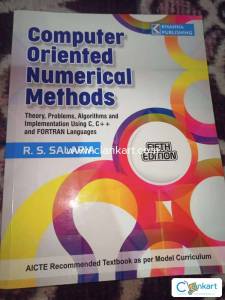
Computer oriented numerical methods
Provides a comprehensive coverage of the subject, Emphasis is laid to ensure the conceptual understanding of numerical methods, Formulae for different numerical methods have been derived in the simplest manner, algorithms for these methods are developed using pseudo language, Large number of programming exercises to test your for reference, large number of multiple choice questions and review exercises to test your programming skills acquired, Majority of the algorithms are implemented in C,C++ and FORTRAN languages.
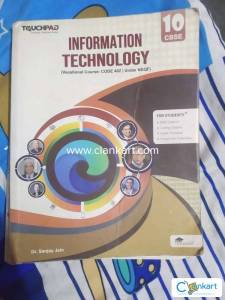
INFORMATION TECHNOLOGY CLASS 10 CBSE
The chapters of this book have been selected and designed as per the CBSE curriculum of Vocational course on IT. KEY FEATURES ? National Education Policy 2020 ? Sneak Peek: This section contains glimpses of MS Office. ? Glossary: This section contains definition of common terms. ? Objective Type Questions: This section contains objective type questions to assess the intellectual skills of the students. ? Subjective Type Questions: This section has subjective questions to assess the comprehensive writing skills of the students. ? CBSE Sample Question Paper: This section contains sample question paper. ? Practical Work: This section has sample questions for practical examination ? Digital Solutions DESCRIPTION (This section should contain complete information about the book from the start to the end, in around 1350 characters with space.)(to be filled by author) The main features of this book are as follows: ? The language of the book is simple and easy to understand. ? The book focuses on Free and Open-Source Software (Foss) with highlights of MS Office. ? Notes are given for add-on knowledge. ? Students are provided with fun facts about the topic. ? Lab Activities are added in between the chapters to develop practical skills. ? The applications of IT Tools are discussed with real life scenarios. ? The contents will help to create opportunity for better job prospects with respect to IT fields. WHAT WILL YOU LEARN You will learn about: ? Communication skills ? Management skills ? Fundamentals of computers ? ICT Tools ? Entrepreneurship ? Green Skills ? Digital Documentation (Advanced) ? Electronic Spreadsheet (Advanced) ? Database Management System ? Web Applications and Security WHO THIS BOOK IS FOR (audience) (Let the readers know what knowledge they should have before reading the book) (350 characters with space)(to be filled by author) Grade - 10 TABLE OF CONTENTS 1. Part A Employability Skills (a) Unit-1 Communication Skills-II (i) Chapter-1 Communication Skills (b) Unit-2 Self-Management Skills-II (ii) Chapte
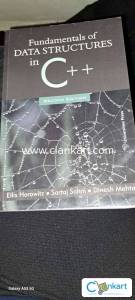
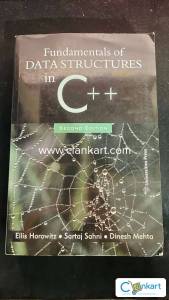
FUNDAMENTALS OF DATA STRUCTURES IN C++
This new edition provides a comprehensive and technically rigorous introduction to data structures such as arrays, stacks, queues, linked lists, trees and graphs and techniques such as sorting hashing that form the basis of all software. In addition, this text presents advanced or specialized data structures such as priority queues, efficient binary search trees, multiway search trees and digital search structures. The book has been updated to include the latest features of the C++ language. Features such as exceptions and templates are now incorporated throughout the text along with limited exposure to STL. Treatment of queues, iterators and dynamic hashing has been improved. The book now discusses topics such as secure hashing algorithms, weightbiased leftist trees, pairing heaps, symmetric min max heaps, interval heaps, top-down splay trees, B+ trees and suffix trees. Red black trees have been made more accessible. The section on multiway tries has been significantly expanded and discusses several trie variations and their application to Internet packet forwarding.
Automate The Boring Stuff With Python
If you've ever spent hours renaming files or updating hundreds of spreadsheet cells, you know how tedious tasks like these can be. But what if you could have your computer do them for you?In "Automate the Boring Stuff with Python," you'll learn how to use Python to write programs that do in minutes what would take you hours to do by hand no prior programming experience required. Once you've mastered the basics of programming, you'll create Python programs that effortlessly perform useful and impressive feats of automation to: Search for text in a file or across multiple filesCreate, update, move, and rename files and foldersSearch the Web and download online contentUpdate and format data in Excel spreadsheets of any sizeSplit, merge, watermark, and encrypt PDFsSend reminder emails and text notificationsFill out online formsStep-by-step instructions walk you through each program, and practice projects at the end of each chapter challenge you to improve those programs and use your newfound skills to automate similar tasks.Don't spend your time doing work a well-trained monkey could do. Even if you've never written a line of code, you can make your computer do the grunt work. Learn how in "Automate the Boring Stuff with Python.""
Data Structures and Algorithms in Python Bits Pillani
Programming and Data Structures: For Anna University has been designed for the course on Programming and Data Structures for the undergraduate students of Anna University, Chennai. It integrates the core concepts of C Programming and Data Structures into a single comprehensive textbook. The contents of the book are student-friendly, example-driven, and program-oriented. Based on the belief that expertise is achieved by practice, this comprehensive book is enriched with illustrations and about 400 solved programs. Each concept of C Programming and Data Structure is explained easily and the reader is then taken straight to the applications. A student can follow the fundamental concepts and run the programs as illustrated. It does not assume prior knowledge of C programming.
Elementary... the Art and Science of Finding Information:
What you don't know can hurt you. What you do know can make you successful. The Information Age has given us a soup of useful and not-so-usable facts and fiction. This is your guide to gaining information superiority in the new era.
Open Source Intelligence Methods and Tools
Apply Open Source Intelligence (OSINT) techniques, methods, and tools to acquire information from publicly available online sources to support your intelligence analysis. Use the harvested data in different scenarios such as financial, crime, and terrorism investigations as well as performing business competition analysis and acquiring intelligence about individuals and other entities. This book will also improve your skills to acquire information online from both the regular Internet as well as the hidden web through its two sub-layers: the deep web and the dark web. The author includes many OSINT resources that can be used by intelligence agencies as well as by enterprises to monitor trends on a global level, identify risks, and gather competitor intelligence so more effective decisions can be made. You will discover techniques, methods, and tools that are equally used by hackers and penetration testers to gather intelligence about a specific target online. And you will be aware of how OSINT resources can be used in conducting social engineering attacks. Open Source Intelligence Methods and Tools takes a practical approach and lists hundreds of OSINT resources that can be used to gather intelligence from online public sources. The book also covers how to anonymize your digital identity online so you can conduct your searching activities without revealing your identity. What You’ll Learn Identify intelligence needs and leverage a broad range of tools and sources to improve data collection, analysis, and decision making in your organization Use OSINT resources to protect individuals and enterprises by discovering data that is online, exposed, and sensitive and hide the data before it is revealed by outside attackers Gather corporate intelligence about business competitors and predict future market directions Conduct advanced searches to gather intelligence from social media sites such as Facebook and Twitter Understand the different layers that make up the Internet and how to search within the invisible web which
Hunting Cyber Criminals
The skills and tools for collecting, verifying and correlating information from different types of systems is an essential skill when tracking down hackers. This book explores Open Source Intelligence Gathering (OSINT) inside out from multiple perspectives, including those of hackers and seasoned intelligence experts. OSINT refers to the techniques and tools required to harvest publicly available data concerning a person or an organization. With several years of experience of tracking hackers with OSINT, the author whips up a classical plot-line involving a hunt for a threat actor. While taking the audience through the thrilling investigative drama, the author immerses the audience with in-depth knowledge of state-of-the-art OSINT tools and techniques. Technical users will want a basic understanding of the Linux command line in order to follow the examples. But a person with no Linux or programming experience can still gain a lot from this book through the commentaries. This book’s unique digital investigation proposition is a combination of story-telling, tutorials, and case studies. The book explores digital investigation from multiple angles: Through the eyes of the author who has several years of experience in the subject. Through the mind of the hacker who collects massive amounts of data from multiple online sources to identify targets as well as ways to hit the targets. Through the eyes of industry leaders. This book is ideal for: Investigation professionals, forensic analysts, and CISO/CIO and other executives wanting to understand the mindset of a hacker and how seemingly harmless information can be used to target their organization. Security analysts, forensic investigators, and SOC teams looking for new approaches on digital investigations from the perspective of collecting and parsing publicly available information. CISOs and defense teams will find this book useful because it takes the perspective of infiltrating an organization from the mindset of a hacker. The commentary provided by outside experts
Hack The World with OSINT
Come along on a technology misadventure, learning OSINT tools & techniques while traveling on a hacker journey. Protect your organisation or find out if your home alarm system is exposed insecurely to the internet. Discover weaknesses in IT, IOT and ICS SCADA systems in-depth. Using Censys, Spiderfoot, ZMap, OWASP ZAP, Maltego and other tools to discover a wide range of vulnerable systems and information. Smart appliances, North American Open ADR smart grid, fire alarms, database servers, intelligence agency security fails, printers, email systems, remote management hacking, smart houses, solar panels, hacked web servers, hydroelectric dams, solar panels, crackable encryption, exploitable ICS/SCADA, IOT, IT & more. Get up to speed on IT/IOT & ICS SCADA hacking using the examples, exercises and tools using Kali and a customized book virtual machine.
Full Stack Recruiter Paperback
Are you ready to learn everything you need to know about sourcing and recruitment ? Then you’ve found the right book! Whether you are already working in recruitment, new to the industry, or just hoping to begin your career as a recruiter, there are essential strategies used by successful recruiters that will help you accelerate your career. Of course, no one is born knowing these things; they come from years of experience in the field. That’s exactly what this book is: years of practical, real-world experience distilled into one comprehensive guide to succeeding in your recruiting career in the digital era. This book is designed to help recruiters gain a broad understanding of the industry while expanding and deepening the knowledge of more senior professionals. Whether you belong in the first category or the second, this book will help you take your career to the next level. This comprehensive recruitment and sourcing guide is divided into two parts. The first part focuses entirely on sourcing strategies. You’ll learn new and creative ways to source and find great candidates, as well as how to uncover their contact details and approach them in a respectful and effective manner. And much more! The second part deals with recruitment. You’ll learn how to excel in recruitment marketing, candidate engagement, recruitment analytics, candidate engagement, cold-calling, and efficiently manage many other essential aspects of your role. Both sections work together to create a comprehensive guide to excelling in every aspect of your recruitment career! The author, Jan Tegze, is an experienced recruiter with extensive talent acquisition expertise and demonstrated success in start-ups and fast-growth environments. In this book, he shares the most successful methods, tips, and strategies that he has learned, tested and implemented throughout his career, with the hope of providing the inspiration and guidance you need to develop into a top-performing recruiter and sourcer. Do you want to learn more about sourcing and recrui
Introduction to the Design and Analysis of Algorithms
In the domain of city planning, smart cities made perceivable differences in easing city life, adding to its quality while keeping its people connected, engaged and informed. This book aims to introduce the idea of ‘Smart cities’ comprehensively by covering the conceptual basis and the principles in practice systematically and sector-wise. Written lucidly, covering both possible new attempts and retrofitting options in turning smart, the book is an all in one handy volume for beginners to city enthusiasts to advanced learners. Features: 1. Contains a concise story of cities and major innovations in city development. 2. Chapters on Mobility, Energy, Governance, Water Supply, Waste Management, Economy, Buildings and Environment as core sectors of smart city transformation. 3. Dedicated chapter on ICT. 4. Chapters on International and Indian case studies cover potential interventions. 5. Review Questions and Project Ideas added to test level of comprehension. Table of Contents: Chapter 1) Story of Cities Chapter 2) Urbanization and Sustainable Cities Chapter 3) Smart Cities: State of the Art Chapter 4) Smart Urban Mobility Chapter 5) Smart Energy Chapter 6) Smart Governance Chapter 7) Smart Water Management Chapter 8) Smart Waste Management Chapter 9) Smart Economy Chapter 10) Smart Buildings Chapter 11) Smart Environment Chapter 12) ICT for Smart Cities Chapter 13) Smart Cities: International Cases Chapter 14) Smart Cities: Indian Cases
Statistics
Statistical methods are a key part of data science, yet few data scientists have formal statistical training. Courses and books on basic statistics rarely cover the topic from a data science perspective. The second edition of this practical guide--now including examples in Python as well as R--explains how to apply various statistical methods to data science, tells you how to avoid their misuse, and gives you advice on what's important and what's not.Many data scientists use statistical methods but lack a deeper statistical perspective. If you're familiar with the R or Python programming languages, and have had some exposure to statistics but want to learn more, this quick reference bridges the gap in an accessible, readable format.With this updated edition, you'll dive into:Exploratory data analysisData and sampling distributionsStatistical experiments and significance testingRegression and predictionClassificationStatistical machine learningUnsupervised learning
Python 3 Object-Oriented Programming
The book begins with the very foundations of OOP and then uses practical examples to show how to correctly implement Object Oriented Programming in Python. Many examples are taken from real-world projects. The book focuses on high-level design as well as the gritty details of the Python syntax. The provided exercises inspire the reader to think about his or her own code, rather than providing solved problems. If you're new to Object Oriented Programming techniques, or if you have basic Python skills and wish to learn in depth how and when to correctly apply Object Oriented Programming in Python, this is the book for you. If you are an object-oriented programmer for other languages, you too will find this book a useful introduction to Python, as it uses terminology you are already familiar with. Python 2 programmers seeking a leg up in the new world of Python 3 will also find the book beneficial, and you need not necessarily know Python 2.
COMPUTER SCIENCE WITH PYTHON FOR CLASS 12
Canada's productivity expert returns with a totally fresh angle on how to do more with less. Throughout his experiments and research, Chris Bailey came across many little-known insights into how we focus (a key element of productivity), including the surprising idea that focus isn't so much a state of heightened awareness (as we'd assume), but a balance between two frames of mind. The most recent neuroscientific research on attention reveals that our brain has two powerful modes that can be unlocked when we use our attention well: a focused mode (hyperfocus), which is the foundation for being highly productive, and a creative mode (scatterfocus), which enables us to connect ideas in novel ways. Hyperfocus helps readers unlock both, so they can concentrate more deeply, think more clearly, and work and live more deliberately. Diving deep into the science and theories about how and why we bring our attention to bear on life's big goals and everyday tasks, Chris Bailey takes his unique approach to productivity to the next level in Hyperfocus, while retaining the approachable voice and perspective that made him a fast favourite.