Buy used Business & Economics online in India
Buy Second Hand Books, Used Books Online In India
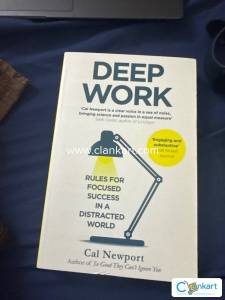
Copycat Marketing 101 (Hindi) - Brand new book for negotiable price
Copycat Marketing 101 will make you aware that most people are stuck in a situation without growth, because they've been taught to copy people who are in jobs that mean salary caps and financial dependence. In short, most people are copycatting the wrong plan! In this book, you'll learn that the current system most people copycat is designed to create temporary income ??" not true wealth ??" because it's based on linear growth of trading time for money. You'll learn that the key to true wealth is leverage, and you will learn about a dynamic form of leverage that wealthy people have been copying for centuries called exponential growth. Best of all, you'll find out how average people can break out of the time-for-money trap by copycatting a simple, duplicatable system of wealth creation that will open the door to financial freedom, once and for all!
Economic theory and operations analysis by Baumol, William J second ed
Economic Theory and Operations Analysis by William J. Baumol covers the foundations of economic theorydemand, supply, equilibrium, production, cost analysis, and market structures such as competition and monopolywhile also linking these concepts to operations research methods like linear programming, optimization, input-output analysis, and decision-making models. The book blends traditional microeconomics with mathematical and quantitative techniques, showing how tools such as resource allocation, inventory models, and game theory can be applied to real-world economic and managerial problems. In short, it connects economic theory with operations analysis to provide a practical approach to solving decision-making and optimization issues in economics, business, and engineering.
Leadership: Theory and Practice Paperback
"Now with a new chapter on Inclusive Leadership Adopted in thousands of courses in 89 countries and translated into 15 different languages, this market-leading text successfully combines an academically robust account of the major theories and models of leadership with an accessible style and focus on how leadership theory can inform leadership practice. Peter G. Northouse uses a consistent structure for each chapter, allowing readers to easily compare and contrast different theories. Case studies and questionnaires provide students with practical examples and opportunities to deepen their understanding of their own leadership style. Key Features: A consistent chapter structure outlines each approach, how it works, and the major studies behind it, followed by an analysis of the strengths and criticisms for each approach Three case studies in each chapter help students to apply leadership theories in real-world scenarios. Questionnaires within each chapter provides self-assessment and reflection opportunities for each theory presented. New to This Edition: New Chapter on Inclusive Leadership provides a model of inclusive leadership that examines antecedent conditions, leader behaviors, and positive organizational outcomes associated with inclusive leadership 18 new real-world case studies profile leaders around the globe including cases on New Zealand Prime Minister Jacinda Ardern, a mental health program in Zimbabwe, and how a university in the US responds to crisis. New discussion of leadership and morality explores leadership as a neutral process and leadership as a moral process"--
THE 48 LAWS OF POWER Paperback
Amoral, cunning, ruthless, and instructive, this piercing work distills three thousand years of the history of power in to forty-eight well explicated laws. As attention-grabbing in its design as it is in its content, this bold volume outlines the laws of power in their unvarnished essence, synthesizing the philosophies of Machiavelli, Sun-tzu, Carl von Clausewitz, and other great thinkers. Some laws teach the need for prudence ("Law 1: Never Outshine the Master"), the virtue of stealth ("Law 3: Conceal Your Intentions"), and many demand the total absence of mercy ("Law 15: Crush Your Enemy Totally"), but like it or not, all have applications in real life. Illustrated through the tactics of Queen Elizabeth I, Henry Kissinger, P. T. Barnum, and other famous figures who have wielded--or been victimized by--power, these laws will fascinate any reader interested in gaining, observing, or defending against ultimate control.
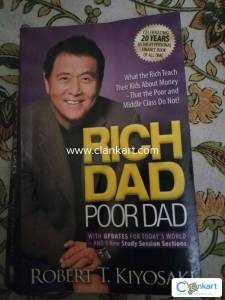
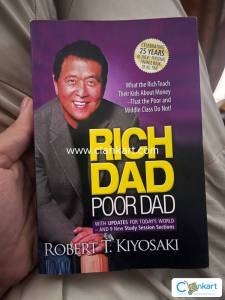
Rich Dad Poor Dad: What the Rich Teach Their Kids About Money That the
Rich Dad Poor Dad is Robert's story of growing up with two dads — his real father and the father of his best friend, his rich dad — and the ways in which both men shaped his thoughts about money and investing. The book explodes the myth that you need to earn a high income to be rich and explains the difference between working for money and having your money work for you.
Microeconomics global edition
Microeconomics exposes students to topics that play a central role in microeconomics. From game theory and competitive strategy, to the roles of uncertainty and information, and the analysis of pricing by firms with market power, the text helps students understand what’s going on in the world of business. It also shows students how microeconomics can be used as a practical tool for decision-making and for designing and understanding public policy. The Ninth Edition, Global Edition, further illustrates microeconomics’ relevance and usefulness with new coverage and examples, and an improved exposition that is clear and accessible as well as lively and engaging. With Microeconomics, readers will be able to fully appreciate how a modern economy functions.For Intermediate Microeconomics courses.
Beyond competitive advantage
A competitive advantage just isn't enough. Your company is turning in regular profits every year, and its market share is only getting bigger. Competitors can’t touch you. So why is your stock price so sluggish? The answer is as simple as it is cruel: investors aren’t interested in history, and they already know you’re profitable and competitive—that knowledge is baked into your stock price. The hard reality is that a competitive advantage just isn’t enough. Investors want companies to surprise them with unexpected value, which means that you can outperform market expectations only if you as a leader know how to find, create, and deliver a series of multiple competitive advantages. This is why a corporate theory is so important. A good corporate theory provides a compass for those at the strategic helm, guiding their decisions about what assets and activities to pursue, what investments to make, and what strategies to adopt. Behind every long-term corporate success story lies a basic theory about how that company creates value. In Beyond Competitive Advantage, strategy professor Todd Zenger describes what makes a great corporate theory and helps readers understand the many tensions and trade-offs they’ll face as they apply the theory to meet the challenge of market expectations. Based on years of research and analysis, Beyond Competitive Advantage provides managers and executives with a framework for both sustaining value and creating growth.
Good Strategy Bad Strategy: The Difference and Why It Matters
Developing and implementing a strategy is the central task of a leader, whether the CEO at a Fortune 100 company, an entrepreneur, a church pastor, the head of a school, or a government official. Richard Rumelt argues that the heart of a good strategy is insight - into the true nature of the situation, into the hidden power in a situation, and into an appropriate response. He shows you how insight can be cultivated with a wide variety of tools for guiding your own thinking.Good Strategy/Bad Strategy integrates fascinating examples from business, nonprofit, and military affairs to bring its original ideas to life: From Apple to General Motors, from the two Iraq wars to Afghanistan, from a small local market to Wal-Mart, from the Getty Trust to the Los Angeles Unified School District, from Global Crossing to the 2007-08 financial crisis, and many more. The abundance of business-ready insights offered by Rumelt stem from his decades of digging beyond the superficial to address hard questions with honesty and integrity.
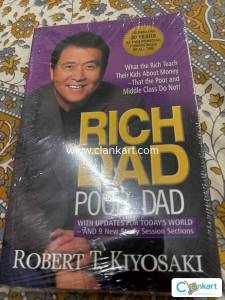
Rich Dad and poor dad
April 2017 marks 20 years since Robert Kiyosaki’s Rich Dad Poor Dad first made waves in the Personal Finance arena.It has since become the #1 Personal Finance book of all time... translated into dozens of languages and sold around the world.Rich Dad Poor Dad is Robert's story of growing up with two dads — his real father and the father of his best friend, his rich dad — and the ways in which both men shaped his thoughts about money and investing. The book explodes the myth that you need to earn a high income to be rich and explains the difference between working for money and having your money work for you.20 Years... 20/20 HindsightIn the 20th Anniversary Edition of this classic, Robert offers an update on what we’ve seen over the past 20 years related to money, investing, and the global economy. Sidebars throughout the book will take readers “fast forward” — from 1997 to today — as Robert assesses how the principles taught by his rich dad have stood the test of time.In many ways, the messages of Rich Dad Poor Dad, messages that were criticized and challenged two decades ago, are more meaningful, relevant and important today than they were 20 years ago.As always, readers can expect that Robert will be candid, insightful... and continue to rock more than a few boats in his retrospective.Will there be a few surprises? Count on it.Rich Dad Poor Dad...• Explodes the myth that you need to earn a high income to become rich• Challenges the belief that your house is an asset• Shows parents why they can't rely on the school system to teach their kids about money• Defines once and for all an asset and a liability• Teaches you what to teach your kids about money for their future financial success
Finance book
Timeless lessons on wealth, greed, and happiness doing well with money isn’t necessarily about what you know. It’s about how you behave. And behavior is hard to teach, even to really smart people. How to manage money, invest it, and make business decisions are typically considered to involve a lot of mathematical calculations, where data and formulae tell us exactly what to do. But in the real world, people don’t make financial decisions on a spreadsheet. They make them at the dinner table, or in a meeting room, where personal history, your unique view of the world, ego, pride, marketing, and odd incentives are scrambled together. In the psychology of money, the author shares 19 short stories exploring the strange ways people think about money and teaches you how to make better sense of one of life’s most important matters.
Macro economics for class 12
Restructured and revised in sync with the revised syllabus & updated guidelines by the CBSE board. A gist of major modifications: Brain Teaser blocks to test logical clarity and implication based learning. Test Your Understanding blocks to promote application, analysis & evaluation of concepts. Basic Numericals following hand-holding approach for budding economists. Categorisation & sub-classification of numericals for easy identification of nature of problem. HOTS: Each chapter is splashed with HOTS to promote clarity of the basics and provide some food for thought to the avid readers. ‘Did You Know’ blocks are provided in each chapter to highlight the significance of core concepts. Wide variety of questions: A wide variety of questions patterned along the CBSE released Sample Question Paper (2023) have been incorporated in each Chapter. The category of questions incorporated are: Competency-Based Learning: Objective Questions: Multiple Choice Questions Fill in the Blanks True-False alternatives Choose the Correct Pair of Statements/Identify the Correct Sequence of Alternatives One Liners: Answer with Reason Competency Based Learning: Data/Picture Based & Case-Study Based Questions Data/Picture Based Questions, Case-Study Based Questions Competency Based Learning: Descriptive Questions: Very Short Answer Type Questions HOTS & applications Analysis & Evaluation NCERT questions (with hints to answers) Miscellaneous Questions and Reference to the Text for Answers Solved Numericals Unsolved Numericals We have also added sample projects patterned along the latest CBSE format for the reference of the students. Sample Paper by “VK Global Study Group” based on the specimen paper woven along the same structure and blueprint as suggested in the CBSE released Sample Question Paper-2023 has been included. Harmony and Synchronisation: To maintain clarity of thought; the information in our book has been compiled and presented in a step by step manner so that students are able to comprehend things better. Comprehensive and elu