Clankart Logo

Buy used History & Archaeology books online in India

Buy Second Hand Books, Used Books Online In India
Egyptology

Egyptology

₹250

Discover the wonders of ancient Egypt through a fascinating journal from a lost expedition -- a treasure trove of fact and fantasy featuring a novelty element on every spread.Who can resist the allure of ancient Egypt -- and the thrill of uncovering mysteries that have lain hidden for thousands of years? Not the feisty Miss Emily Sands, who in 1926, four years after the discovery of King Tut's tomb, led an expedition up the Nile in search of the tomb of the god Osiris. Alas, Miss Sands and crew soon vanished into the desert, never to be seen again. But luckily, her keen observations live on in the form of a lovingly kept journal, full of drawings, photographs, booklets, foldout maps, postcards, and many other intriguing samples. Here are just a few of EGYPTOLOGY's special features:-- an extravagantly gilded cover, featuring a raised Horus hawk pendant with three encrusted gems-- a playable game of Senet -- ancient Egyptian checkers -- including board, pieces, original-style dice, and rules-- a souvenir booklet showing how to read simple hieroglyphs-- a scrap of textured "mummy cloth"-- a facsimile of the gilded mummy mask of King Tut-- a gilded eye-of-Horus amulet with a "jewel" at the endRich with information about life in ancient Egypt and peppered with Miss Sands's lively narration, EGYPTOLOGY concludes with a letter from the former Keeper of Antiquities at the British Museum, explaining which parts of this unique tale may be accepted as fact, which are guided by legend, and which reflect the author's delightful sense of fancy.

2 years ago
Mein Kampf

Mein Kampf

₹550 ₹799
31% off

Alternate cover edition of this book.Madman, tyrant, animal—history has given Adolf Hitler many names. In Mein Kampf (My Struggle), often called the Nazi bible, Hitler describes his life, frustrations, ideals, and dreams. Born to an impoverished couple in a small town in Austria, the young Adolf grew up with the fervent desire to become a painter. The death of his parents and outright rejection from art schools in Vienna forced him into underpaid work as a laborer. During the First World War, Hitler served in the infantry and was decorated for bravery. After the war, he became actively involved with socialist political groups and quickly rose to power, establishing himself as Chairman of the National Socialist German Worker's party. In 1924, Hitler led a coalition of nationalist groups in a bid to overthrow the Bavarian government in Munich. The infamous Munich "Beer-hall putsch" was unsuccessful, and Hitler was arrested. During the nine months he was in prison, an embittered and frustrated Hitler dictated a personal manifesto to his loyal follower Rudolph Hess. He vented his sentiments against communism and the Jewish people in this document, which was to become Mein Kampf, the controversial book that is seen as the blue-print for Hitler's political and military campaign. In Mein Kampf, Hitler describes his strategy for rebuilding Germany and conquering Europe. It is a glimpse into the mind of a man who destabilized world peace and pursued the genocide now known as the Holocaust.

2 years ago
Advertisement
Want to see your books here? Have Used Books?
Make some extra cash by selling your old books for actual money in your UPI/Bank account. Go on, it's quick and easy.

Advertisement
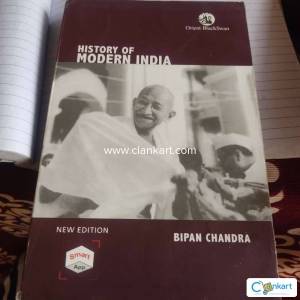
History of Modern India

History of Modern India

₹389 ₹495
21% off

The SAGE Series in Modern Indian History consists of well-researched volumes with a wider scope and is intended to bring together the growing volume of historical studies that share a broad common historiographic focus. The approach that the authors have tried to evolve looks sympathetically, though critically, at the Indian national liberation struggle and other popular movements such as those of labour, peasants, lower castes, tribal peoples and women. The series also looks at colonialism as a structure and a system, and analyzes changes in economy, society and culture in the colonial context as also in the context of independent India. It focuses on communalism and casteism as major features of modern Indian development. The volumes in the series will tend to reflect this approach as also its changing and developing features. At the broadest plane this approach is committed to the Enlightenment values of rationalism, humanism, democracy and secularism. This set includes: Volume 1: Independence and Partition: The Erosion of Colonial Power in India by Sucheta Mahajan Volume 2: A Narrative of Communal Politics: Uttar Pradesh, 1937–39 by Salil Misra Volume 3: Imperialism, Nationalism and the Making of the Indian Capitalist Class, 1920–1947 by Aditya Mukherjee Volume 4: From Movement to Government: The Congress in the United Provinces, 1937–42 by Visalakshi Menon Volume 5: Peasants in India’s Non-Violent Revolution: Practice and Theory by Mridula Mukherjee Volume 6: Communalism in Bengal: From Famine to Noakhali, 1943–47 by Rakesh Batabyal Volume 7: Political Mobilization and Identity in Western India, 1934–47 by Shri Krishan Volume 8: The Garrison State: Military, Government and Society in Colonial Punjab, 1849–1947 by Tan Tai Yong Volume 9: Colonializing Agriculture: The Myth of Punjab Exceptionalism by Mridula Mukherjee Volume 10: Region, Nation, “Heartland”: Uttar Pradesh in India’s Body-Politic by Gyanesh Kudaisya Volume 11: National Movement and Politics in Orissa, 1920–29 by Pritish Acharya Volume 12: Commun

2 years ago
What Gandhi Didnt See: Being Indian in South Africa

What Gandhi Didnt See: Being Indian in South Africa

₹300

From the vantage point of her own personal history--a fourth-generation Indian South African of mixed lineage--indentured as well as trader class, part Hindu, part Muslim--Dala explores the nuts and bolts of being Indian in South Africa today. From 1684 till the present, the Indian diaspora in South Africa has had a long history. But in the country of their origin, they remain synonymous with three points of identity: indenture, apartheid and Mahatma Gandhi. In this series of essays, Zainab Priya Dala deftly lifts the veil on some of the many other facets of South African Indians, starting with the question: How relevant is Gandhi to them today? It is a question Dala answers with searing honesty, just as she tackles the questions of the 'new racism'--between Black Africans and Indians--and the 'new apartheid'--money; the tussle between the 'canefields' where she grew up, and the 'Casbah', or the glittering town of Durban; and what the changing patterns in the names the Indian community chooses to adopt reflect. In writing that is fluid, incisive and sensitive, she explores the new democratic South Africa that took birth long after Gandhi returned to the subcontinent, and the fight against apartheid was fought and won. In this new 'Rainbow Nation', the people of Indian origin are striving to keep their ties to Indian culture whilst building a stronger South African identity. Zainab Priya Dala describes some of the scenarios that result from this dichotomy.

2 years ago
Advertisement
India that is Bharat by J Sai Deepak

India that is Bharat by J Sai Deepak

₹500 ₹899
44% off

India, That Is Bharat, the first book of a comprehensive trilogy, explores the influence of European 'colonial consciousness' (or 'coloniality'), in particular its religious and racial roots, on Bharat as the successor state to the Indic civilisation and the origins of the Indian Constitution. It lays the foundation for its sequels by covering the period between the Age of Discovery, marked by Christopher Columbus' expedition in 1492, and the reshaping of Bharat through a British-made constitution-the Government of India Act of 1919. This includes international developments leading to the founding of the League of Nations by Western powers that tangibly impacted this journey.Further, this work also traces the origins of seemingly universal constructs such as 'toleration', 'secularism' and 'humanism' to Christian political theology. Their subsequent role in subverting the indigenous Indic consciousness through a secularised and universalised Reformation, that is, constitutionalism, is examined. It also puts forth the concept of Middle Eastern coloniality, which preceded its European variant and allies with it in the context of Bharat to advance their shared antipathy towards the Indic worldview. In order to liberate Bharat's distinctive indigeneity, 'decoloniality' is presented as a civilisational imperative in the spheres of nature, religion, culture, history, education, language and, crucially, in the realm of constitutionalism.

2 years ago
Advertisement
Advertisement