Buy used Finance & Accounting Entrance Exam books online in India
Buy Second Hand Books, Used Books Online In India
Treasury Investment and Risk Management
About the Book This book has been designed keeping in mind the needs of professionals who are preparing for the Independent Director's Online Proficiency Self-Assessment Test. The book would be immensely useful for the chartered accountants, company secretaries, lawyers and management professionals while undertaking the Independent Director's examination as it gives the updated provisions of different statutes and MCQs relevant for it. Contents Chapter 1: Companies Act, 2013 and relevant Rules (sections 3 to 246) Chapter 2: Secretarial Standards (SS-1 and SS-2) Chapter 3: Securities Laws and Regulations (covering SEBI Act, 1992; SEBI (LODR) Regulations, 2015; SEBI (ICDR) Regulations, 2018; Securities Contracts (Regulation) Act, 1956 and Depositories Act, 1996) Chapter 4: Independent Director (covering entire day-to-day reference materials specially meant for the Independent Directors) Chapter 5: Corporate Governance & Strategy (covering corporate governance and board effectiveness matters) Chapter 6: Financial Accountancy (covering understanding about the Accounting Standards, Balance-Sheet, Profit & Loss Account, Cash Flow Statements, CARO-2020 and the Financial Ratios) Chapter 7: Case Laws (Includes 7 leading case studies)
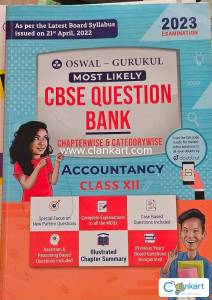
Arihant class 12 15 - sample paper accountancy book
Includes:15 Fully Solved Sample Question PapersBased on latest CBSE pattern (202526)Detailed step-by-step solutionsExam-oriented questions (Partnership, Company Accounts, Cash Flow, etc.)Great for last-minute revision & board preparation Condition:Well-maintained, minimal writing/highlighting (if any). Pages intact and clean. Perfect for Class 12 Commerce students targeting 90%+ in Accountancy boards.Reason for selling: Boards over / no longer needed.
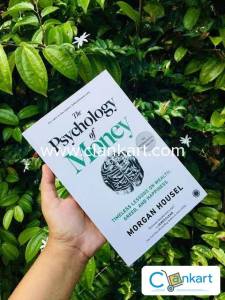
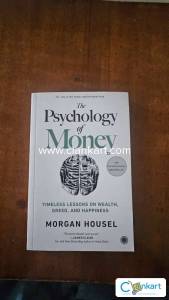
The Psychology of money
Timeless lessons on wealth, greed, and happiness doing well with money isn’t necessarily about what you know. It’s about how you behave. And behavior is hard to teach, even to really smart people. How to manage money, invest it, and make business decisions are typically considered to involve a lot of mathematical calculations, where data and formulae tell us exactly what to do. But in the real world, people don’t make financial decisions on a spreadsheet. They make them at the dinner table, or in a meeting room, where personal history, your unique view of the world, ego, pride, marketing, and odd incentives are scrambled together. In the psychology of money, the author shares 19 short stories exploring the strange ways people think about money and teaches you how to make better sense of one of life’s most important matters.
think and grow rich
“Both poverty and riches are the offspring of thought.” since its first publication in 1937, think and Grow Rich has been considered the best self-help book in the world.A Bible for people seeking riches and prosperity, this book draws on the life stories of the wealthiest and most successful people of all time. Through this book Napoleon Hill will teach you what to do, and how to do it, to achieve lasting and unprecedented success. In this updated edition, the editors Bill and Ann Hartley have provided commentaries on many passages of the original text and examples of many more successful people, some of whom were inventors, senators, leaders of business and strategy, and even presidents of countries. Change your life as you learn to be ‘the master of your fate and the Captain of your soul’ through this powerful book.
INVESTMENT VALUATION
About The Book: This edition includes a new chapter on decision analysis, and additional material on computer solutions of linear programming problems, LP applications, the use of sensitivity analysis output, minimal spanning tree, goal programming, network of queues, and more. Throughout, mathematics is kept to an intermediate level.
Equity Asset Valuation
Navigate equity investments and asset valuation with confidence Equity Asset Valuation, Fourth Edition blends theory and practice to paint an accurate, informative picture of the equity asset world. The most comprehensive resource on the market, this text supplements your studies for the third step in the three-level CFA certification program by integrating both accounting and finance concepts to explore a collection of valuation models and challenge you to determine which models are most appropriate for certain companies and circumstances. Detailed learning outcome statements help you navigate your way through the content, which covers a wide range of topics, including how an analyst approaches the equity valuation process, the basic DDM, the derivation of the required rate of return within the context of Markowitz and Sharpe's modern portfolio theory, and more.
The Psychology of Money - Morgan Housel
Doing well with money isn't necessarily about what you know. It's about how you behave. And behavior is hard to teach, even to really smart people. Money--investing, personal finance, and business decisions--is typically taught as a math-based field, where data and formulas tell us exactly what to do. But in the real world people don't make financial decisions on a spreadsheet. They make them at the dinner table, or in a meeting room, where personal history, your own unique view of the world, ego, pride, marketing, and odd incentives are scrambled together. In The Psychology of Money, award-winning author Morgan Housel shares 19 short stories exploring the strange ways people think about money and teaches you how to make better sense of one of life's most important topics.
Value Investing by Parag Parikh
"When others are greedy be fearful and when others are fearful be greedy" - ill-timed bouts of greed and fear among investors make stock markets volatile. Rational and successful investing is all about restraining and channelizing these emotions and understanding behavioral finance, not market sentiments, crowd behavior or company performances. At a time when market upheavals are eroding investors' confidence, dooming life's earnings and corporate fortunes, and whipping up mass hysteria-Value Investing and Behavioral Finance comes as an antidote to investor anxiety and a guide to sane and safe investment decisions. Using investing trends in Indian capital markets over the last three decades, it shows how collective behavioral biases affect investment decisions, returns and market vagaries. As a corrective, it spells out long-term value and contrarian investing strategies based on the principles of behavioral finance. Further, it advises on how to spot investment opportunities and pitfalls in commodity stocks, growth stocks, PSUs, IPOs, sectors and index stocks. It also alerts the reader to a 'bubble' or crisis situation, and ways to identify and insure against it.
Coffee Can Investing by Saurabh Mukherjea
Most people invest in the usual assets: real estate, gold, mutual funds, fixed deposits, and stock markets. It's always the same four or five instruments. All they end up making is a measly 8 to 12 percent per annum. Those who are exceptionally unfortunate get stuck in the middle of a crash and end up losing a lot of money. What if there was another way? What if you could make not 10 not 15 but 20 percent compound annual growth rate (CAGR) on your investments? What if there was a way to grow your money four to five times whilst taking half the risk compared to the overall market? Bestselling author of Gurus of Chaos and The Unusual Billionaires, Saurabh Mukherjea puts his money where his mouth is. Saurabh follows the Coffee Can approach to high-quality, low-risk investing. His firm, Ambit Capital, is one the largest wealth managers in India which invests with this approach and delivers stupendous returns. In Coffee Can Investing, Saurabh will show you how to go about low-risk investments that generate great returns.