Buy used Computers & Internet books online in India
Buy Second Hand Books, Used Books Online In India
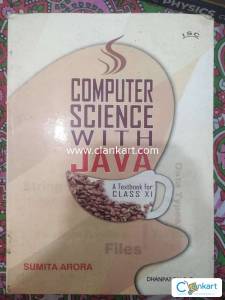
Computer science with Java Class 11
Written in Accordance with CBSE Syllabus for Board Examination to be Held in 2009 and 2010 This textbook is a sequel to the Textbook of Computer Science for Class XI. It is written in a simple, direct style for maximum clarity. It comprehensively covers the Class XII CBSE syllabus of Computer Science (subject code 083). The goal of the book is to develop the student’s proficiency in fundamentals and make the learning process creative, engrossing and interesting. There are practice exercises and questions throughout the text, designed on the pattern of sample question papers published by CBSE. The approach of this book is to teach the students through extensive “skill and drill” type exercises in order to make them high-ranking achievers in the Board examinations. KEY FEATURES Provides accurate and balanced coverage of topics as prescribed in the CBSE syllabus code 083. Builds a solid programming foundation in C++. Students can prepare a Practical File with solved programming examples given in the text. End-of-chapter questions help teachers prepare assignments for self-practice by the students. End-of-chapter Programming Exercises help students in preparing for the Board practical examination. Solved questions at the end of each chapter prepare students for the Board theory examination. For further guidance on how to use this book effectively, e-mail the author using seema_591@rediffmail.com
Rd sharma books
Learn Python Quickly, A Programmer-Friendly GuideDESCRIPTIONMost Programmer's learning Python are usually comfortable with some or the other programming language and are not interested in going through the typical learning curve of learning the first programming language. Instead, they are looking for something that can get them off the ground quickly. They are looking for similarities and differences in a feature that they have used in other language(s). This book should help them immediately. It guides you from the fundamentals of using module through the use of advanced object orientation. KEY FEATURESStrengthens the foundations, as detailed explanation of programming language concepts are given in simple manner. Lists down all the important points that you need to know related to various topics in an organized manner.Prepares you for coding related interview and theoretical questions.Provides In depth explanation of complex topics and Questions.Focuses on how to think logically to solve a problem.Follows a systematic approach that will help you to prepare for an interview in short duration of time.Exercises are exceptionally useful to complete the reader's understanding of a topic. WHAT WILL YOU LEARNData types, Control flow instructions, console & File Input/OutputStrings, list & tuples, List comprehensionSets & Dictionaries, Functions & LambdasDictionary ComprehensionModules, classes and objects, InheritanceOperator overloading, Exception handlingIterators & Generators, Decorators, Command-line Parsing WHO THIS BOOK IS FORStudents, Programmers, researchers, and software developers who wish to learn the basics of Python programming language. Table of Contents 1. Introduction to Python2. Python Basics 3. Strings4. Decision Control Instruction5. Repetition Control Instruction6. Console Input/Output7. Lists8. Tuples9. Sets10. Dictionaries11. Comprehensions12. Functions13. Recursion14. Functional Programming15. Modules and Packages16. Namespaces17. Classes and Objects18. Intricacies of Classes and Objects19. Con
Artificial Intelligence class -10 CBSE
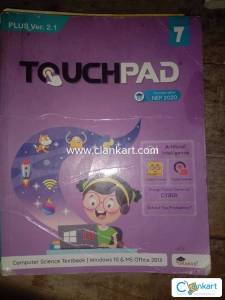
Touchpad AI series has some salient features such as AI Game, AI Lab. KEY FEATURES (5-7 points)(each point should be 70 characters with space)(to be filled by author) ● National Education Policy 2020 ● AI Game: It contains an interesting game or activity for the students. ● AI Lab: It contains questions to improve practical skills. ● Brainy Fact: It is an interesting fact relevant to the topic. ● AI Glossary: This section contains definition of important AI terms. ● Digital Solutions DESCRIPTION Touchpad Artificial Intelligence series has some salient features such as AI Reboot, AI Deep Thinking, AI in Life, AI Lab and AI Ready which ensures that NEP 2020 guidelines are followed. The series is written keeping in mind about the future and scope that lies in Artificial Intelligence. The knowledge is spread in a phased manner so that at no age the kid finds it difficult to understand the theory. There are some brainstorming activities in the form of AI Task in between the topics to ensure that students give pause to their learning and use their skills to reach to some creative ideas in solving given problems. Every chapter has competency based questions as guided by CBSE to ensure that students are capable of applying their learning to solve some real-life challenges. There are plenty of Video Sessions for students and teachers to go beyond the syllabus and enrich their knowledge. WHAT WILL YOU LEARN You will learn about: ● Communication skills ● Management skills ● Fundamentals of computers ● ICT Tools ● Entrepreneurship ● Green Skills ● Introduction to AI ● Computer vision ● Natural Language Processing ● Data Science ● AI Project Cycle ● Advance Python WHO THIS BOOK IS FOR Grade 10 TABLE OF CONTENTS 1. Part A Employability Skills a. Unit-1 Communication Skills-II b. Unit-2 Self Management Skills-II c. Unit-3 ICT Skills-II d. Unit-4 Entrepreneurial Skills-II e. Unit-5 Green Skills-II 2. Part B Subject Specific Skills a. Unit-1 Introduction to AI b. Unit-2 AI Project Cycle c. Unit-3 Advance Python d. Unit-4 Data Sci
Cyber beans Computer application
Asset Pricing Theory is an advanced textbook for doctoral students and researchers that offers a modern introduction to the theoretical and methodological foundations of competitive asset pricing. Costis Skiadas develops in depth the fundamentals of arbitrage pricing, mean-variance analysis, equilibrium pricing, and optimal consumption/portfolio choice in discrete settings, but with emphasis on geometric and martingale methods that facilitate an effortless transition to the more advanced continuous-time theory. Among the book's many innovations are its use of recursive utility as the benchmark representation of dynamic preferences, and an associated theory of equilibrium pricing and optimal portfolio choice that goes beyond the existing literature. Asset Pricing Theory is complete with extensive exercises at the end of every chapter and comprehensive mathematical appendixes, making this book a self-contained resource for graduate students and academic researchers, as well as mathematically sophisticated practitioners seeking a deeper understanding of concepts and methods on which practical models are built. Covers in depth the modern theoretical foundations of competitive asset pricing and consumption/portfolio choice Uses recursive utility as the benchmark preference representation in dynamic settings Sets the foundations for advanced modeling using geometric arguments and martingale methodology Features self-contained mathematical appendixes Includes extensive end-of-chapter exercises
Let Us C engineering books
Learn the hand-crafted notes on C programming Key Features Strengthens the foundations, as a detailed explanation of programming language concepts are given Lucid explanation of the concept Well thought-out, fully working programming examples End-of-chapter exercises that would help you practice the skills learned in the chapterHand-crafted "KanNotes" at the end of the each chapter that would help the reader remember and revise the concepts covered in the chapter Focuses on how to think logically to solve a problem DescriptionThe new edition of this classic book has been thoroughly revamped, but remains faithful to the principles that have established it as a favourite amongst students, teachers and software professionals round the world. "Simplicity"- that has been the hallmark of this book in not only its previous sixteen English editions, but also in the Hindi, Gujrati, Japanese, Korean, Chinese and US editions. This book doesn't assume any programming background. It begins with the basics and steadily builds the pace so that the reader finds it easy to handle advanced topics towards the end of the book.What will you learn C Instructions Decision Control Instruction, Loop Control Instruction, Case Control Instruction Functions, Pointers, Recursion Data Types, The C Preprocessor Arrays, Strings Structures, Console Input/Output, File Input/Output Who this book is forStudents, Programmers, researchers, and software developers who wish to learn the basics of C++ programming language.Table of Contents 1. Getting Started2. C Instructions3. Decision Control Instruction4. More Complex Decision Making5. Loop Control Instruction6. More Complex Repetitions7. Case Control Instruction8. Functions9. Pointers10. Recursion11. Data Types Revisited12. The C Preprocessor13. Arrays14. Multidimensional Arrays15. Strings16. Handling Multiple Strings17. Structures18. Console Input/Output19. File Input/Output20. More Issues In Input/Output21. Operations On Bits22. Miscellaneous Features23. Interview FAQsAppendix A- Compilation and E