Buy used Bachelor of Computer Applications (BCA) books online in India
Buy Second Hand Books, Used Books Online In India
Software Engineering 7th edition roger s pressman
La séptima edición de IngenierÃa del software: un enfoque práctico tiene la intención de funcionar como guÃa hacia una disciplina de ingenierÃa que madura. Como las seis ediciones que la precedieron, la séptima se dirige a estudiantes y profesionales, y conserva su atractivo como guÃa para el profesional industrial y como introducción abarcadora para el estudiante en los niveles superiores de pregrado o en el primer año de graduado.La séptima edición es considerablemente más que una simple actualización. El libro se revisó y reestructuró para mejorar el flujo pedagógico y enfatizar nuevos e importantes procesos y prácticas de la ingenierÃa del software. Además, este texto cuenta con un paquete de complementos, los cuales están disponibles para los profesores que lo adopten. Consulte con el representante de McGraw-Hill local.
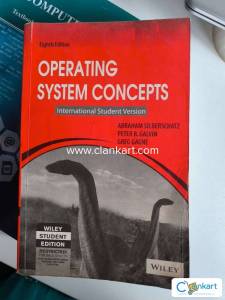
Operating system concepts
Written in an easy-to-understand style, this textbook, now in its third edition, continues to discuss in detail important concepts and major developments in network security and management. It is designed for a one-semester course for undergraduate students of Computer Science, Information Technology, and undergraduate and postgraduate students of Computer Applications. Students are first exposed to network security principles, organizational policy and security infrastructure, and then drawn into some of the deeper issues of cryptographic algorithms and protocols underlying network security applications. Encryption methods, secret key and public key cryptography, digital signature and other security mechanisms are emphasized. Smart card, biometrics, virtual private networks, trusted operating systems, pretty good privacy, database security, and intrusion detection systems are comprehensively covered. An in-depth analysis of technical issues involved in security management, risk management and security and law is presented. In the third edition, two new chapters—one on Information Systems Security and the other on Web Security—and many new sections such as digital signature, Kerberos, public key infrastructure, software security and electronic mail security have been included. Additional matter has also been added in many existing sections. KEY FEATURES : Extensive use of block diagrams throughout helps explain and clarify the concepts discussed. About 250 questions and answers at the end of the book facilitate fruitful revision of the topics covered. Includes a glossary of important terms. KEY FEATURES : Extensive use of block diagrams throughout helps explain and clarify the concepts discussed. About 250 questions and answers at the end of the book facilitate fruitful revision of the topics covered. Includes a glossary of important terms.
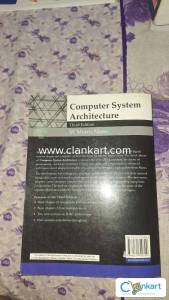
Computer system Architecture third edition
Focused primarily on hardware design and organization and the impact of software on the architecture this volume first covers the basic organization, design, and programming of a simple digital computer, then explores the separate functional units in detail.Key FeaturesDevelops an elementary computer to demonstrate by example the organization and design of digital computers.Uses a simple register transfer language to specify various computer operations.Table of ContentsDigital Logic Circuits.Digital Components.Data Representation.Register Transfer and Microoperations.Basic Computer Organization and Design.Programming the Basic Computer.Microprogrammed Control.Central Progressing Unit (CPU).Pipeline and Vector Processing.Computer Arithmetic.Input-Output Organization.Memory Organization.Multiprocessors.Index.
Programming
Learn the basics of most favoured dynamic language for application development Key Features Major reorganisation of chapters with a view to improve comprehension of concepts involved Comprehensive coverage of all the concepts of Core Java Simple language, crystal clear approach, user-friendly book Concepts are duly supported by several examples and self-explanatory analogies. Description Java Language is very popularly used for creating applications for PC, Laptop, Tablet, Web and Mobile world Learning a language that can work on so many different platforms can be a challenge. This is where you would find this book immediately useful. It follows a simple and easy narration style. It doesn't assume any programming background. It begins with the basics and steadily builds the pace so that the reader finds it easy to handle complex topics towards the end. Each chapter has been designed to create a deep and lasting impression on the reader's mind. Object-Oriented Programming has been covered in detail to give a strong foundation for Java Programming. Well thought out and fully working example programs and carefully crafted exercises of this book, cover every aspect of Java programming. What will you learn Data types & Control Instructions Classes & Objects Arrays & Strings Inheritance & Polymorphism Interfaces, Packages Exception Handling, Effective IO Multithreading & Synchronization Generics, Collection classes, GUI Using Swing Database Connectivity Using JDBC Who this book is for This book will prove to be a "must have" for beginners as well as experienced professionals as it is a stepping stone for learning Java technology. Table of Contents 1. An Overview of Java 2. Getting Started 3. Java Data Types and Instructions 4. Decision Control Instruction 5. Loop Control Instruction 6. Case-Control Instruction 7. Functions 8. Advanced Features of Functions 9. Introduction to OOP 10. Classes and Objects 11. Arrays 12. Strings and Enums 13. Inheritance 14. Polymorphism 15. Exception Handling 16. Effective Input/ Output 1
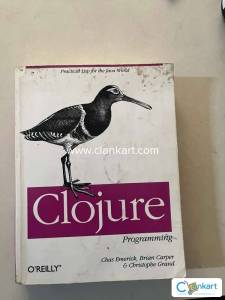
Wonderful book to learn cloujure
The Clojure language is a practical alternative for everyday programming that offers expressivity rivaling other dynamic languages like Ruby and Python, but allows you to seamlessly take advantage of Java libraries, services, and all of the resources of the JVM ecosystem. This book helps you learn the fundamentals of Clojure with examples relating it to the languages you know already, in the domains and topics you work with every day. See how this JVM language can help eliminate unnecessary complexity from your programming practice and open up new options for solving the most challenging problems. Clojure Programming demonstrates the language's flexibility by showing how it can be used for common tasks like web programming and working with databases, up through more demanding applications that require safe, effective concurrency and parallelism, data and statistical analysis, and more. This in-depth look helps tie together the full Clojure development experience, from how to organize your project and an introduction to Clojure build tooling, to a tutorial on how to make the most of Clojure’s REPL during development, and how to deploy your finished application in a cloud environment.Learn how to use Clojure without losing your investment in the Java platform Understand the advantages of Clojure as an efficient Lisp for the JVM See how Clojure is used today in several practical domains Discover how Clojure eliminates the need for many verbose and complicated design patterns Deploy large web applications across tens or hundreds of cloud nodes with Clojure
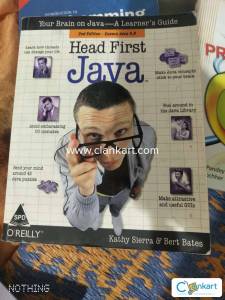
head first java
Learning a complex new language is no easy task especially when it's an object-oriented computer programming language like Java. You might think the problem is your brain. It seems to have a mind of its own, a mind that doesn't always want to take in the dry, technical stuff you're forced to study. The fact is your brain craves novelty. It's constantly searching, scanning, waiting for something unusual to happen. After all, that's the way it was built to help you stay alive. It takes all the routine, ordinary, dull stuff and filters it to the background so it won't interfere with your brain's real work--recording things that matter. How does your brain know what matters? It's like the creators of the Head First approach say, suppose you're out for a hike and a tiger jumps in front of you, what happens in your brain? Neurons fire. Emotions crank up. Chemicals surge. That's how your brain knows. And that's how your brain will learn Java. "Head First Java combines puzzles, strong visuals, mysteries, and soul-searching interviews with famous Java objects to engage you in many different ways. It's fast, it's fun, and its effective. And, despite its playful appearance, Head First Java is serious stuff: a complete introduction to object-oriented programming and Java. You'll learn everything from the fundamentals to advanced topics, including threads, network sockets, and distributed programming with RMI. And the new. second edition focuses on Java 5.0, the latest version of the Java language and development platform. Because Java 5.0 is a major update to the platform, with deep, code-level changes, even more careful study and implementation is required. So learning the Head Firstway is more important than ever. If you've read a Head First book, you know what to expect--a visually rich format designed for the way your brain works. If you haven't, you're in for a treat. You'll see why people say it's unlike any other Java book you've ever read. By exploiting how your brain works, "Head First Java compresses the time
Database System Concepts
Written by leading information security educators, this fully revised, full-color computer security textbook covers CompTIAs fastest-growing credential, CompTIA Security+. Principles of Computer Security, Fourth Edition is a student-tested, introductory computer security textbook that provides comprehensive coverage of computer and network security fundamentals in an engaging and dynamic full-color design. In addition to teaching key computer security concepts, the textbook also fully prepares you for CompTIA Security+ exam SY0-401 with 100% coverage of all exam objectives. Each chapter begins with a list of topics to be covered and features sidebar exam and tech tips, a chapter summary, and an end-of-chapter assessment section that includes key term, multiple choice, and essay quizzes as well as lab projects. Electronic content includes CompTIA Security+ practice exam questions and a PDF copy of the book. Key features: CompTIA Approved Quality Content (CAQC) Electronic content features two simulated practice exams in the Total Tester exam engine and a PDF eBook Supplemented by Principles of Computer Security Lab Manual, Fourth Edition, available separately White and Conklin are two of the most well-respected computer security educators in higher education Instructor resource materials for adopting instructors include: Instructor Manual, PowerPoint slides featuring artwork from the book, and a test bank of questions for use as quizzes or exams Answers to the end of chapter sections are not included in the book and are only available to adopting instructors Learn how to: Ensure operational, organizational, and physical security Use cryptography and public key infrastructures (PKIs) Secure remote access, wireless networks, and virtual private networks (VPNs) Authenticate users and lock down mobile devices Harden network devices, operating systems, and applications Prevent network attacks, such as denial of service, spoofing, hijacking, and password guessing Combat viruses, worms, Trojan horses, and rootkits Manage
Data Structures
The classic data structure textbook provides a comprehensive and technically rigorous introduction to data structures such as arrays, stacks, queues, linked lists, trees and graphs, and techniques such as sorting hashing that form the basis of all software. In addition, it presents advanced of specialized data structures such as priority queues, efficient binary search trees, multiway search trees and digital search structures. The book now discusses topics such as weight biased leftist trees, pairing heaps, symmetric min-max heaps, interval heaps, top-down splay trees, B+ trees and suffix trees. Red-black trees have been made more accessible. The section on multiway tries has been significantly expanded and several trie variations and their application to Interner packet forwarding have been disused.
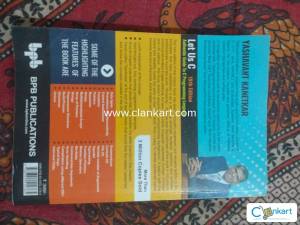
Let US C by Yashwant Kanetkar
Description: ""Simplicity""- That has been the hallmark of this book in not only its previous fourteen English editions, but also in the Hindi, Guajarati, Japanese, Korean, Chinese and US editions. This book does not assume any programming background. It begins with the basics towards the end of the book. Each Chapter Contains: Lucid explanation of the concept well thought-out, fully working programming examples End of chapter exercises that would help you practise the learned in the chapter Hand crafted ""kanNotes"" that would help you remember and revise the concepts covered in each chapter. Table of Contents: Getting Started C Instructions Decision Control Instruction More Complex Decision Making Loop Control Instruction More Complex Repetitions Case Control Instruction Functions Pointers Recursion Data Types Revisited The C Preprocessor Arrays Multidimensional Arrays Strings Handling Multiple Strings Structures Console Input/ Output File Input/ Output More Issues in Input/ Output Operations on Bits Miscellaneous Features C Under Linux Interview FAQ's Appendix A- Compilation and Execution Appendix B- Precedence table Appendix C-Chasing the Bugs Appendix D- ACII Chart Periodic Tests I to IV Index
SQL, PL/SQL by Ivan Bayross
Oracle's Workgroup or Enterprise Server, are the world's largest selling RDBMS products. It is estimated that the combined sales of both these Oracle products account for more than 80% of RDBMS products. It is estimated that the combines sales of both these Oracle products account for more than 80% of RDBMS engines sold worldwide.A very large amount of commercial applications are developed around these products. Most ERP software such as SAP R3, Avalon, Marshall, PeopleSoft, Oracle Applications and a host of other such client software work with the Oracle RDBMS engine worldwide.Whether a corporate entity chooses to use Oracle Work Group of Enterprise Server, the natural programming language of both of these products in ANSI SQL and PL/SQL. This book has been written to address the need of programmers who wish to have a ready reference book, with examples, which covers ANSI SQL and PL/SQL.The creating of User Defined Functions, Procedures, Database triggers and other specific data processing PL/SQL code blocks for commercial applications will always required programmers who can code comfortably in ANSI SQL and PL/SQL.Exception handling, Oracle's default locking and User defined locking has been covered in a fair amount of detail. However these areas are of great interest to commercial application developers Programmers with these explicit skills will always find employment in that segment of the software industry, which develops commercial applications.I have tried to use my extensive commercial application development experience in Oracle using ANSI SQL and PL/SQL to produce a book that has answers to most of the questions that seem to puzzle programmers in ANSI SQL and PL/SQL.Every single programming question has not been answered, indeed if I tried to actually do that I would fail since I believe that I myself have not encountered every single programming problem. However, I''ve chosen several key areas in commercial applications and tried to address a set of issues that most commercial applications developers