Buy used Politics Books online in India
Buy Second Hand Books, Used Books Online In India
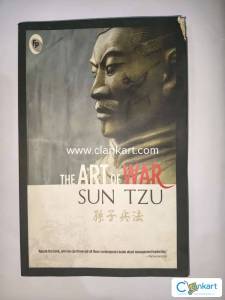
Art of war
Twenty-Five Hundred years ago, Sun Tzu wrote this classic book of military strategy based on Chinese warfare and military thought. Since that time, all levels of military have used the teaching on Sun Tzu to warfare and civilization have adapted these teachings for use in politics, business and everyday life. The Art of War is a book which should be used to gain advantage of opponents in the boardroom and battlefield alike.
Chetan Bhagat
In late-2000, a young boy in Ahmedabad called Govind dreamt of having a business. To accomodate his friends Ish and Omi's passion, they open a cricket shop. Govind's wants to make money and thinks big. Ish is all about nurturing Ali, the batsman with a rare gift. Omi knows his limited capabiltiies and just wants to be with his friends. However, nothing comes easy in a turbulent city. To realize their goals, they will have to face it all - religious politics, earthquakes, riots, unacceptable love and above all, their own mistakes. Will they make it? Can an individual's dreams overcome the nightmares offered by real life? Can we succeed despite a few mistakes?
SPY CHRONICLES RAW ISI AND THE ILLUSION OF PEACE
Pointing to the horizon where the sea and sky are joined, he says, 'It is only an illusion because they can't really meet, but isn't it beautiful, this union which isn't really there.' - SAADAT HASAN MANTOSometime in 2016, a series of dialogues took place which set out to find a meeting ground, even if only an illusion, between A.S. Dulat and Asad Durrani. One was a former chief of RAW, India's external intelligence agency, the other of ISI, its Pakistani counterpart. As they could not meet in their home countries, the conversations, guided by journalist Aditya Sinha, took place in cities like Istanbul, Bangkok and Kathmandu. On the table were subjects that have long haunted South Asia, flashpoints that take lives regularly. It was in all ways a deep dive into the politics of the subcontinent, as seen through the eyes of two spymasters. Among the subjects: Kashmir, and a missed opportunity for peace; Hafiz Saeed and 26/11; Kulbhushan Jadhav; surgical strikes; the deal for Osama bin Laden; how the US and Russia feature in the India-Pakistan relationship; and how terror undermines the two countries' attempts at talks. When the project was first mooted, General Durrani laughed and said nobody would believe it even if it was written as fiction. At a time of fraught relations, this unlikely dialogue between two former spy chiefs from opposite sides-a project that is the first of its kind-may well provide some answers.
India that is Bharat
India, That Is Bharat, the first book of a comprehensive trilogy, explores the influence of European 'colonial consciousness' (or 'coloniality'), in particular its religious and racial roots, on Bharat as the successor state to the Indic civilisation and the origins of the Indian Constitution. It lays the foundation for its sequels by covering the period between the Age of Discovery, marked by Christopher Columbus' expedition in 1492, and the reshaping of Bharat through a British-made constitution-the Government of India Act of 1919. This includes international developments leading to the founding of the League of Nations by Western powers that tangibly impacted this journey.Further, this work also traces the origins of seemingly universal constructs such as 'toleration', 'secularism' and 'humanism' to Christian political theology. Their subsequent role in subverting the indigenous Indic consciousness through a secularised and universalised Reformation, that is, constitutionalism, is examined. It also puts forth the concept of Middle Eastern coloniality, which preceded its European variant and allies with it in the context of Bharat to advance their shared antipathy towards the Indic worldview. In order to liberate Bharat's distinctive indigeneity, 'decoloniality' is presented as a civilisational imperative in the spheres of nature, religion, culture, history, education, language and, crucially, in the realm of constitutionalism.
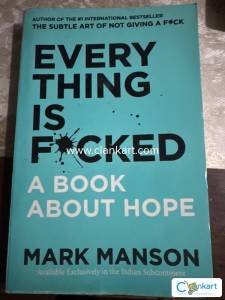
MARK MANSON
From the author of the international mega-bestseller The Subtle Art of Not Giving A F*ck comes a counterintuitive guide to the problems of hope. We live in an interesting time. Materially, everything is the best it’s ever been—we are freer, healthier and wealthier than any people in human history. Yet, somehow everything seems to be irreparably and horribly f*cked—the planet is warming, governments are failing, economies are collapsing, and everyone is perpetually offended on Twitter. At this moment in history, when we have access to technology, education and communication our ancestors couldn’t even dream of, so many of us come back to an overriding feeling of hopelessness.What’s going on? If anyone can put a name to our current malaise and help fix it, it’s Mark Manson. In 2016, Manson published The Subtle Art of Not Giving A F*ck, a book that brilliantly gave shape to the ever-present, low-level hum of anxiety that permeates modern living. He showed us that technology had made it too easy to care about the wrong things, that our culture had convinced us that the world owed us something when it didn’t—and worst of all, that our modern and maddening urge to always find happiness only served to make us unhappier. Instead, the “subtle art” of that title turned out to be a bold challenge: to choose your struggle; to narrow and focus and find the pain you want to sustain. The result was a book that became an international phenomenon, selling millions of copies worldwide while becoming the #1 bestseller in 13 different countries.Now, in Everthing Is F*cked, Manson turns his gaze from the inevitable flaws within each individual self to the endless calamities taking place in the world around us. Drawing from the pool of psychological research on these topics, as well as the timeless wisdom of philosophers such as Plato, Nietzsche, and Tom Waits, he dissects religion and politics and the uncomfortable ways they have come to resemble one another. He looks at our relationships with money, entertainment and the internet, a
Mein Kampf
Alternate cover edition of this book.Madman, tyrant, animal—history has given Adolf Hitler many names. In Mein Kampf (My Struggle), often called the Nazi bible, Hitler describes his life, frustrations, ideals, and dreams. Born to an impoverished couple in a small town in Austria, the young Adolf grew up with the fervent desire to become a painter. The death of his parents and outright rejection from art schools in Vienna forced him into underpaid work as a laborer. During the First World War, Hitler served in the infantry and was decorated for bravery. After the war, he became actively involved with socialist political groups and quickly rose to power, establishing himself as Chairman of the National Socialist German Worker's party. In 1924, Hitler led a coalition of nationalist groups in a bid to overthrow the Bavarian government in Munich. The infamous Munich "Beer-hall putsch" was unsuccessful, and Hitler was arrested. During the nine months he was in prison, an embittered and frustrated Hitler dictated a personal manifesto to his loyal follower Rudolph Hess. He vented his sentiments against communism and the Jewish people in this document, which was to become Mein Kampf, the controversial book that is seen as the blue-print for Hitler's political and military campaign. In Mein Kampf, Hitler describes his strategy for rebuilding Germany and conquering Europe. It is a glimpse into the mind of a man who destabilized world peace and pursued the genocide now known as the Holocaust.
IGCSE ECONOMICS COURSEBOOK
Covers the Cambridge IGCSE syllabus (0455) and the Cambridge O Level syllabus (2281), first examination from 2020. This series helps students understand economic theory, terminology and principles. It matches the Cambridge IGCSE and O Level Economics syllabuses. The coursebook helps students apply tools of economic analysis, make judgements on economic issues, use basic economic numeracy and literacy, and take greater part in decision-making processes in everyday life. Sample questions provide opportunities for students to develop their evaluative skills. It provides a foundation for advanced study in Economics such as A Level. Answers to the coursebook and workbook questions are in the teacher's resource.
NCERT IT CLASS 10
This revised new edition, now available as a handy pocket-sized paperback, provides more than 4,500 quotations, covering the people, events, and ideas of some 2,500 years of politics: the inspiring speeches and the disastrous gaffes. Antony Jay has selected the best sayings of and aboutpoliticians both past and present, ranging from Karl Marx to George W. Bush and Elizabeth I to Ken Livingstone, and touching on subjects as diverse as warfare, nationalism, honesty, and the ever-sensitive issue of taxation. Newspaper headlines, Slogans, and other special categories are groupedtogether for easier access, and an extensive index helps you to find out who really said that half-remembered phrase. With the addition of Sound bites of 2000-4, events covered include the terrorist attacks of 11 September 2001, wars in Afghanistan and Iraq, and the enlargement of the EuropeanUnion.Just when we thought it was safe to go back in the water, the sharks are circling again.Anonymous British Cabinet Minister on the forthcoming report of the European ConventionStates like these...constitute an axis of evil.George W. BushI wasn't even in the index.Edwina Currie, on John Major's autobiographyYou know what some people call us: the nasty party.Theresa MayA good day to bury bad news.Summary of Jo Moore's email of 11 September 2001You don't look tall if you surround yourself by short grasses.Michael Portillo on Iain Duncan SmithEntitlement cards will not be compulsory, but everyone will have to have one.John PrescottThere is no list, and Syria isn't on it.Jack Straw
Textbook for political science first semester ug
Examines a fairly wide range of issues concerning the ever-expanding field of political theory, in a multidisciplinary (historical-sociological-economic-philosophical-juristic) perspective. It elaborates the nature and significance of political theory, concept of ideology with a concise and critical discussion of major political ideologies, nature of politics and various approaches to its study including empirical, normative, behavioural, post-behavioural as well as interdisciplinary approach. It elucidates the concepts of the state and sovereignty with reference to the challenges of imperialism, colonialism, neo-colonialism, impact of globalization, grounds and limits of political obligation, various dimensions of law (including rule of law), power (along with authority and legitimacy) citizenship (including democratic citizenship), human rights, liberty (including freedom as emancipation), equality (including equality of opportunity), justice (including social justice) and the common good. Then it dwells on various models and theories of democracy (including participatory and deliberative democracy), indicating the significance of multiculturalism. Finally it gives a critical account of the theories of social change and development with special reference to the problems of underdevelopment, sustainable development and political development
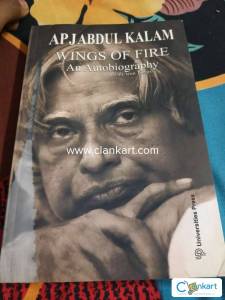
Wings of Fire: APJ Abdul Kalam
Avul Pakir Jainulabdeen Abdul Kalam, the son of a little-educated boat-owner in Rameswaram, Tamil Nadu, had an unparalleled career as a defence scientist, culminating in the highest civilian award of India, the Bharat Ratna. As chief of the country's defence research and development programme, Kalam demonstrated the great potential for dynamism and innovation that existed in seemingly moribund research establishments. This is the story of Kalam's rise from obscurity and his personal and professional struggles, as well as the story of Agni, Prithvi, Akash, Trishul and Nag-missiles that have become household names in India and that have raised the nation to the level of a missile power of international reckoning. This is also the saga of independent India's struggle for technological self-sufficiency and defensive autonomy-a story as much about politics, domestic and international, as it is about science.
Wings of Fire eBook : Kalam, APJ Abdul, Tiwari, Arun
This is a digital exclusive edition with additional photographs not available in the print book. Avul Pakir Jainulabdeen Abdul Kalam, the son of a little-educated boat-owner in Rameswaram, Tamil Nadu, had an unparalleled career as a defence scientist, culminating in the highest civilian award of India, the Bharat Ratna. As chief of the country’s defence research and development programme, Kalam demonstrated the great potential for dynamism and innovation that existed in seemingly moribund research establishments. This is the story of Kalam’s rise from obscurity and his personal and professional struggles, as well as the story of Agni, Prithvi, Akash, Trishul and Nag—missiles that have become household names in India and that have raised the nation to the level of a missile power of international reckoning. This is also the saga of independent India’s struggle for technological self-sufficiency and defensive autonomy—a story as much about politics, domestic and international, as it is about science.
Chanakya Chant - Aswin Sanghi
Vodafone Crossword Popular Choice Award Winner 2010About the Book: Chanakya's ChantThe year is 340 BC. A hunted, haunted Brahmin youth vows revenge for the gruesome murder of his beloved father.Cold, calculating, cruel and armed with a complete absence of accepted morals, he becomes the most powerful political strategist in Bharat and succeeds in uniting a ragged country against the invasion of the army of that demigod, Alexander the Great.Pitting the weak edges of both forces against each other, he pulls off a wicked and astonishing victory and succeeds in installing Chandragupta on the throne of the mighty Mauryan empire.History knows him as the brilliant strategist Chanakya. Satisfied and a little bored by his success as a kingmaker, through the simple summoning of his gifted mind, he recedes into the shadows to write his Arthashastra, the science of wealth .But history, which exults in repeating itself, revives Chanakya two and a half millennia later, in the avatar of Gangasagar Mishra, a Brahmin teacher in small town India who becomes puppeteer to a host of ambitious individuals including a certain slum child who grows up into a beautiful and powerful woman.Modern India happens to be just as riven as ancient Bharat by class hatred, corruption and divisive politics and this landscape is Gangasagar s feasting ground. Can this wily pandit who preys on greed, venality and sexual deviance bring about another miracle of a united India?Will Chanakya's chant work again? Ashwin Sanghi, the bestselling author of The Rozabal Line, brings you yet another historical spine chiller.
Mein Kampf
Alternate cover edition of this book.Madman, tyrant, animal—history has given Adolf Hitler many names. In Mein Kampf (My Struggle), often called the Nazi bible, Hitler describes his life, frustrations, ideals, and dreams. Born to an impoverished couple in a small town in Austria, the young Adolf grew up with the fervent desire to become a painter. The death of his parents and outright rejection from art schools in Vienna forced him into underpaid work as a laborer. During the First World War, Hitler served in the infantry and was decorated for bravery. After the war, he became actively involved with socialist political groups and quickly rose to power, establishing himself as Chairman of the National Socialist German Worker's party. In 1924, Hitler led a coalition of nationalist groups in a bid to overthrow the Bavarian government in Munich. The infamous Munich "Beer-hall putsch" was unsuccessful, and Hitler was arrested. During the nine months he was in prison, an embittered and frustrated Hitler dictated a personal manifesto to his loyal follower Rudolph Hess. He vented his sentiments against communism and the Jewish people in this document, which was to become Mein Kampf, the controversial book that is seen as the blue-print for Hitler's political and military campaign. In Mein Kampf, Hitler describes his strategy for rebuilding Germany and conquering Europe. It is a glimpse into the mind of a man who destabilized world peace and pursued the genocide now known as the Holocaust.
Everything Is F*cked: A Book About Hope: Manson, Mark
From the author of the international mega-bestseller The Subtle Art of Not Giving A F*ck comes a counterintuitive guide to the problems of hope. We live in an interesting time. Materially, everything is the best it’s ever been—we are freer, healthier and wealthier than any people in human history. Yet, somehow everything seems to be irreparably and horribly f*cked—the planet is warming, governments are failing, economies are collapsing, and everyone is perpetually offended on Twitter. At this moment in history, when we have access to technology, education and communication our ancestors couldn’t even dream of, so many of us come back to an overriding feeling of hopelessness.What’s going on? If anyone can put a name to our current malaise and help fix it, it’s Mark Manson. In 2016, Manson published The Subtle Art of Not Giving A F*ck, a book that brilliantly gave shape to the ever-present, low-level hum of anxiety that permeates modern living. He showed us that technology had made it too easy to care about the wrong things, that our culture had convinced us that the world owed us something when it didn’t—and worst of all, that our modern and maddening urge to always find happiness only served to make us unhappier. Instead, the “subtle art” of that title turned out to be a bold challenge: to choose your struggle; to narrow and focus and find the pain you want to sustain. The result was a book that became an international phenomenon, selling millions of copies worldwide while becoming the #1 bestseller in 13 different countries.Now, in Everthing Is F*cked, Manson turns his gaze from the inevitable flaws within each individual self to the endless calamities taking place in the world around us. Drawing from the pool of psychological research on these topics, as well as the timeless wisdom of philosophers such as Plato, Nietzsche, and Tom Waits, he dissects religion and politics and the uncomfortable ways they have come to resemble one another. He looks at our relationships with money, entertainment and the internet, a
Upinder Singh History Of Ancient India and Early Medieval College
Established as a classic in its first edition, the second edition of Upinder Singh’s A History of Ancient and Early Medieval India, incorporates the latest discoveries, research, and insights in the field. Drawing on a vast array of textual, archaeological, and visual sources, it weaves together discussions of politics, economy, society, religion, philosophy, art, and ideas into a seamless narrative. The book reveals the complex and dynamic history of the regions of the subcontinent across millennia by focusing on macro-level changes as well the everyday lives of ordinary people. Widely acclaimed as an excellent introduction to the subject for general readers as well as the most comprehensive and authoritative textbook for undergraduate and postgraduate students, this classic maintains its reputation of offering a lucid, detailed, and balanced exposition, equipping readers with skills to critically assess historical evidence, arguments, and debates. The book is a reader’s delight, with excerpts from original sources and a wealth of images and illustrations of India's diverse and rich historical heritage, making an exploration of the past a truly exciting journey.