Buy used Politics Books online in India
Buy Second Hand Books, Used Books Online In India
The india way
The decade from the 2008 global financial crisis to the 2020 coronavirus pandemic has seen a real transformation of the world order. The very nature of international relations and its rules are changing before our eyes.For India, this means optimal relationships with all the major powers to best advance its goals. It also requires a bolder and non-reciprocal approach to its neighbourhood. A global footprint is now in the making that leverages India’s greater capability and relevance, as well as its unique diaspora. This era of global upheaval entails greater expectations from India, putting it on the path to becoming a leading power.In The India Way, S. Jaishankar, India’s Minister of External Affairs, analyses these challenges and spells out possible policy responses. He places this thinking in the context of history and tradition, appropriate for a civilizational power that seeks to reclaim its place on the world stage.
The Verdict
What are the key factors that win or lose elections in India? What does, or does not, make India's democracy tick? Is this the end of anti-incumbency? Are opinion polls and exit polls reliable? How pervasive is the 'fear factor'? Does the Indian woman's vote matter? Does the selection of candidates impact results? Are elections becoming more democratic or less so? Can electronic voting machines (EVMs) be fiddled with? Can Indian elections be called 'a jugaad system'? Published on the eve of India's next general elections, The Verdict will use rigorous psephology, original research and as-yet-undisclosed facts to talk about the entire span of India's electoral history from the first elections in 1952. Crucially, for 2019, it provides pointers to look out for, to see if the incumbent government will win or lose. Written by Prannoy Roy, renowned for his knack of demystifying electoral politics, and Dorab R. Sopariwala, this book will be compulsory reading for anyone interested in politics and elections in India.
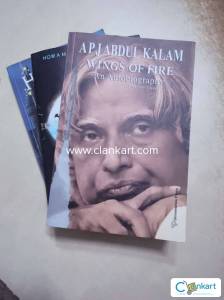
WINGS OF FIRE - An Autobiography APJ Abdul Kalam
Avul Pakir Jainulabdeen Abdul Kalam, the son of a little-educated boat-owner in Rameswaram, Tamil Nadu, had an unparalleled career as a defence scientist, culminating in the highest civilian award of India, the Bharat Ratna. As chief of the country's defence research and development programme, Kalam demonstrated the great potential for dynamism and innovation that existed in seemingly moribund research establishments. This is the story of Kalam's rise from obscurity and his personal and professional struggles, as well as the story of Agni, Prithvi, Akash, Trishul and Nag-missiles that have become household names in India and that have raised the nation to the level of a missile power of international reckoning. This is also the saga of independent India's struggle for technological self-sufficiency and defensive autonomy-a story as much about politics, domestic and international, as it is about science.
Savarkar Part:2 by Vikram Sampat
Was Savarkar really a co-conspirator in the Gandhi murder?Was there a pogrom against a particular community after Gandhi's assassination?Decades after his death, Vinayak Damodar Savarkar continues to uniquely influence India's political scenario. An optimistic advocate of Hindu-Muslim unity in his treatise on the 1857 War of Independence, what was it that transformed him into a proponent of 'Hindutva'? A former president of the All-India Hindu Mahasabha, Savarkar was a severe critic of the Congress's appeasement politics. After Gandhi's murder, Savarkar was charged as a co-conspirator in the assassination. While he was acquitted by the court, Savarkar is still alleged to have played a role in Gandhi's assassination, a topic that is often discussed and debated.In this concluding volume of the Savarkar series, exploring a vast range of original archival documents from across India and outside it, in English and several Indian languages, historian Vikram Sampath brings to light the life and works of Vinayak Damodar Savarkar, one of the most contentious political thinkers and leaders of the twentieth century.
Botany Med Easy
Events in West Asia constantly demand global attention due to regional conflicts, faith-based divisions, sectarian violence and wars that are often ignited by external powers. Popular agitations for political, economic and social reform frequently make the scenario even more fragile, turbulent and uncertain. West Asia is a destination for millions of pilgrims to sacred sites venerated by the three Abrahamic faiths - Islam, Christianity and Judaism. It is also at the heart of global energy, trade and financial dynamics, the centre of logistical connectivity projects, and an emerging hub of technological research and development. As a new world order asserts its claims across Eurasia and the Indian Ocean, West Asia is witnessing new diplomatic initiatives to reshape regional alignments and define the new order. Developments here are of abiding concern for India - it is closely tied to the region in terms of energy, trade, investment, logistical connectivity and the interests of its eight-million strong resident community. West Asia at War, written by veteran Indian diplomat Talmiz Ahmad, combines an understanding of the diverse forces that are shaping the politics and economics of this region, and paints a portrait that is at once grim, painful, colourful and exciting.
Political Theory by Hovyeda Abbas &Ranajay Kumar
Political Theory is about the description, observation, analysis and inquiry into the issues of political science. Divided into 15 chapters, the book captures all relevant aspects of political science and analyses them in the light of examples from India and the rest of the world. Through a thorough examination of various political institutions, the role of different social groups and the evolution of our politics, this book will help students understand the basic concepts and notions of political theory, and illustrate how these concepts apply to political systems across the world.
Self help book
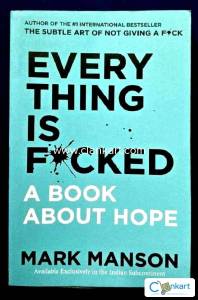
From the author of the international mega-bestseller The Subtle Art of Not Giving A F*ck comes a counterintuitive guide to the problems of hope. We live in an interesting time. Materially, everything is the best it’s ever been—we are freer, healthier and wealthier than any people in human history. Yet, somehow everything seems to be irreparably and horribly f*cked—the planet is warming, governments are failing, economies are collapsing, and everyone is perpetually offended on Twitter. At this moment in history, when we have access to technology, education and communication our ancestors couldn’t even dream of, so many of us come back to an overriding feeling of hopelessness.What’s going on? If anyone can put a name to our current malaise and help fix it, it’s Mark Manson. In 2016, Manson published The Subtle Art of Not Giving A F*ck, a book that brilliantly gave shape to the ever-present, low-level hum of anxiety that permeates modern living. He showed us that technology had made it too easy to care about the wrong things, that our culture had convinced us that the world owed us something when it didn’t—and worst of all, that our modern and maddening urge to always find happiness only served to make us unhappier. Instead, the “subtle art” of that title turned out to be a bold challenge: to choose your struggle; to narrow and focus and find the pain you want to sustain. The result was a book that became an international phenomenon, selling millions of copies worldwide while becoming the #1 bestseller in 13 different countries.Now, in Everthing Is F*cked, Manson turns his gaze from the inevitable flaws within each individual self to the endless calamities taking place in the world around us. Drawing from the pool of psychological research on these topics, as well as the timeless wisdom of philosophers such as Plato, Nietzsche, and Tom Waits, he dissects religion and politics and the uncomfortable ways they have come to resemble one another. He looks at our relationships with money, entertainment and the internet, a
THE 3 MISTAKES OF MY LIFE- CHETAN BHAGAT
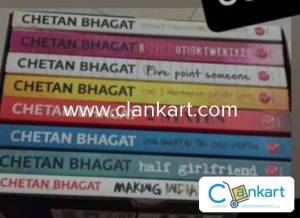
In late-2000, a young boy in Ahmedabad called Govind dreamt of having a business. To accomodate his friends Ish and Omi's passion, they open a cricket shop. Govind's wants to make money and thinks big. Ish is all about nurturing Ali, the batsman with a rare gift. Omi knows his limited capabiltiies and just wants to be with his friends. However, nothing comes easy in a turbulent city. To realize their goals, they will have to face it all - religious politics, earthquakes, riots, unacceptable love and above all, their own mistakes. Will they make it? Can an individual's dreams overcome the nightmares offered by real life? Can we succeed despite a few mistakes?
NCERT Book for class 8
The Constitution Of India Came Into Force On 26Th January, 1950 And Since Then Indigenous Ideas Have Been Introduced, New Experiments Have Been Conducted And New Thrust Areas Have Been Identified In Different Aspects Of Education In India To Keep Pace With The Developments In Society, Politics, Economics, Emotions And Sentiments At The National And International Levels. A Vast And Fast Developing Country Like India Is Bound To Encounter New And Recurring Problems Of Educational Expansion, Total Quality Management, Planning, Administration, Supervision, Curriculum, Evaluation, Teacher Education, Special Education, Integrated Education, Leadership, Ecology And Guidance Services In Schools.This Book Is An Humble Attempt To Understand Some Of The Afore-Said Problems Of Education In Their Right Perspectives And To Find Out Solutions In The Light Of Recommendations Of Various Committees And Commissions, Policies, Reports And Publications Of Mhrd, Ncert, Niepa, Ncte, Other Institutes, Frontline Educationists And Authors Of Eminence.The Distinguishing Features Of The Book Are Lucidity And Simplicity Of Language, Uniformity And Precision In Organisation Of Facts And Figures With Scope For Reading Between Lines And Beyond Suitable For Students Of Teacher Education Institutions And University Departments Of Education.
The Art of War
Conflict is an inevitable part of life, according to this ancient Chinese classic of strategy, but everything necessary to deal with conflict wisely, honorably, victoriously, is already present within us. Compiled more than two thousand years ago by a mysterious warrior-philosopher, The Art of War is still perhaps the most prestigious and influential book of strategy in the world, as eagerly studied in Asia by modern politicians and executives as it has been by military leaders since ancient times. As a study of the anatomy of organizations in conflict, The Art of War applies to competition and conflict in general, on every level from the interpersonal to the international. Its aim is invincibility, victory without battle, and unassailable strength through understanding the physics, politics, and psychology of conflict.(Original publish date was circa 500 BCE.)
An introduction to the political theory
Examines a fairly wide range of issues concerning the ever-expanding field of political theory, in a multidisciplinary (historical-sociological-economic-philosophical-juristic) perspective. It elaborates the nature and significance of political theory, concept of ideology with a concise and critical discussion of major political ideologies, nature of politics and various approaches to its study including empirical, normative, behavioural, post-behavioural as well as interdisciplinary approach. It elucidates the concepts of the state and sovereignty with reference to the challenges of imperialism, colonialism, neo-colonialism, impact of globalization, grounds and limits of political obligation, various dimensions of law (including rule of law), power (along with authority and legitimacy) citizenship (including democratic citizenship), human rights, liberty (including freedom as emancipation), equality (including equality of opportunity), justice (including social justice) and the common good. Then it dwells on various models and theories of democracy (including participatory and deliberative democracy), indicating the significance of multiculturalism. Finally it gives a critical account of the theories of social change and development with special reference to the problems of underdevelopment, sustainable development and political development
Turning Points & Why I Assassinated Gandhi? ( Combo Set )
Book contains the original statement given by Nathuram Godse (Assassin of Mahatma Gandhi).Writer is real brother of Nathuram Godse himself and narrates his accounts of all the events and takes us through the day of assassination till the day Nathuram Godse was hanged.Writer also puts forward crucial accounts of public and political opinions and reactions which were stirred up by assassination itself and also by Nathuram Godse's official statement to court.
The Communist Manifesto by Friedrich Engels and Karl Marx
A rousing call to arms whose influence is still felt todayOriginally published on the eve of the 1848 European revolutions, The Communist Manifesto is a condensed and incisive account of the worldview Marx and Engels developed during their hectic intellectual and political collaboration. Formulating the principles of dialectical materialism, they believed that labor creates wealth, hence capitalism is exploitive and antithetical to freedom.This new edition includes an extensive introduction by Gareth Stedman Jones, Britain's leading expert on Marx and Marxism, providing a complete course for students of The Communist Manifesto, and demonstrating not only the historical importance of the text, but also its place in the world today.For more than seventy years, Penguin has been the leading publisher of classic literature in the English-speaking world. With more than 1,700 titles, Penguin Classics represents a global bookshelf of the best works throughout history and across genres and disciplines. Readers trust the series to provide authoritative texts enhanced by introductions and notes by distinguished scholars and contemporary authors, as well as up-to-date translations by award-winning translators.
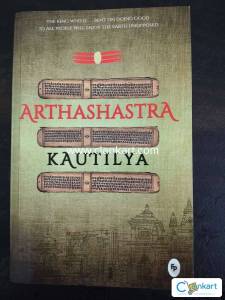
Kautilya Arthashastra
The Arthashastra is an ancient Indian treatise on statecraft, economic policy and military strategy, written in Sanskrit. It identifies its author by the names 'Kauṭilya' and 'Vishnugupta', both names that are traditionally identified with Chanakya (c. 350–283 BC), who was a scholar at Takshashila and the teacher and guardian of Emperor Chandragupta Maurya, founder of the Mauryan Empire. The text was influential until the 12th century, when it disappeared. It was rediscovered in 1904 by R. Shamasastry, who published it in 1909. The first English translation was published in 1915.Roger Boesche describes the Arthaśāstra as "a book of political realism, a book analysing how the political world does work and not very often stating how it ought to work, a book that frequently discloses to a king what calculating and sometimes brutal measures he must carry out to preserve the state and the common good."Centrally, Arthaśāstra argues how in an autocracy an efficient and solid economy can be managed. It discusses the ethics of economics and the duties and obligations of a king. The scope of Arthaśāstra is, however, far wider than statecraft, and it offers an outline of the entire legal and bureaucratic framework for administering a kingdom, with a wealth of descriptive cultural detail on topics such as mineralogy, mining and metals, agriculture, animal husbandry, medicine and the use of wildlife. The Arthaśāstra also focuses on issues of welfare (for instance, redistribution of wealth during a famine) and the collective ethics that hold a society together.