Buy used Politics Books online in India
Buy Second Hand Books, Used Books Online In India
Rage in Kashmir
Since the economic liberalization of the early 1990s, India has been, on several occasions and at different forums, feted as a great power. This subject has been discussed in numerous books, but mostly in terms of rapid economic growth and immense potential in the emerging market. There is also a vast collection of literature on India's 'soft power '- culture, tourism, frugal engineering, and knowledge economy. However, there has been no serious exploration of the alternative path India can take to achieving great power status - a combination of hard power, geostrategics, and realpolitik. In this book, Bharat Karnad delves exclusively into these hard power aspects of India's rise and the problems associated with them. He offers an incisive analysis of the deficits in the country's military capabilities and in the 'software' related to hard power--absence of political vision and will, insensitivity to strategic geography, and unimaginative foreign and military policies--and arrives at powerful arguments on why these shortfalls have prevented the country from achieving the great power status.
OBAMA'S WARS ( Inside Story)
In Obama’s Wars, Bob Woodward provides the most intimate and sweeping portrait yet of the young president as commander in chief. Drawing on internal memos, classified documents, meeting notes and hundreds of hours of interviews with most of the key players, including the president, Woodward tells the inside story of Obama making the critical decisions on the Afghanistan War, the secret campaign in Pakistan and the worldwide fight against terrorism. At the core of Obama’s Wars is the unsettled division between the civilian leadership in the White House and the United States military as the president is thwarted in his efforts to craft an exit plan for the Afghanistan War. “So what’s my option?” the president asked his war cabinet, seeking alternatives to the Afghanistan commander’s request for 40,000 more troops in late 2009. “You have essentially given me one option. ...It’s unacceptable.” “Well,” Secretary of Defense Robert Gates finally said, “Mr. President, I think we owe you that option.” It never came. An untamed Vice President Joe Biden pushes relentlessly to limit the military mission and avoid another Vietnam. The vice president frantically sent half a dozen handwritten memos by secure fax to Obama on the eve of the final troop decision. President Obama’s ordering a surge of 30,000 troops and pledging to start withdrawing U.S. forces by July 2011 did not end the skirmishing. General David Petraeus, the new Afghanistan commander, thinks time can be added to the clock if he shows progress. “I don’t think you win this war,” Petraeus said privately. “This is the kind of fight we’re in for the rest of our lives and probably our kids’ lives.” Hovering over this debate is the possibility of another terrorist attack in the United States. The White House led a secret exercise showing how unprepared the government is if terrorists set off a nuclear bomb in an American city—which Obama told Woodward is at the top of the list of what he worries about all the time. Verbatim quotes from sec
The India Way
The decade from the 2008 global financial crisis to the 2020 coronavirus pandemic has seen a real transformation of the world order. The very nature of international relations and its rules are changing before our eyes.For India, this means optimal relationships with all the major powers to best advance its goals. It also requires a bolder and non-reciprocal approach to its neighbourhood. A global footprint is now in the making that leverages India’s greater capability and relevance, as well as its unique diaspora. This era of global upheaval entails greater expectations from India, putting it on the path to becoming a leading power.In The India Way, S. Jaishankar, India’s Minister of External Affairs, analyses these challenges and spells out possible policy responses. He places this thinking in the context of history and tradition, appropriate for a civilizational power that seeks to reclaim its place on the world stage.
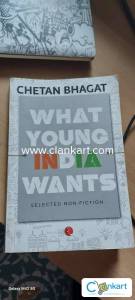
What young India wants
In his latest book, What Young India Wants, Chetan Bhagat asks hard questions, demands answers and presents solutions for a better, more prosperous India.Why do our students regularly commit suicide?Why is there so much corruption in India?Cant our political parties ever work together?Does our vote make any difference at all?We love our India, but shouldnt some things be different?All of us have asked these questions at some time or the other. So does Chetan Bhagat, Indias most loved writer, in What Young India Wants, his first book of non-fiction.What Young India Wants is based on Chetan Bhagats vast experience as a very successful writer and motivational speaker. In clear, simple prose, and with great insight, he analyses some of the complex issues facing modern India, offers solutions and invites discussion on them. And, at the end, he asks this important question: Unless we are all in agreement on what it is going to take to make our country better, how will things ever change? Non-fiction If you want to understand contemporary India, the problems that face it, and want to be a part of the solution, What Young India Wants is the book for you.
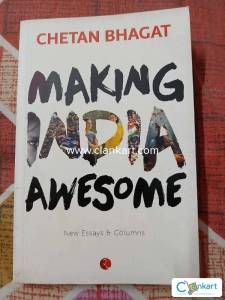
Making India Awesome
This book is dedicated to the youth of this country to broaden their political views, making them aware of the problems currently residing in our country and of the possible solutions. It's really a good read if you are tired of romcoms and thrillers.The book is in good condition.Buying price-176. Selling price-100
PUBLIC POLICY AND POLITICS IN INDIA
Policymaking in India evokes an image of rational decision-making and technical optimality. However, the arena of policymaking is characterized by conflict and contestation resolved through processes of negotiations and compromises. A significant amount of research in India focuses on policy goals and consequences, and less on policy processes. Breaking away from that approach, Public Policy and Politics in India directly addresses policy processes and discusses the role of institutions in policymaking in India. The wide-ranging essays cover issues such as environment, education, Parliament, liberalization, and governance. They highlight failures of implementation resulting from deep-rooted flaws in overall policy design. The volume aims not only to provoke a debate but also to encourage more systematic studies in the area.