Buy used Politics Books online in India
Buy Second Hand Books, Used Books Online In India
The battle for Sanskrit
There is a new awakening in India that is challenging the ongoing westernization of the discourse about India. The Battle for Sanskrit seeks to alert traditional scholars of Sanskrit and sanskriti - Indian civilization - concerning an important school of thought that has its base in the US and that has started to dominate the discourse on the cultural, social and political aspects of India. This academic field is called Indology or Sanskrit studies. From their analysis of Sanskrit texts, the scholars of this field are intervening in modern Indian society with the explicitly stated purpose of removing 'poisons' allegedly built into these texts. They hold that many Sanskrit texts are socially oppressive and serve as political weapons in the hands of the ruling elite; that the sacred aspects need to be refuted; and that Sanskrit has long been dead. The traditional Indian experts would outright reject or at least question these positions. The start of Rajiv Malhotra's feisty exploration of where the new thrust in Western Indology goes wrong, and his defence of what he considers the traditional, Indian approach, began with a project related to the Sringeri Sharada Peetham in Karnataka, one of the most sacred institutions for Hindus. There was, as he saw it, a serious risk of distortion of the teachings of the peetham, and of sanatana dharma more broadly. Whichever side of the fence one may be on, The Battle for Sanskrit offers a spirited debate marshalling new insights and research. It is a valuable addition to an important subject, and in a larger context, on two ways of looking. Is each view exclusive of the other, or can there be a bridge between them? Readers can judge for themselves.
Hinterland by Chris Mullin
All serious politicians are supposed to possess a hinterland, but not all do. Chris Mullin was one who did. By the time he entered parliament he had reported from the wars in Vietnam, Laos and Cambodia and tracked down the survivors of the CIA operation in Tibet. He was the author of three novels, including the classic A Very British Coup. His successful campaign to free the innocent people convicted of the Birmingham bombings was described as 'one of the greatest feats ever achieved by an investigative reporter'. Elected to parliament, aged 39, he quickly established himself as a fearless inquisitor before going on to become a minister in three departments. His three volumes of diaries have been widely acclaimed as the best account of the Blair years and the rise and fall New Labour. He left parliament in 2010 ('better to go while people are still asking why rather than when'). These are his memoirs.
Chetan Bhagat : What young india wants ( selected non-fiction)
In his latest book, What Young India Wants, Chetan Bhagat asks hard questions, demands answers and presents solutions for a better, more prosperous India.Why do our students regularly commit suicide?Why is there so much corruption in India?Cant our political parties ever work together?Does our vote make any difference at all?We love our India, but shouldnt some things be different?All of us have asked these questions at some time or the other. So does Chetan Bhagat, Indias most loved writer, in What Young India Wants, his first book of non-fiction.What Young India Wants is based on Chetan Bhagats vast experience as a very successful writer and motivational speaker. In clear, simple prose, and with great insight, he analyses some of the complex issues facing modern India, offers solutions and invites discussion on them. And, at the end, he asks this important question: Unless we are all in agreement on what it is going to take to make our country better, how will things ever change? Non-fiction If you want to understand contemporary India, the problems that face it, and want to be a part of the solution, What Young India Wants is the book for you.
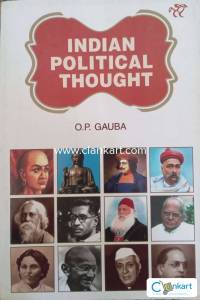
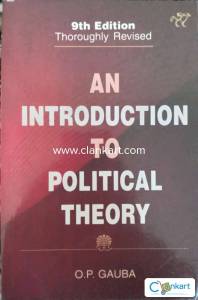
Including modern political analysis (Modern and Marxist concept)
Comprehensively written, this book presents the political theories, concepts, analysis, thoughts and main currents. The book begins with introduction to political theory, its history, evolution & approaches while also discussing forms & organs of Government. It progresses to discuss contemporary political analysis in light of American concepts and main currents of Political Thought in detail. This book would be extremely useful for the students pursuing BA Political Science.
For political science students
From Hindu notions of dirt, South Asia's preference for women leaders to patronage in democratic politics, Dipankar Gupta resolves many of the paradoxes of contemporary India in this book. In the process, he issues a damning indictment of the "westoxicated" elitist Indian middle class, and shows how unmodern the people of this class are in the very areas in which they are considered to be modern. A brilliant and chilling treatise on the hypocrisy and vanity of the Indian middle class, and its pathetic attempts to cloak its traditional ways in superficial modernity.
The Namo Story
One of the truly enigmatic personalities on the contemporary Indian political canvas, Narendra Damodardas Modi is difficult to ignore. From his humble beginnings as a RSS pracharak to his rise in the Hindutva ranks, and from being Bharatiya Janata Partys master planner to one of the its most popular and controversial state chief ministers, Modis mantra of change and development is gradually finding many takers. Though he evokes vastly different reactions among the citizens for his alleged role during the Godhra aftermath, what is absolutely clear is that he indeed is racing towards the centre stage, making the 2014 General Elections look more like a Presidential system where, you either vote for him or against him. And that, as they say, is the Modi effect. Kingshuk Nag paints the most vivid portrait of the extraordinary politician who is poised to take on a new role in the coming years.
PSIR PAPER 1A
Examines a fairly wide range of issues concerning the ever-expanding field of political theory, in a multidisciplinary (historical-sociological-economic-philosophical-juristic) perspective. It elaborates the nature and significance of political theory, concept of ideology with a concise and critical discussion of major political ideologies, nature of politics and various approaches to its study including empirical, normative, behavioural, post-behavioural as well as interdisciplinary approach. It elucidates the concepts of the state and sovereignty with reference to the challenges of imperialism, colonialism, neo-colonialism, impact of globalization, grounds and limits of political obligation, various dimensions of law (including rule of law), power (along with authority and legitimacy) citizenship (including democratic citizenship), human rights, liberty (including freedom as emancipation), equality (including equality of opportunity), justice (including social justice) and the common good. Then it dwells on various models and theories of democracy (including participatory and deliberative democracy), indicating the significance of multiculturalism. Finally it gives a critical account of the theories of social change and development with special reference to the problems of underdevelopment, sustainable development and political development
The Democracy Project
A bold rethinking of the most powerful political idea in the world—democracy—as seen through the lens of the most transformative political movements of our time and the story of how radical democracy can yet transform America Democracy has been the American religion since before the Revolution—from New England town halls to the multicultural democracy of Atlantic pirate ships. But can our current political system, one that seems responsive only to the wealthiest among us and leaves most Americans feeling disengaged, voiceless, and disenfranchised, really be called democratic? And if the tools of our democracy are not working to solve the rising crises we face, how can we—average citizens—make change happen? David Graeber, one of the most influential scholars and activists of his generation, takes readers on a journey through the idea of democracy, provocatively reorienting our understanding of pivotal historical moments, and extracts their lessons for today—from the birth of Athenian democracy and the founding of the United States of America to the global revolutions of the twentieth century and the rise of a new generation of activists. Underlying it all is a bracing argument that in the face of increasingly concentrated wealth and power in this country, a reenergized, reconceived democracy—one based on consensus, equality, and broad participation—can yet provide us with the just, free, and fair society we want. The Democracy Project tells the story of the resilience of the democratic spirit and the adaptability of the democratic idea. It offers a fresh take on vital history and an impassioned argument that radical democracy is, more than ever, our best hope.
Bharat ka savidhan
A book for everybody in India and abroad who wants to know anything about the Constitution of India during its first fifty years. Meets the requirements of the various universities of India for the LL.B., LL.M., B.A. and M.A.(Political Science) and Competitive examinations held by the Union and State Public Service Commissions. Also indispensable for politicians, journalists, statesman and administrative authorities. Prescribed in several Universities even for undergraduate courses in Civics. Incorporates all amendments to the Constitution upto 83rd Constitutional Amendment Act 2000. Elaborate comments on separatism in Punjab, Assam and elsewhere.
#Modi Again
Aabhas, a self-professed Marxist voted against BJP and Narendra Modi in 2014. This is the story of his journey of transformation from a Modi hater to a Modi supporter.In his own words—”I had both heart at twenty and now have brain while I kiss thirty. This is a true story of journey from being a ‘Marxist’ to an alleged ‘Modi Bhakt.’ I once saw Arvind Kejriwal as the saviour of the realm and Modi as a mass-murderer.”A study tour to Ajanta Caves began to shape a new Aabhas. He questioned the indoctrination into Communist ideology he got in college. “India leaped to become the third-fastest growing economy and its respect in the world reflects on the leadership of Modi. This is a New India, making alliances and friends, and willing to hit its enemies hard.”
Pranab mukherjee : The dramatic decade
The Dramatic Decade focuses on one of the most fascinating periods in the life of this nation—the decade of the 1970s. This was when India found herself engaging with the true meaning of democracy. The nation displayed her commitment to liberty by extending full support to East Pakistan’s struggle for independence. Later, between 1975 and 1977, during the Emergency, she found herself grappling with the limits of personal expression. Finally, in 1977, India saw the emergence of the politics of coalition, with the Janata Party—an amalgam of Indian parties opposed to the Emergency, comprising the Congress (O), the Bharatiya Lok Dal, the Jana Sangh and the Socialists—coming to power. This was a turning point in the history of the Indian legislature.This was the decade when Pranab Mukherjee committed himself to the role of a political activist. As one of the keenest observers of and participants in this dramatic decade, Pranab Mukherjee’s insights are invaluable. Indeed, he nudges our impressions of the 1970s. For instance, recounting the urgent appeal for Indira Gandhi’s mid-term resignation, he asks:Which democracy in the world would permit a change of a popularly and freely elected government through means other than a popular election? Can parties beaten at the hustings replace a popularly elected government by sheer agitation? Was it not prudent for those who were determined to change the government to wait till the elections which were but round the corner? Does the rule of law mean that the remedies available to the common man are to be denied to someone holding an elected office? […] How could anybody replace her when the overwhelming majority of Congress MPs—with a two-thirds majority in the Lok Sabha—resolved that Indira Gandhi should continue as the party’s leader in Parliament and thereby as the Prime Minister of India?Drawing from personal diary extracts, conversations with key players of the 1970s, and vital secondary literature, Pranab Mukherjee presents an exceptional portrait of a complex nation.Unfli
This brave new world
"The US has the power to shape the geopolitical future of this century. We must stop obsessing about China alone and actively encourage India's enormous potential to balance China's power. India, China, and the US will be the twenty-first century's dynamic triumvirate. The axial shift of world power from the United States and Europe to China and India is unrelenting. By 2030, intelligence agencies estimate that Asia will surpass the combined power of North America and Europe in economic might, population size, and military spending. From a front row seat Anja Manuel argues and demonstrates that India has the assets and structure to grow democratically to full strength and balance the Chinese hegemony and aggression while it takes its proper place in leadership with India and the US. In This Brave New World, Manuel takes the reader along on her business trips as she meets leaders and counts the assets and deficiencies of the two giant countries. India has a youthful, English-speaking population and democratic traditions, but it is inefficient, misogynist, and often corrupt. China has an aging population, no tradition of citizen rule, an ideological central government, and is ruthlessly expansionist. India's democratic system slows it down; China's centralized authority races it erratically. Balancing these giants is the key to a prosperous and open global system and America's opportunity to maintain its world power. In the present and near future the US's aim should be to embrace the inevitable rise of India and China and with them continue to lead the global governance. We must stop our handwringing about China's rise and focus instead, warns Manuel, on forging harmonious relationships with both giants, to create this brave new world"--