Buy used Philosophy online in India
Buy Second Hand Books, Used Books Online In India
Shrimad Bhagwatam
Śrīmad-Bhāgavatam and commentary by Śrīla Viśvanātha Cakravarti Ṭhākura, volume 1, consisting of the first and second cantos of Śrīmad-Bhāgavatam or Bhāgavata-purāṇa.This is the first in the series of the 17th century commentary known as Śrīmad-Bhāgavata-Śārārthadarśinī-tika. The entire set of books translated by His Holiness Bhanu Swami.
India's Ancient Past RS Sharma
R.S. Sharma, one of the best-known historians of early India, provides a comprehensive yet accessible text on the ancient period of Indian history. Beginning with topics such as historiography and the importance of Ancient Indian history, he goes on to cover the geographical, econological and linguistic settings, before looking at specific cultures of neolithic, chalcolithic types, the Harappan civilization, the Vedic period, the rise of Jainism and Buddhism, Magadha and the beginning of territorial states, the age of the Mauryas, Satavahanas, Guptas, and Harshavardhana. While taking the reader on this journey through time, he highlights important phenomena such as the beginning of urbanization and monarchy in India, invasions, the Varna system, commerce and trade, developments in philosophy and cultural efflorescence. He ends this insightful volume with a comments on the transition from the Ancient to the Medieval.This book also addresses a number of issues which have become current in discussion on Ancient Inida today, such as the Identity of the Aryan Culture, and Historical Construction. This is a volume meant for all those who want a masterly, lucid, yet eminently readable introduction to and overview on India's early history by one of the master-scholars of Indian history - be it students, tourists, or the interested lay reader
The alchemist
Like the one-time bestseller Jonathan Livingston Seagull, The Alchemist presents a simple fable, based on simple truths and places it in a highly unique situation. And though we may sniff a bestselling formula, it is certainly not a new one: even the ancient tribal storytellers knew that this is the most successful method of entertaining an audience while slipping in a lesson or two. Brazilian storyteller Paulo Coehlo introduces Santiago, an Andalusian shepherd boy who one night dreams of a distant treasure in the Egyptian pyramids. And so he's off: leaving Spain to literally follow his dream. Along the way he meets many spiritual messengers, who come in unassuming forms such as a camel driver and a well-read Englishman. In one of the Englishman's books, Santiago first learns about the alchemists--men who believed that if a metal were heated for many years, it would free itself of all its individual properties, and what was left would be the "Soul of the World." Of course he does eventually meet an alchemist, and the ensuing student-teacher relationship clarifies much of the boy's misguided agenda, while also emboldening him to stay true to his dreams. "My heart is afraid that it will have to suffer," the boy confides to the alchemist one night as they look up at a moonless night. "Tell your heart that the fear of suffering is worse than the suffering itself," the alchemist replies. "And that no heart has ever suffered when it goes in search of its dreams, because every second of the search is a second's encounter with God and with eternity." --Gail Hudson
The Secret
Το μυστικό κληροδοτήθηκε μέσα από τους αιώνες, και ήταν πολλοί εκείνοι που το πόθησαν, το επιβουλεύτηκαν, το έκλεψαν και το αγόρασαν με αντίτιμο τεράστια χρηματικά ποσά. Αυτό το προαιώνιο Μυστικό ήταν προσβάσιμο σε κάποιους ανθρώπους ―εφευρέτες, επιστήμονες, θεολόγους, επιχειρηματίες, στοχαστές, καλλιτέχνες― κι ανάμεσα σε αυτούς που κατανόησαν τη θαυματουργή δύναμή του συγκαταλέγονται ιστορικές προσωπικότητες όπως ο Πλάτωνας, ο Γαλιλαίος, ο Μπετόβεν, ο Έντισον, ο Κάρνεγκι, ο Αϊνστάιν, ο Μπλέικ. Τώρα το Μυστικό αποκαλύπτεται σε όλο τον κόσμο.
Mahabharatha
A long time ago two families were to inherit a vast kingdom known as the Kuru Empire The five sons of Pandu called the Pandavas were brave warriors each of them born with divine blood running through their veins They were virtuous examples of humanity at its peak They were endowed with wisdom patience strength knowledge and compassion Their cousins the hundred sons of Dhritarashtra were called the Kauravas The Kauravas were greedy always hankering after more wealth Since neither Pandu nor Dhritarashtra were suited to reign over the kingdom the throne had to be equally divided between these two families However the Kauravas cheated the Pandavas out of their share and drove them into a long exile They constantly try to kill them throughout their exile but the Pandavas persist At long last they return to claim their rightful inheritance but the Kauravas are not ready to part with even a portion of the kingdom With the stage set the Pandavas and the Kauravas meet in an epic battle on a fie
MAPS OF MEANING
Why have people from different cultures and eras formulated myths and stories with similar structures? What does this similarity tell us about the mind, morality, and structure of the world itself? Jordan Peterson offers a provocative new hypothesis that explores the connection between what modern neuropsychology tells us about the brain and what rituals, myths, and religious stories have long narrated. A cutting-edge work that brings together neuropsychology, cognitive science, and Freudian and Jungian approaches to mythology and narrative, Maps of Meaning presents a rich theory that makes the wisdom and meaning of myth accessible to the critical modern mind.
Na athma katha
The published writing and speeches of Swami Vivekananda cover more than four thousand pages. Many do not have an access to all his writings and many others have not the time or patience to go through them all. Though it is a difficult task to produce a representative selection out of the Swami's varied writings and speeches, this volume is placed before the public with the hope that this will inspire the readers to study Swamiji more thoroughly.
Srimad Bhagavatam
About the book:This is a summarized version of Mahapurana Srimad Bhagvatam. Though condensed the book carries all the important aspects. The author has done away with the ornamentation and decorations and has kept the hard core of the Mahapurana. She has brought out the essentials of Srimad Bhagavatam in a simple and appealing language. This book is a confluence of Bhakti yoga, karma yoga and Jnana yoga. More details: Bhagavatam is the essence of all Vedic wisdom. This book-Bhagavat Purana is made up of ten sections. Various stories of Purana are told in this book. Krishna s story with the Mahabharat story in it is told in more detail than the others. The story of Pururavas and the celestial maid Urvashi, the story of King Trishanku who wanted to enter heaven with his earthly body, Yayati and Devyani s story, Dushyanta Shakuntala, and many others are told here.
Mahabharatha K.S
Long ago, the Earth witnessed a catastrophic battle. It was a time when the Gods walked the world and mankind knew secrets they have long since forgotten. In such a time, there were two half-brothers named Pandu and Dhritarashtra. They were the heirs of the Kuru dynasty, the mighty kingdom fathered by the legendary Bharata, son of Shakuntala and Dushyanta. However, neither were fit to rule. Dhritarashtra was born blind, and Pandu had an illness which doomed him to die were he to ever engage in sexual intercourse. Dhritarashtra marries Gandhari, who bears him one hundred sons, the hundred Kauravas. Pandu marries Kunti, the adopted daughter of King Kuntibhoja, and Madri. Kunti s miraculous ability to summon Gods to grant her children yields Pandu five heirs, the Pandavas. Although the vast empire of Bharata had to be equally divided between the cousins, the Kauravas greed knew no end. Soon, this very greed engulfs both families in a battle that immortalized their names in legends and songs. Attributed to the Sage Veda Vyasa, the Mahabharata is one of the two great Epics of India, and this English translation retells the story for a new generation.
Ramayana K.S
The two epics, the Ramayana and the Mahabharat are two encyclopaedias of ancient Aryan life and wisdom, portraying an ideal civilization. The Ramayan is a perennial source of spiritual, cultural and artistic inspiration to all readers. Rama is the ideal son, the ideal ruler, the ideal husband and the ideal son. Sita is unique, the embodiment of the ideals of womanhood. More details: Bala Kanda, Ayodhya Kanda, Aranya Kanda, Kishkinda Kanda, Sundara Kanda, Yuddha Kanda, form the different sections of this great love story. Beginning with Valmiki and Narada, Bala Kanda deals with Dasaratha and the birth of Rama, Vishvamitra taking the lads to the forest and ends with Sita kalyanam. The second part deals with Rama's banishment and Bharata's appeal. The third talks of Panchavati, Dandaka forest, Shurpanakha, Shabari and Sita being taken to Ravana s Lanka. Kishkinda Kanda deals with Rama's search for Sita while Sundara Kanda talks of Hanuman entering Lanka. Yudha Kanda talks of the war between humans, monkeys and the rakshasas, ending with the coronation of Rama.
Hero The Secret Telugu Edition
From Rhonda Byrne, creator of the international bestselling movie and book, The Secret, comes Hero, her latest world-changing project and the most important to date.FROM ZERO TO HERO... YOUR SECRET MAP TO A RICH LIFEWhat is your true calling and why aren't you already living it?Imagine if there was a map that showed you step by step how to get from where you are now to your true calling and the life you were born to live—the most brilliant, rich, fulfilling, and dazzling life you could ever dream of. You are holding in your hands such a map. Hero is the map for your life.By following the journeys of twelve of the most successful people on the planet today, you’ll learn how to use your inner powers to overcome obstacles and to make impossible dreams come true. You'll be inspired to find your own calling and start taking the steps toward making the life of your dreams an everyday reality.Be the hero you are meant to be.
Ego is the enemy
As in The Obstacle is the Way, Ryan Holiday delivers practical and inspiring philosophy, this time exploring a powerful concept that runs back centuries, across borders and schools of thought: ego.Ego is our biggest enemy. Early in our careers, it can prevent us from learning and developing our talents. When we taste success, ego can blind us to our own faults, alienate us from others and lead to our downfall. In failure, ego is devastating and makes recovery all the more difficult. It is only by identifying our ego, speaking to its desires, and systematically disarming it that we can create our best work.Organised into bite-sized observations featuring characters and narratives that illustrate themes and life lessons designed to resonate, uplift and inspire, Ego is the Enemy shows how you can be humble in your aspirations, gracious in your success and resilient in your failures. It is an inspiring and timely reminder that humility and confidence are still our greatest friends when confronting the challenges of a culture which tends to fan the flames of ego and encourage the cult of personality at all costs.
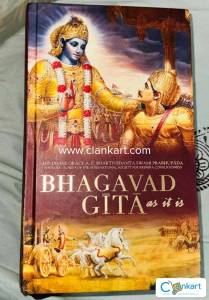
Yatharth bhagvat Geeta
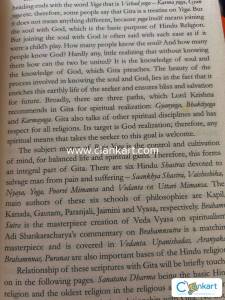
The **Bhagavad Gita**, often referred to as the **Gita**, is a 700-verse Hindu scripture that is part of the Indian epic **Mahabharata**, specifically in the **Bhishma Parva** (Book of Bhishma), chapters 2340. It is written in **Sanskrit** and is presented as a dialogue between **Prince Arjuna** and **Lord Krishna**, who serves as his charioteer.### Key Highlights of the Bhagavad Gita:1. **Context**: * Set on the battlefield of **Kurukshetra**, where two groups of royal cousins, the Pandavas and the Kauravas, are about to go to war. * Arjuna, a warrior prince, is morally troubled about fighting his own kin and teachers in battle.2. **Main Themes**: * **Dharma (duty/righteousness)**: Krishna urges Arjuna to perform his Kshatriya (warrior) duty without attachment. * **Yoga**: The Gita discusses different paths of yoga: * **Karma Yoga**: Path of selfless action. * **Bhakti Yoga**: Path of devotion to God. * **Jnana Yoga**: Path of knowledge and wisdom. * **Detachment**: Emphasis on acting without attachment to results. * **The Self**: Discussion of the eternal nature of the soul (Atman) and its difference from the body.3. **Philosophical Significance**: * The Gita combines elements of Vedanta, Sankhya, and Yoga philosophy. * It addresses the moral, ethical, and spiritual dilemmas faced by individuals.4. **Universal Appeal**: * Revered by Hindus and respected globally as a spiritual and philosophical classic. * Commentaries have been written by great thinkers like **Adi Shankaracharya**, **Madhvacharya**, **Swami Vivekananda**, and **Mahatma Gandhi**.
Choosing A Path by Swami Rama
The search for truth alone provides a ray of hope for the individual and for humanity as a whole. We have done so much research on matter, mind, and energy, yet we have not discovered the ways and methods of attaining happiness and loving others selflessly. This book gives a glimpse and creates a provocative atmosphere for the intelligent and learned so that they will begin studying their inclination to follow a particular path, and so that they don't waste time and energy in the prevailing confusion of our times, but choose a definite path for themselves. With these views in mind and to serve the needs of the aspirants and free thinkers, I present this book.-Swami RamaSWAMI RAMA, one of the greatest masters from the Himalayas, is the founder of the Himalayan Institute. Born in India, he studied in both India and Europe and received his spiritual training in the Himalayan cave monasteries and in Tibet. His best-known work, Living With the Himalayan Masters, reveals the many facets of this singular adept and demonstrates his embodiment of the living tradition of the East.
Letting Go: The pathway of surrender
The present work describes a simple and effective means by which to let go of the obstacles to Enlightenment and become free of negativity. During the many decades of the author's clinical psychiatric practice, the primary aim was to seek the most effective ways to relieve human suffering in all its many forms. The letting go technique (surrender) was found to be of great practical benefit and is described in this book.