Clankart Logo

Buy used Class 8 Books online in India

Buy Second Hand Books, Used Books Online In India
Advertisement
Want to see your books here? Have Used Books?
Make some extra cash by selling your old books for actual money in your UPI/Bank account. Go on, it's quick and easy.
Advertisement
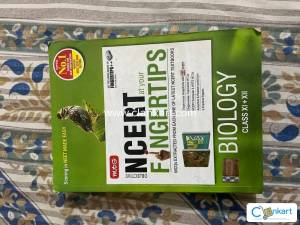
MTG NCERT FINGERTIPS Biology Unmarked

MTG NCERT FINGERTIPS Biology Unmarked

₹100

1. “NEET in 40 Day” is Best-Selling series for medical entrance preparations 2. This book deals with Biology subject 3. The whole syllabus is divided into day wise learning modules 4. Each day is assigned with 2 exercise; The Foundation Questions & Progressive Questions 5. 8 Unit Tests and 3 Full Length Mock Test papers for practice 6. NEET solved Papers are provided to understand the paper pattern 7. Free online Papers are given for practice 40 Days Biology for NEET serves as a Revision – cum crash course manual that is designed to provide focused and speedy revision. It has been conceived keeping in mind the latest trend of questions according to the level of different types of students. The whole syllabus of Biology has been divided into day wise learning module. Each day is assigned with two exercises – Foundation Question exercises – having topically arranged question exercise, and Progressive Question Exercise consists of higher difficult level question. Along with daily exercises, this book provides 8 Unit Test and 3 Full length Mock Tests for the complete practice. At the end of the book, NEET Solved Papers 2021 have been given for thorough practice. TOC Preparing NEET 2022 Biology in 40 Days! Day 1: The Living World, Day 2: Plant Kingdom, Day 3: Animal Kingdom, Day 4: Unit Test 1, Day 5: Morphology of Flowering Plants, Day 6: Anatomy of Flowering Plants, Day 7: Structural Organisation in Animals, Day 8: Unit Test 2 Day 9 Cell: The Unit of Life, Day 10: Biomolecules and Enzymes, Day 11: The Cell Division, Day 12: Unit Test 3, Day 13: Transport in Plants, Day 14: Mineral Nutrition, Day 15: Photosynthesis, Day 16: Respiration in Plants, Day 17: Plant Growth and Development, Day 18: Unit Test 4, Day 19: Digestion and Absorption, Day 20: Breathing and Exchange of Gases, Day 21: Body Fluids and Circulation, Day 22: Excretory Products and Their Elimination, Day 23: Movement and Locomotion, Day 24: Neural Control and Chemical Coordination, Day 25: Unit Test 5, Day 26: Reproduction in Plants, Day 27: Animal Repro

3 months ago
Advertisement
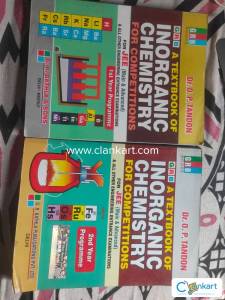
GRB In-organic chemistry by O.P. tandon for Jee

GRB In-organic chemistry by O.P. tandon for Jee

₹899

An advanced-level textbook of inorganic chemistry for the graduate (B.Sc) and postgraduate (M.Sc) students of Indian and foreign universities. This book is a part of four volume series, entitled "A Textbook of Inorganic Chemistry – Volume I, II, III, IV". CONTENTS: Chapter 1. Stereochemistry and Bonding in Main Group Compounds: VSEPR theory, dπ -pπ bonds, Bent rule and energetic of hybridization. Chapter 2. Metal-Ligand Equilibria in Solution: Stepwise and overall formation constants and their interactions, Trends in stepwise constants, Factors affecting stability of metal complexes with reference to the nature of metal ion and ligand, Chelate effect and its thermodynamic origin, Determination of binary formation constants by pH-metry and spectrophotometry. Chapter 3. Reaction Mechanism of Transition Metal Complexes – I: Inert and labile complexes, Mechanisms for ligand replacement reactions, Formation of complexes from aquo ions, Ligand displacement reactions in octahedral complexes- acid hydrolysis, Base hydrolysis, Racemization of tris chelate complexes, Electrophilic attack on ligands. Chapter 4. Reaction Mechanism of Transition Metal Complexes – II: Mechanism of ligand displacement reactions in square planar complexes, The trans effect, Theories of trans effect, Mechanism of electron transfer reactions – types; Outer sphere electron transfer mechanism and inner sphere electron transfer mechanism, Electron exchange. Chapter 5. Isopoly and Heteropoly Acids and Salts: Isopoly and Heteropoly acids and salts of Mo and W: structures of isopoly and heteropoly anions. Chapter 6. Crystal Structures: Structures of some binary and ternary compounds such as fluorite, antifluorite, rutile, antirutile, crystobalite, layer lattices- CdI2, BiI3; ReO3, Mn2O3, corundum, pervoskite, Ilmenite and Calcite. Chapter 7. Metal-Ligand Bonding: Limitation of crystal field theory, Molecular orbital theory, octahedral, tetrahedral or square planar complexes, π-bonding and molecular orbital theory. Chapter 8. Electronic Spectra of Transi

3 months ago
Advertisement
Advertisement