Buy used Business & Economics online in India
Buy Second Hand Books, Used Books Online In India
Rich dad poor dad
Book Summary of Rich Dad Poor Dad Table of Contents Iskit Bahut Jarurat Hain Rich Dad, Poor Dad Ameer Log Paise ke Liye Kaam Nahi Karte Paise ki Samajh Kyo Sikhai Jana Chahiye? Apne Kaam se Kaam Rakho Tax ke Itihas aur Corporations ki Takat Ameer Log Paise ke Avishkar Karte Hain Seekhane ke Liye Kaam Kare-Paise ke Liye Kaam Na Kare Badhao ko Paar Karna Shuru Karna Aur Jyada Chahiye? Kewal 7,000 Dollar mein hi Collge ki Shiksha
Indian Economy for Civil Services by Ramesh Singh
India’s struggle for Independence by Bipin Chandra is your go to book for an in-depth and detailed overview on Indian independence movement . Indian freedom struggle is one of the most important parts of its history. A lot has been written and said about it, but there still remains a gap. Rarely do we get to hear accounts of the independence from the entire country and not just one region at one place. This book fits in perfectly in this gap and also provides a narration on the impact this movement had on the people. Bipin Chandra’s book is a well-documented history of India's freedom struggle against the British rule. It is one of the most accurate books which have been painstakingly written after thorough research based on legal and valid verbal and written sources. It maps the first war of independence that started with Mangal Pandey’s mutiny and witnessed the gallant effort of Sri Rani Laxmi Bai. Many of the pages of this book are dedicated to Mahatma Gandhi’s non-cooperation and the civil disobedience movements. It contains detailed description of Subash Chandra Bose’s weapon heavy tactics and his charisma. This book includes all the independence movements and fights, irrespective of their size and impact, covering India in its entirety. Although these movements varied in means and ideas, but they shared a common goal of independence. This book contains oral and written narratives from different parts of the country, making this book historically rich and diverse. The book captures the evolution of Indian independence struggle in full detail and leaves no chapter of this story untouched. This book is a good read for the students of Indian modern history and especially for students who are preparing for UPSC examination and have taken History as their subject.
Getting Things Done
With first-chapter allusions to martial arts, "flow," "mind like water," and other concepts borrowed from the East (and usually mangled), you'd almost think this self-helper from David Allen should have been called Zen and the Art of Schedule Maintenance. Not quite. Yes, Getting Things Done offers a complete system for downloading all those free-floating gotta-do's clogging your brain into a sophisticated framework of files and action lists--all purportedly to free your mind to focus on whatever you're working on. However, it still operates from the decidedly Western notion that if we could just get really, really organized, we could turn ourselves into 24/7 productivity machines. (To wit, Allen, whom the New Economy bible Fast Company has dubbed "the personal productivity guru," suggests that instead of meditating on crouching tigers and hidden dragons while you wait for a plane, you should unsheathe that high-tech saber known as the cell phone and attack that list of calls you need to return.) As whole-life-organizing systems go, Allen's is pretty good, even fun and therapeutic. It starts with the exhortation to take every unaccounted-for scrap of paper in your workstation that you can't junk, The next step is to write down every unaccounted-for gotta-do cramming your head onto its own scrap of paper. Finally, throw the whole stew into a giant "in-basket" That's where the processing and prioritizing begin; in Allen's system, it get a little convoluted at times, rife as it is with fancy terms, subterms, and sub-subterms for even the simplest concepts. Thank goodness the spine of his system is captured on a straightforward, one-page flowchart that you can pin over your desk and repeatedly consult without having to refer back to the book. That alone is worth the purchase price. Also of value is Allen's ingenious Two-Minute Rule: if there's anything you absolutely must do that you can do right now in two minutes or less, then do it now, thus freeing up your time and mind tenfold over the long term. It's commonsens
Rich Dad Poor Dad
April 2017 marks 20 years since Robert Kiyosaki’s Rich Dad Poor Dad first made waves in the Personal Finance arena.It has since become the #1 Personal Finance book of all time... translated into dozens of languages and sold around the world.Rich Dad Poor Dad is Robert's story of growing up with two dads — his real father and the father of his best friend, his rich dad — and the ways in which both men shaped his thoughts about money and investing. The book explodes the myth that you need to earn a high income to be rich and explains the difference between working for money and having your money work for you.20 Years... 20/20 HindsightIn the 20th Anniversary Edition of this classic, Robert offers an update on what we’ve seen over the past 20 years related to money, investing, and the global economy. Sidebars throughout the book will take readers “fast forward” — from 1997 to today — as Robert assesses how the principles taught by his rich dad have stood the test of time.In many ways, the messages of Rich Dad Poor Dad, messages that were criticized and challenged two decades ago, are more meaningful, relevant and important today than they were 20 years ago.As always, readers can expect that Robert will be candid, insightful... and continue to rock more than a few boats in his retrospective.Will there be a few surprises? Count on it.Rich Dad Poor Dad...• Explodes the myth that you need to earn a high income to become rich• Challenges the belief that your house is an asset• Shows parents why they can't rely on the school system to teach their kids about money• Defines once and for all an asset and a liability• Teaches you what to teach your kids about money for their future financial success
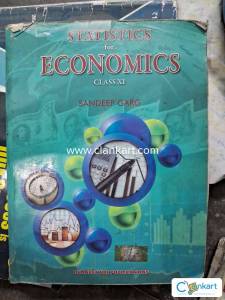
STATISTICS FOR ECONOMICS
The CBSE board has recently shown a bent towards analysis and interpretation based questions under the label of ‘competency- based questions’. This book is prepared according to revised syllabus and new paper pattern. ‘The Same but Different’: Revised and restructured on positive feedback, the Statistics for Economics Textbook is all geared up to provide its readers step by step comprehension of the subject matter. Novelties of the text include: 1. NEW TYPOLOGY OF QUESTIONS: (Image/Data interpretation, defend and refute type questions etc.) have been incorporated in each chapter. 2. ‘BRAIN TEASER’ BLOCKS: Implication based questions related to current happenings around have been incorporated in each chapter. These help gauge the inferences the students are able to draw from the text and how easily they are able to relate economic theory to the ground level realities. 3. OTHERS: HOTS & Focus Zones DAV Board Question Paper (Solved) Sample Paper By “VK Global Study Group”[A specimen paper woven along the same structure and blueprint as suggested in the CBSE released Sample Question Paper-2023.]
Principles of Microeconomics HL Ahuja 22th edition
The book makes a comprehensive and analytical study of theories of demand, production/cost and determination of price and output of products in different market structures. It also discusses theory of factor pricing and income distribution as wages, rent, interest and profits. Above all, it critically analyses the conditions of economic efficiency and maximum social welfare and causes of market failures. It takes a further lead with this revision by aligning its contents with the prescribed UGC model curriculum and new Choice Based Credit System (CBCS) syllabus.
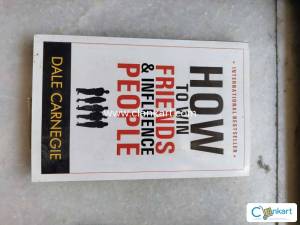
How to Develop Self Confidence and influence People By Public Speaking
Please Read Notes: Brand New, International Softcover Edition, Printed in black and white pages, minor self wear on the cover or pages, Sale restriction may be printed on the book, but Book name, contents, and author are exactly same as Hardcover Edition. Fast delivery through DHL/FedEx express.
Mindset novel
Now updated with new research — the book that has changed millions of lives.After decades of research, world-renowned Stanford University psychologist Carol S. Dweck, Ph.D., discovered a simple but groundbreaking idea: the power of mindset. In this brilliant book, she shows how success in school, work, sports, the arts, and almost every area of human endeavor can be dramatically influenced by how we think about our talents and abilities. People with a fixed mindset — those who believe that abilities are fixed — are less likely to flourish than those with a growth mindset — those who believe that abilities can be developed. Mindset reveals how great parents, teachers, managers, and athletes can put this idea to use to foster outstanding accomplishment.In this edition, Dweck offers new insights into her now famous and broadly embraced concept. She introduces a phenomenon she calls false growth mindset and guides people toward adopting a deeper, truer growth mindset. She also expands the mindset concept beyond the individual, applying it to the cultures of groups and organizations. With the right mindset, you can motivate those you lead, teach, and love — to transform their lives and your own.
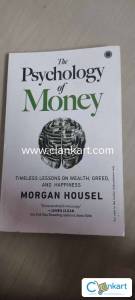
The psychology of money
Timeless lessons on wealth, greed, and happiness doing well with money isn’t necessarily about what you know. It’s about how you behave. And behavior is hard to teach, even to really smart people. How to manage money, invest it, and make business decisions are typically considered to involve a lot of mathematical calculations, where data and formulae tell us exactly what to do. But in the real world, people don’t make financial decisions on a spreadsheet. They make them at the dinner table, or in a meeting room, where personal history, your unique view of the world, ego, pride, marketing, and odd incentives are scrambled together. In the psychology of money, the author shares 19 short stories exploring the strange ways people think about money and teaches you how to make better sense of one of life’s most important matters.
Shoe Dog: A Memoir by the Creator of NIKE
In this candid and riveting memoir, for the first time ever, Nike founder and CEO Phil Knight shares the inside story of the company’s early days as an intrepid start-up and its evolution into one of the world’s most iconic, game-changing, and profitable brands.In 1962, fresh out of business school, Phil Knight borrowed $50 from his father and created a company with a simple mission: import high-quality, low-cost athletic shoes from Japan. Selling the shoes from the trunk of his lime green Plymouth Valiant, Knight grossed $8,000 his first year. Today, Nike’s annual sales top $30 billion. In an age of startups, Nike is the ne plus ultra of all startups, and the swoosh has become a revolutionary, globe-spanning icon, one of the most ubiquitous and recognizable symbols in the world today.But Knight, the man behind the swoosh, has always remained a mystery. Now, for the first time, in a memoir that is candid, humble, gutsy, and wry, he tells his story, beginning with his crossroads moment. At 24, after backpacking around the world, he decided to take the unconventional path, to start his own business—a business that would be dynamic, different.Knight details the many risks and daunting setbacks that stood between him and his dream—along with his early triumphs. Above all, he recalls the formative relationships with his first partners and employees, a ragtag group of misfits and seekers who became a tight-knit band of brothers. Together, harnessing the transcendent power of a shared mission, and a deep belief in the spirit of sport, they built a brand that changed everything.
Cost accounting (Mc Graw Hill)
1. FINANCIAL AND MANAGEMENT ACCOUNTING: AN OVERVIEW 2. ACCOUNTING POSTULATES, CONCEPTS AND PRINCIPLES 3. ACCOUNTING EQUATION AND TRANSACTION ANALYSIS 4. ACCOUNTING MECHANICS-I: JOURNALS 5. CASH BOOK AND SUBSIDIARY BOOKS 6. ACCOUNTING MECHANICS-II: LEDGER POSTING AND TRIAL BALANCE 7. BANK RECONCILIATION STATEMENT 8. ERRORS AND THEIR RECTIFICATION 9. PREPARATION OF FINANCIAL STATEMENTS: PROFIT AND LOSS ACCOUNT AND BALANCE SHEET 10. DEPRECIATION ACCOUNTING 11. INVENTORY VALUATION 12. STATEMENT OF CHANGES IN FINANCIAL POSITION (SCFP) 13. CASH FLOW STATEMENT 14. FINANCIAL STATEMENT ANALYSIS 15. NATURE OF COST ACCOUNTING 16. COST: CONCEPTS AND CLASSIFICATIONS 17. MATERIALS CONTROL 18. LABOUR COSTS ACCOUNTING AND CONTROL 19. OVERHEADS: DISTRIBUTION 20. JOB, CONTRACT AND BATCH COSTING 21. PROCESS COSTING 22. SERVICE COSTING 23. MARGINAL (VARIABLE) COSTING 24. ALTERNATIVE CHOICES DECISIONS 25. STANDARD COSTING 26. BUDGETING 27. RESPONSIBILITY ACCOUNTING, DIVISIONAL PERFORMANCE MEASUREMENT AND TRANSFER PRICING 28. ACTIVITY-BASED COSTING (ABC) APPENDIX - CASES.
the Millionaire FASTLANE: Book for SALE
Has the "settle-for-less" financial plan become your plan for wealth? That plan sounds a little something like this:"Graduate from college, get a good job, save 10% of your paycheck, buy a used car, cancel the movie channels, quit drinking expensive Starbucks mocha lattes, save and penny-pinch your life away, trust your life-savings to the stock market, and one day, when you are oh, say, 65 years old, you can retire rich."Since you were old enough to hold a job, you've been hoodwinked to believe that wealth can be created by blindly trusting in the uncontrollable and unpredictable markets: the housing market, the stock market, and the job market. I call this soul-sucking, dream-stealing dogma "The Slowlane" - an impotent FINANCIAL GAMBLE that dubiously promises wealth in a wheelchair.Accept the Slowlane as your financial roadmap and your financial future will blow carelessly asunder on a sailboat of HOPE: HOPE you can get a job and keep it, HOPE the stock market doesn't tank, HOPE the economy rebounds, HOPE, HOPE, and HOPE. Do you really want HOPE to be the centerpiece of your family's financial plan?Drive the Slowlane road and you will find your life deteriorate into a miserable exhibition about what you cannot do, versus what you can. For those who don't want a lifetime subscription to "settle-for-less", there is an alternative; an expressway to extraordinary wealth capable of burning a trail to financial independence faster than any road out there. And shockingly, this road has nothing to do with jobs, 401(k), mutual funds, or a lifestyle of mediocrity.Demand more. Change lanes and find your explosive wealth accelerator. Hit the Fastlane, crack the code to wealth, and find out how to live rich for a lifetime.
STAY HUNGRY STAY FOOLISH
The inspiring stories of 25 IIM Ahmedabad graduates who chose the rough road of entrepreneurship. They are diverse in age, in outlook and the industries they made a mark in. But they have one thing in common: they believed in the power of their dreams. This book seeks to inspire young graduates to look beyond placements and salaries. To believe in their dreams.