Buy used Business & Economics online in India
Buy Second Hand Books, Used Books Online In India
Richest man in babylon
The Richest Man in Babylon is a timeless classic in the world of personal finance, offering valuable lessons on wealth-building and financial wisdom. Published as a paperback by GOWOO, this educational novel is compact and easy to carry, with dimensions of 7.6 x 5 inches, making it an ideal read for those looking to gain financial knowledge on the go. Written by George S. Clason, this book provides powerful lessons on managing money, investing wisely, and building wealth through parables set in ancient Babylon. The book’s practical advice is timeless, offering insights that are just as relevant today as they were when first written. With its simple yet profound principles, The Richest Man in Babylon teaches readers how to make smart financial decisions, avoid debt, and achieve long-term success. Each chapter is filled with engaging stories of characters who embody essential financial virtues such as thrift, discipline, and prudence. Whether you are just beginning your financial journey or looking to refine your wealth-building strategies, this book serves as an invaluable resource. The Richest Man in Babylon is a must-read for anyone seeking to take control of their financial future and achieve lasting prosperity.
THE 7 HABBITS OF HIGHLY EFFECTIVE PEOPLE
In The 7 Habits of Highly Effective People, author Stephen R. Covey presents a holistic, integrated, principle-centered approach for solving personal and professional problems. With penetrating insights and pointed anecdotes, Covey reveals a step-by-step pathway for living with fairness, integrity, service, and human dignity -- principles that give us the security to adapt to change and the wisdom and power to take advantage of the opportunities that change creates.
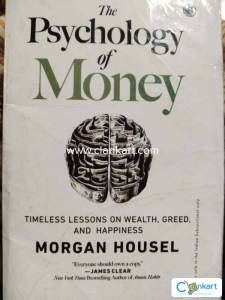
Psychology of money
Timeless lessons on wealth, greed, and happiness doing well with money isn’t necessarily about what you know. It’s about how you behave. And behavior is hard to teach, even to really smart people. How to manage money, invest it, and make business decisions are typically considered to involve a lot of mathematical calculations, where data and formulae tell us exactly what to do. But in the real world, people don’t make financial decisions on a spreadsheet. They make them at the dinner table, or in a meeting room, where personal history, your unique view of the world, ego, pride, marketing, and odd incentives are scrambled together. In the psychology of money, the author shares 19 short stories exploring the strange ways people think about money and teaches you how to make better sense of one of life’s most important matters.
Rich dad poor dad
April 2017 marks 20 years since Robert Kiyosaki’s Rich Dad Poor Dad first made waves in the Personal Finance arena.It has since become the #1 Personal Finance book of all time... translated into dozens of languages and sold around the world.Rich Dad Poor Dad is Robert's story of growing up with two dads — his real father and the father of his best friend, his rich dad — and the ways in which both men shaped his thoughts about money and investing. The book explodes the myth that you need to earn a high income to be rich and explains the difference between working for money and having your money work for you.20 Years... 20/20 HindsightIn the 20th Anniversary Edition of this classic, Robert offers an update on what we’ve seen over the past 20 years related to money, investing, and the global economy. Sidebars throughout the book will take readers “fast forward” — from 1997 to today — as Robert assesses how the principles taught by his rich dad have stood the test of time.In many ways, the messages of Rich Dad Poor Dad, messages that were criticized and challenged two decades ago, are more meaningful, relevant and important today than they were 20 years ago.As always, readers can expect that Robert will be candid, insightful... and continue to rock more than a few boats in his retrospective.Will there be a few surprises? Count on it.Rich Dad Poor Dad...• Explodes the myth that you need to earn a high income to become rich• Challenges the belief that your house is an asset• Shows parents why they can't rely on the school system to teach their kids about money• Defines once and for all an asset and a liability• Teaches you what to teach your kids about money for their future financial success
Business school
The book describes what the real values of network marketing business are. It is more than just making money. He says that it is a business having a heart. Rich Dad’s The Business School does not promote any specific network marketing organization, but aims to educate the reader on how to select one.
The 48 Laws of Power by Robert Greene
Amoral, cunning, ruthless, and instructive, this piercing work distills three thousand years of the history of power in to forty-eight well explicated laws. As attention-grabbing in its design as it is in its content, this bold volume outlines the laws of power in their unvarnished essence, synthesizing the philosophies of Machiavelli, Sun-tzu, Carl von Clausewitz, and other great thinkers. Some laws teach the need for prudence ("Law 1: Never Outshine the Master"), the virtue of stealth ("Law 3: Conceal Your Intentions"), and many demand the total absence of mercy ("Law 15: Crush Your Enemy Totally"), but like it or not, all have applications in real life. Illustrated through the tactics of Queen Elizabeth I, Henry Kissinger, P. T. Barnum, and other famous figures who have wielded--or been victimized by--power, these laws will fascinate any reader interested in gaining, observing, or defending against ultimate control.
Losing My Virginity
"Oh, screw it, let's do it."That's the philosophy that has allowed Richard Branson, in slightly more than twenty-five years, to spawn so many successful ventures. From the airline business (Virgin Atlantic Airways), to music (Virgin Records and V2), to cola (Virgin Cola), to retail (Virgin Megastores), and nearly a hundred others, ranging from financial services to bridal wear, Branson has a track record second to none.Losing My Virginity is the unusual, frequently outrageous autobiography of one of the great business geniuses of our time. When Richard Branson started his first business, he and his friends decided that "since we're complete virgins at business, let's call it just that: Virgin." Since then, Branson has written his own "rules" for success, creating a group of companies with a global presence, but no central headquarters, no management hierarchy, and minimal bureaucracy.Many of Richard Branson's companies--airlines, retailing, and cola are good examples--were started in the face of entrenched competition. The experts said, "Don't do it." But Branson found golden opportunities in markets in which customers have been ripped off or underserved, where confusion reigns, and the competition is complacent. And in this stressed-out, overworked age, Richard Branson gives us a new model: a dynamic, hardworking, successful entrepreneur who lives life to the fullest. Family, friends, fun, and adventure are equally important as business in Branson's life. Losing My Virginity is a portrait of a productive, sane, balanced life, filled with rich and colorful stories: Crash-landing his hot-air balloon in the Algerian desert, yet remaining determined to have another go at being the first to circle the globeSigning the Sex Pistols, Janet Jackson, the Rolling Stones, Boy George, and Phil CollinsFighting back when British Airways took on Virgin Atlantic and successfully suing this pillar of the British business establishmentSwimming two miles to safety during a violent storm off the coast of MexicoSelling Virgin Records
Good to great
To find the keys to greatness, Collins's 21-person research team read and coded 6,000 articles, generated more than 2,000 pages of interview transcripts and created 384 megabytes of computer data in a five-year project. The findings will surprise many readers and, quite frankly, upset others.The ChallengeBuilt to Last, the defining management study of the nineties, showed how great companies triumph over time and how long-term sustained performance can be engineered into the DNA of an enterprise from the very beginning. But what about the company that is not born with great DNA? How can good companies, mediocre companies, even bad companies achieve enduring greatness? The StudyFor years, this question preyed on the mind of Jim Collins. Are there companies that defy gravity and convert long-term mediocrity or worse into long-term superiority? And if so, what are the universal distinguishing characteristics that cause a company to go from good to great?The StandardsUsing tough benchmarks, Collins and his research team identified a set of elite companies that made the leap to great results and sustained those results for at least fifteen years. How great? After the leap, the good-to-great companies generated cumulative stock returns that beat the general stock market by an average of seven times in fifteen years, better than twice the results delivered by a composite index of the world's greatest companies, including Coca-Cola, Intel, General Electric, and Merck. The ComparisonsThe research team contrasted the good-to-great companies with a carefully selected set of comparison companies that failed to make the leap from good to great. What was different? Why did one set of companies become truly great performers while the other set remained only good? The FindingsThe findings of the Good to Great study will surprise many readers and shed light on virtually every area of management strategy and practice. The findings include:Level 5 Leaders: The research team was shocked to discover the type of leadership required to
A Guide to the Project Management Body of Knowledge (PMBOK Guide) S
A Guide to the Project Management Body of Knowledge (PMBOK® Guide) is the go-to resource for project management practitioners. Reflecting this evolution, The Standard for Project Management enumerates 12 principles of project management and the PMBOK® Guide – Seventh Edition is structured around eight project performance domains. Both the standard and the guide reflect the wide range of development approaches that lead to value delivery. This edition is designed to address practitioners’ current and future needs and to help them be more proactive, innovative, and nimble in enabling desired project outcomes. This edition of the PMBOK® Guide: reflects the full range of development approaches (predictive, adaptive, hybrid, etc.); provides an entire section devoted to tailoring the development approach and processes; includes an expanded list of models, methods, and artifacts; focuses on not just delivering project outputs but also enabling outcomes; and integrates with PMIstandards+™ for information and standards application content based on project type, development approach, and industry sector.
A guide to the Project Management Body of Knowledge (PMBOK guide)
Whether you are a senior executive or a project manager, its your job to help your organization grow and increase its value to stakeholders. Project management is the unique organizational competency that manages change and drives competitive advantage with the outcome of delivering results in line with corporate strategy. A Guide to the Project Management Body of Knowledge (PMBOK Guide)Third Edition is the map to get you there. In 1983, Project Management Institute (PMI) volunteers first sat down to distill the project management body of knowledge. Today, the PMBOK Guide has become a global standard for the project management profession and is one of the best, most versatile documents available across major industries. It contains the fundamental, baseline practices that drive business results for any organization. The third edition has been updated to reflect the most current industry knowledge and practices. One of the most important changes is the evolution from generally accepted on most projects, most of the time to generally recognized as good practice on most projects, most of the time. Several chapters have been updated, rewritten or expanded to include the most current and pressing information facing project managers today. It also includes an expanded index and glossary. The PMBOK GuideThird Edition reflects the collaboration and knowledge of project management leaders who deliver business results. Successful project management is a constant advantage in the dynamic nature of todays organizations. Companies, non-profits, and government agencies around the world are turning to project management to achieve corporate strategic objectives. As recognition of the value of projectmanagement continues to grow, the PMBOK Guide will become even more of an indispe
Principles of micro economics
The book makes a comprehensive and analytical study of theories of demand, production/cost and determination of price and output of products in different market structures. It also discusses theory of factor pricing and income distribution as wages, rent, interest and profits. Above all, it critically analyses the conditions of economic efficiency and maximum social welfare and causes of market failures. It takes a further lead with this revision by aligning its contents with the prescribed UGC model curriculum and new Choice Based Credit System (CBCS) syllabus.
The almanack of naval ravikant
Getting rich is not just about luck; happiness is not just a trait we are born with. These aspirations may seem out of reach, but building wealth and being happy are skills we can learn.So what are these skills, and how do we learn them? What are the principles that should guide our efforts? What does progress really look like?Naval Ravikant is an entrepreneur, philosopher, and investor who has captivated the world with his principles for building wealth and creating long-term happiness. The Almanack of Naval Ravikant is a collection of Naval's wisdom and experience from the last ten years, shared as a curation of his most insightful interviews and poignant reflections. This isn't a how-to book, or a step-by-step gimmick. Instead, through Naval's own words, you will learn how to walk your own unique path toward a happier, wealthier life.
Chanakyas 7 Secrets of Leadership
The long-awaited sequel to the bestselling book Corporate Chanakya is finally here. Co-authored by leadership guru Radhakrishnan Pillai and former Director General of Police (Maharashtra) D. Sivanandhan, Chanakya’s 7 Secrets of Leadership puts forth a model for leadership drawn from the teachings of Chanakya and Sivanadhan’s own decades-long experience in the police force.Chanakya, who lived in the 4th Century BC, was prime minister and guru to one of India’s most powerful and successful emperors. His political treatise, the Arthashastra, is often likened to Machiavelli’s The Prince and deals with the principles of governance in all its myriad forms.The ideal nation in the Arthashastra rests on seven pillars (the Saptanga): the lord, the minister, the citizens, the fortified city, the treasury, the army and the ally. In this path-breaking book, Chanakya's 7 Secrets of Leadership, author Radhakrishnan Pillai reveals the Saptanga as a model of leadership for all individuals and organizations. The archetype of an able administrator, co-author D. Sivanandhan illustrates this model with case studies from his own stellar career.Anyone can use the seven secrets of leadership to run their ‘kingdom’ effectively. In Chanakya's 7 Secrets of Leadership, leadership concepts meet application and an age-old formula is revealed in modern-day success stories.