Find from over 1000s of used books online
Buy Second Hand Books, Used Books Online In India
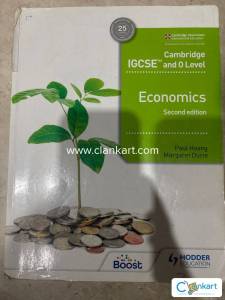
Economics IGCSE SECOND EDITION Paul Hoang
We are working with Cambridge Assessment International Education to gain endorsement for this forthcoming series. Discover Economics as a real-world subject through case studies from around the world and provide in-depth coverage of the latest Cambridge IGCSE and O Level Economics syllabuses (0455/2281). - Trust an experienced author team to navigate the syllabuses confidently with clearly-defined learning objectives throughout. - Deepen understanding by applying knowledge to real-life global case studies. - Extend learning beyond the classroom by reflecting on skills learned and applying them to local and global environments. - Check understanding with engaging activities that thoroughly integrate deep learning skills. - Benefit from language support with an accessible text and definitions of technical terms throughout. - Consolidate learning with chapter reviews and examination-style questions, as well as useful links to extra activities and answers to the questions online. Available in this series: Student Textbook Second edition (ISBN 9781510421271) Student eTextbook (ISBN 9781510420212) Whiteboard eTextbook (ISBN 9781510420229) Workbook (ISBN 9781510421288) Online Teacher's Guide (ISBN 9781510424135) Study and Revision Guide (ISBN 9781510421295)
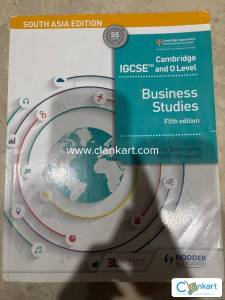
Business studies
Send students into their exam with the confidence to achieve their maximum potential using step-by-step guidance that helps to practise skills learned and improve exam technique. - Avoid common misconceptions with frequent mistakes highlighted throughout - Build students' skills constructing and writing answers with a range of practice and exam-style questions - Easily identify areas for improvement with the answers in the back of the book - Help students target their revision and focus on important concepts and skills with key objectives at the beginning of every chapter - Ensure that students maximise their time in the exam with examiner's tips and suggestions on how to approach questions - Contextualise knowledge with authentic case studies This Study and Revision Guide has been updated for the latest syllabus for examination from 2020. This title has not been through the Cambridge Assessment International Education endorsement process.
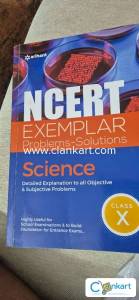
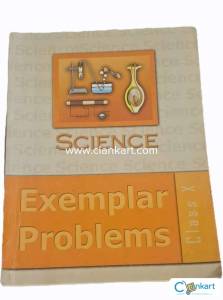
NCERT SCIENCE EXEMPLAR - X
In the present Science Textbook for Class X, the science concepts are framed not along disciplinary lines, but rather organized around themes that are potentially cross disciplinary in nature. The themes are Materials, The world of the Living, How Things work, Natural Phenomena and Natural Resources. There are sixteen chapters in the Textbook of Science for Class X and these cover the above mentioned themesChapter-1 " Chemical Reaction and Equations" deals with chemical reactions and balancing of chemical equations. Different types of reactions like combination, decomposition, displacement, double displacement, oxidation and reduction have been discussed.Chapter-2 "Acids, Bases and Salts" deals with classification ol substances into acids, bases and salts, their identification using indicators. The characteristic chemical properties have also been discussed. Importance of pH, preparing of some salts and their uses have also been highlighted.Chapter-3 "Metals and Non-metals" discusses about properties of metals and non- metals which are the key areas of discussion. Extraction of metals from their ores have been explained in a stepwise manner. A common phenomena of corrosion of metals and its prevention has also been discussedChapter-4 "Carbon and its Compounds" highlights the versatile nature of carbon and its ability to form a wide range of hydrocarbons. Nomenclature, isomerism and chemical properties of these compounds have been discussed. Concept of heteroatom and functional group has been introduced with special reference to properties and uses of ethanol and ethanoic acid. The use of carbon and its compounds is highllghted in soaps and detergents.& much more chapters .