Find from over 1000s of used books online
Buy Second Hand Books, Used Books Online In India
How to Prepare for QUANTITATIVE APTITUDE for CAT 10th Edition
1. ‘Quantum Cat’- the bestselling study guide for Management entrances 2. The entire syllabus has been divided into 21 Chapters 3. Every chapter is accompanied with CAT Test for quick revision of concepts 4. More than 400 Fundamental Concepts are provided for better understanding 5. More than 1000 Examples are provided with Use-Cases, Twists, Tricks Choices and Lateral Solutions 6. More than 5000 hand crafted problem are given for the practice 7. 2000 New MCQs have been provided for thorough practice Quantitative Aptitude is a core component for getting a winning CAT Score. Out of every section, Quantitative Ability is one of the most unpredictable and time consuming section. Quantitative Aptitude stems an important part of an individuals’ analytical and logical ability for solving complex problems, making it a filtering tool for qualifying CAT and other Management Entrances. The current edition of “Quantum Cat” has been designed by keeping in mind the needs of those who wish to enhance Quantitative Aptitude for CAT and other Management Examinations. The entire syllabus of Quantitative Aptitude section is divided into 21 Chapters and every topic has 2-3 levels of questions that help students to get prepared for the most difficult problems even beyond the CAT Level. At the end of every chapter there is ‘CAT Test’ that contains problems related to the topic that helps in the quick revision of the concepts. This edition has more than 400 Fundamental Concepts to remember, more than 1000 examples are used to give the conceptual clarity with the methods and tricks are used to solve the questions. With the solution oriented approach this book provides more than 5000 hand crafted problems with their respective solution. It also includes more than 2000 MCQs for thorough practice. This book provides the alternative and smarter solutions to get correct answers in lesser time to crack CAT. This book is highly useful for not only for management entrances but for other competitive examinations. With so many features this book
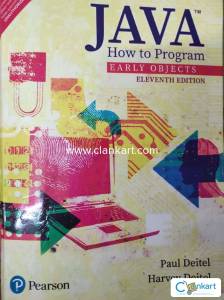
Java How To Program, Early Objects, 11Th Edition
Summary Java's much-awaited "Project Jigsaw" is finally here! Java 11 includes a built-in modularity framework, and The Java Module System is your guide to discovering it. In this new book, you'll learn how the module system improves reliability and maintainability, and how it can be used to reduce tight coupling of system components. Foreword by Kevlin Henney. Purchase of the print book includes a free eBook in PDF, Kindle, and ePub formats from Manning Publications. You'll find registration instructions inside the print book. About the Technology Packaging code into neat, well-defined units makes it easier to deliver safe and reliable applications. The Java Platform Module System is a language standard for creating these units. With modules, you can closely control how JARs interact and easily identify any missing dependencies at startup. This shift in design is so fundamental that starting with Java 9, all core Java APIs are distributed as modules, and libraries, frameworks, and applications will benefit from doing the same. About the Book The Java Module System is your in-depth guide to creating and using Java modules. With detailed examples and easy-to-understand diagrams, you'll learn the anatomy of a modular Java application. Along the way, you'll master best practices for designing with modules, debugging your modular app, and deploying to production. What's inside The anatomy of a modular Java app Building modules from source to JAR Migrating to modular Java Decoupling dependencies and refining APIs Handling reflection and versioning Customizing runtime images Updated for Java 11 About the Reader Perfect for developers with some Java experience. About the Author Nicolai Parlog is a developer, author, speaker, and trainer. His home is codefx.org. Table of Contents PART 1 - Hello, modules First piece of the puzzle Anatomy of a modular application Defining modules and their properties Building modules from source to JAR Running and debugging modular applications PART 2 - Adapting real-world projects Compati
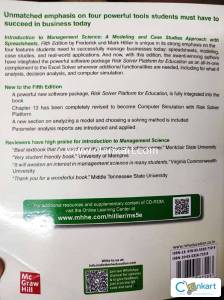
Introduction to Management Science; A Modeling and Case Studies Approa
Introduction to Management Science, 4/e, offers a unique model approach and integrates the use of Excel. Through this approach students are better able to grasp the essential concepts covered in the course and see their utility. Each chapter includes a case study that is meant to show the students a real and interesting application of the topics addressed in that chapter. These cases and related applications cuts across all functional areas of business and show how management science techniques apply in the business environment.
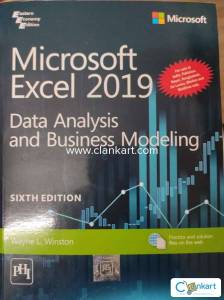
Microsoft Excel 2019: Data Analysis and Business Modeling
This highly acclaimed text, now in its seventh edition, is designed as a first-level course in MBA and professional programmes. It explains how to prepare, analyze, and interpret financial statements. NEW TO THE EDITION Topics: ESG, fraud analytics, fraud triangle and analysis of the statement of cash flows of Dr. Reddy's Laboratories. Major revisions: Revenue recognition, lease accounting and employee benefits. Expanded coverage: Fraud, earnings quality, earnings management, pro forma measures and short-sellers. Real-world cases: Autonomy, Coffee Day, Cox & Kings, EIH, General Electric Company, Indian Oil, Indian Overseas Bank, Mahindra & Mahindra, McNally Bharat, Noble Group, Punjab National Bank, Reliance Jio Infocomm, Sun Pharma, Tesco, Tesla, Theranos , Wirecard, Yes Bank, Zee Entertainment and Zomato. Pedagogical features: Technology in accounting and impact of Covid-19 on reporting. Examples: New examples in Application, Chapter Vignette, Earnings Quality Analysis, Financial View, and Real World. LEARNING RESOURCES Interactive Study Guide available at https://www.phindia.com/narayanaswamy_financial_accounting has solution templates, self-test questions, key ideas, and chapter review slides. TARGET AUDIENCE • MBA • BBA
Microeconomics
Over the years, the word 'yoga' has become synonymous with Hatha Yoga, a type of yoga that focusses on a set of physical postures to keep our bodies fit and healthy. However, there are many other types of yoga, with each having the same primary objective-the union of mind, body and spirit. Mantra Yoga also connects our lower selves with our higher selves through the sound vibrations emanating from mantras or japas. Despite the growing popularity of chanting mantras, the discipline and the rationale underlying this unique and distinct form of yoga have not been expounded in a manner that explains its enormous benefits. Fortunately, the Western world's insistence on scientific reasoning has led to numerous modern-day experiments that prove the physiological benefits of the ancient tradition of chanting mantras. This book will help the reader feel the power of connecting with the universe through vibrational frequencies and achieve their fullest potential. The book uses the ancient wisdom of Mantra Yoga to address issues related to modern living. The book will guide the reader towards the possibilities of a higher existence. An essential guide for the practice of Mantra Yoga to attain peace, happiness and awakening.
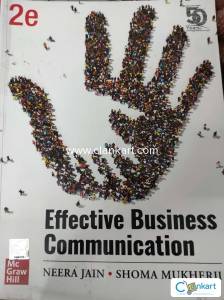
Effective Business Communication 2nd Edition
Develop, validate, and deploy powerful decentralized applications using blockchain Get the most out of cutting-edge blockchain technology using the hands-on information contained in this comprehensive resource. Written by a team of technology and legal experts, Blockchain: A Practical Guide to Developing Business, Law, and Technology Solutions demonstrates each topic through a start-to-finish, illustrated case study. The book includes financial, technology, governance, and legal use cases along with advantages and challenges. Validation, implementation, troubleshooting, and best practices are fully covered. You will learn, step-by-step, how to build and maintain effective, reliable, and transparent blockchain solutions. •Understand the fundamentals of decentralized computing and blockchain•Explore business, technology, governance, and legal use cases•Review the evolving practice of law and technology as it concerns legal and governance issues arising from blockchain implementation•Write and administer performant blockchain-enabled applications•Handle cryptographic validation in private, public, and consortium blockchains•Employ blockchain in cloud deployments and Internet of Things (IoT) devices•Incorporate Web 3.0 features with Swarm, IPFS, Storj, Golem, and WHISPER•Use Solidity to build and validate fully functional distributed applications and smart contracts using Ethereum•See how blockchain is used in crypto-currency, including Bitcoin and Ethereum•Overcome technical hurdles and secure your decentralized IT platform
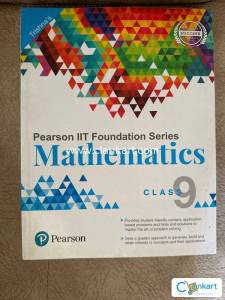
Pearson IIT Foundation series class 9
The new and updated edition of the Pearson IIT Foundation Series continueis to be a source of comprehensive and reliable content for competitive readiness. Conceptual clarity and gaining mastery over the art of problem-solving are the central themes of thee series. To ensure this, the series has lucid content along with neatly sketched diagrams and real-life application-based examples.Features: Key concepts explained in a learner-friendly mannerApplication-based problems, graded by difficulty, leading to conceptual clarity.Solved examples presented in a logical and step-wise manner for each concept‘Test your Concepts section at the end of every chapter to check progressHints and Explanation for key questions along with common mistakes and how to avoid themTable of Contents: 1. Number systems2. Logarithms3. Polynomials and square roots of algebraic expressions4. Linear equations and in equations5. Quadratic expressions and equations6. Sets and relations7. Matrices8. Significant figures9. Statistics10. Probability11. Banking unit- I, computing unit- II12. Geometry13. Mensuration14. Coordinate geometry15. Locus16. Trigonometry17. Percentages, profit and loss, discount, partnership18. Sales tax and cost of living index19. Simple interest and compound interest20. Ratio, proportion and variation21. Shares and dividends22. Time and work23. Time and distance.