Find from over 1000s of used books online
Buy Second Hand Books, Used Books Online In India

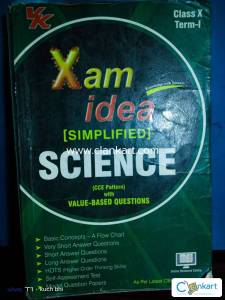
Xam idea for class 10th science (CBSE)
Keeping in mind the immense importance and significance of the NCERT Textbooks for a student, Arihant has come up with a unique book containing only and all Question-Answers of NCERT Textbook based questions. This book has been designed for the students studying in Class X following the NCERT Textbook of Social Science. The present book has been divided into two parts according to the syllabi of Social Science Term I and Term II, further divided into History, Geography, Political Science and Economics sections. This book has been worked out with an aim of overall development of the students in such a way that it will help students define the way how to write the answers of the textbook based questions. This book has answer to each & every question covered in the chapters of the textbook for Class X Social Science. Also each chapter in the book begins with a summary of the chapter which will help in effective understanding of the theme of the chapter and to make sure that the students will be able to answer all popular questions concerned to a particular chapter whether it is Long Answer Type or Short Answer Type Question. The curriculum for Disaster Management has been covered at the end of the book with necessary theoretical content and solved textbook questions. The book has been designed systematically in the simplest manner for easy comprehension of the chapters and their themes. As the book has been designed strictly according to the NCERT Textbook of Social Science for Class X and provides a thorough and complete coverage of the textbook based questions, it for sure will help the Class X students in an effective way for Social Science.
Indian Economy (14th Edition 2022-2023) - Ramesh Singh
Economics is an interesting subject when simplified. Often students are not at home with the subject because of dearth of story-telling economics. That explains why you have this book in your hands. This book is an outcome of threadbare discussions with tens of thousands of students appearing for the Civil Services Examination. The book has a strong conventional and conceptual foundations, thereby it is meant to be the base book for covering economics for all competitive examinations in the country-particularly, the Civil Services Examination conducted by the Union Public Service Commission (UPSC). This book addresses the needs of the aspirants completely as per the new UPSC trend as it makes concepts amply clear at the basic level; covers facts in the most updated manner; connects them dynamically to the current developments; roots them in the Indian context; and links them with the world. Features: 1.Helpful aide for Prelim and Main examination 2. Supplemented with related suitable graphs and images 3.Includes significant segments of latest Economic Survey 4.Difficult concepts are explained in easy-to-understand language
Indian Polity(Sixth Edition) - M Laxmikant
The South Asian Edition of Lippincott illustrated Reviews: physiology provides an adequate yet concise tool to master the essential concepts of physiology with a smart approach. Physiology is a discipline that lies at the core of medicine.The book tells the story of who we are; how we live; and, ultimately, how we die. By first identifying organ function and then showing how cells and tissues are designed to fulfil that function, this resource decodes physiology in a unique format. Tailored for ease of use and fast content Absorption, the book's outline format, illuminating artwork tightlyintegrated with the text, clinical applications, and online br>Unit review questions help you master the most essential concepts in physiology, making it perfect for classroom learning and entrance test and usage preparations.
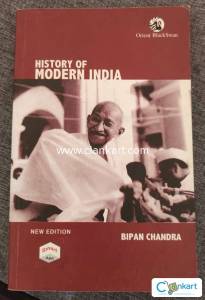
History of Modern India - Bipan Chandra
The SAGE Series in Modern Indian History consists of well-researched volumes with a wider scope and is intended to bring together the growing volume of historical studies that share a broad common historiographic focus. The approach that the authors have tried to evolve looks sympathetically, though critically, at the Indian national liberation struggle and other popular movements such as those of labour, peasants, lower castes, tribal peoples and women. The series also looks at colonialism as a structure and a system, and analyzes changes in economy, society and culture in the colonial context as also in the context of independent India. It focuses on communalism and casteism as major features of modern Indian development. The volumes in the series will tend to reflect this approach as also its changing and developing features. At the broadest plane this approach is committed to the Enlightenment values of rationalism, humanism, democracy and secularism. This set includes: Volume 1: Independence and Partition: The Erosion of Colonial Power in India by Sucheta Mahajan Volume 2: A Narrative of Communal Politics: Uttar Pradesh, 1937–39 by Salil Misra Volume 3: Imperialism, Nationalism and the Making of the Indian Capitalist Class, 1920–1947 by Aditya Mukherjee Volume 4: From Movement to Government: The Congress in the United Provinces, 1937–42 by Visalakshi Menon Volume 5: Peasants in India’s Non-Violent Revolution: Practice and Theory by Mridula Mukherjee Volume 6: Communalism in Bengal: From Famine to Noakhali, 1943–47 by Rakesh Batabyal Volume 7: Political Mobilization and Identity in Western India, 1934–47 by Shri Krishan Volume 8: The Garrison State: Military, Government and Society in Colonial Punjab, 1849–1947 by Tan Tai Yong Volume 9: Colonializing Agriculture: The Myth of Punjab Exceptionalism by Mridula Mukherjee Volume 10: Region, Nation, “Heartland”: Uttar Pradesh in India’s Body-Politic by Gyanesh Kudaisya Volume 11: National Movement and Politics in Orissa, 1920–29 by Pritish Acharya Volume 12: Commun
History of Mediaeval India - Satish Chandra
Satish Chandra's History of Medieval India is a comprehensive overview of the history of the Indian subcontinent during the thousand-year period between the eighth and the eighteenth century. History of Medieval India studies this interesting period in Indian history when the land underwent drastic changes and was deeply influenced by the invading armies, religious movements, and the vicissitudes of the changing political, economic and cultural scene. To tell the history of a land spanning the geographical dimensions and the political divisions of the Indian subcontinent is in itself a formidable task. Satish Chandra executes this difficult mission withthe eye of an enquirer and the pen of a scholar.