Find from over 1000s of used books online
Buy Second Hand Books, Used Books Online In India

MTG NEET GUIDE - BIOLOGY
Comprehensive chapter-wise and topic-wise biology guide for NEET 2024. Includes 10 years of solved AIPMT/NEET questions (2014-2023), detailed theory based on the latest NCERT syllabus, and concept maps for quick revision. Book is in great condition with no missing pages. Perfect for medical entrance aspirants!
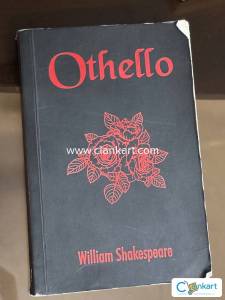
Othello - Shakespeare
In Othello, Shakespeare creates a powerful drama of a marriage that begins with fascination (between the exotic Moor Othello and the Venetian lady Desdemona), with elopement, and with intense mutual devotion and that ends precipitately with jealous rage and violent deaths. He sets this story in the romantic world of the Mediterranean, moving the action from Venice to the island of Cyprus and giving it an even more exotic coloring with stories of Othello's African past. Shakespeare builds so many differences into his hero and heroine—differences of race, of age, of cultural background—that one should not, perhaps, be surprised that the marriage ends disastrously. But most people who see or read the play feel that the love that the play presents between Othello and Desdemona is so strong that it would have overcome all these differences were it not for the words and actions of Othello's standard-bearer, Iago, who hates Othello and sets out to destroy him by destroying his love for Desdemona. As Othello succumbs to Iago's insinuations that Desdemona is unfaithful, fascination—which dominates the early acts of the play—turns to horror, especially for the audience. We are confronted by spectacles of a generous and trusting Othello in the grip of Iago's schemes; of an innocent Desdemona, who has given herself up entirely to her love for Othello only to be subjected to his horrifying verbal and physical assaults, the outcome of Othello's mistaken convictions about her faithlessness.
Right Here Right Now
Reinventing yourself is harder when you don’t remember who you wereSeventeen-year-old Kalindi wakes up in hospital with no recollection of how she got there. But that's not the only thing she doesn't remember: Her whole memory has been wiped clean. How? The doctors can only speculate.Kalindi doesn’t know what happened to her and—worse—she doesn’t know who she is. She enters her own life as if for the first time. Feeling like an invader, she meets her parents, friends and boyfriend. Everybody says her life was perfect, but she's having a hard time accepting who she was, and the kind of person she wanted to be. She’s also got boards to pass—but she doesn’t remember anything she learned! And the recurrent nightmares don't make it any easier.Nobody knows what happened to her.Can she have a peaceful present and future, without a past? Can she just live in the here and now?
Macbeth by William Shakespeare
After learning he was destined to be King, the scottish nobleman McBeth usurps the throne from King Duncan at the behest of his wife. McBeth, now king, becomes paranoid and worries even close friends are trying to steal the throne from him. His newfound anxieties and fear work against him as he does all he can to maintain himself upon the throne. One of the most well known plays by the great playwright William Shakespeare.
The School for Scandal by Richard Brinsley Sheridan
The School for Scandal is a comedy of manners, a play satirizing the behavior and customs of upper classes through witty dialogue and an intricate plot with comic situations that expose various shortcomings of the characters. In general, the characters consist of stock types—such as the bore, the flirt, the gossip, the wastrel, the rich uncle, etc.—rather than individuals with unique qualities. Comedies of manners in Sheridan’s time typically avoided the romantic sentimentality that characterized many other stage dramas of the 18th century. In this play, the author mainly satirizes malicious gossip and hypocrisy in the fashionable society of London at that time. The School for Scandal is one of the most engaging high comedies in the English language, a work which according to Hazlitt, “has a genial spirit of frankness and generosity about it.”