Clankart Logo

Find from over 1000s of used books online

Buy Second Hand Books, Used Books Online In India

Advertisement
Want to see your books here? Have Used Books?
Make some extra cash by selling your old books for actual money in your UPI/Bank account. Go on, it's quick and easy.
Advertisement
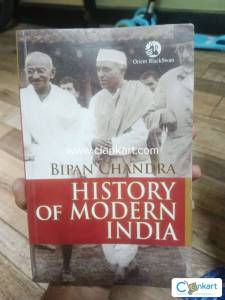
history of modern india

history of modern india

₹199

Published in the year 2009, History Of Modern India is a book that revolves around the history of British India, throwing light on the nationalist movement and colonialism. History Of Modern India is a book that is written by renowned historian, Bipan Chandra. The contents of this book are a result of Chandra’s research on the subjects of colonialism and nationalism in the country. Apart from his research, Chandra has also drawn from the works of renowned historians during that time in history.In total, there are 14 chapters in this book that cover different periods in Indian history. Some of the chapters in this book include Indian States And Society In The Eighteenth Century, Religious And Social Reform After 1858, The Struggle For Sawaraj, The Nationalist Movement, European Penetration And The British Conquest, Social And Cultural Awakening In The First Half Of The Nineteenth Century, The Decline Of The Mughal Empire, and The Revolt Of 1857. Some other chapters include The Nationalist Movement: 1858-1905, Administrative Changes After 1858, and Administrative Organisation And Society And Cultural Policy.This book doesn’t focus on the political factors during that period, but deals with the economic, religious, and social history of India. Through the course of this book, Chandra provides insight on several events in modern Indian history such as the establishment of the British East India Company, which led to a tightened grip of the British over India. Chandra also explains that the major reason behind the colonial rule was to exploit India by means of investment and trade. The chapters in this book are arranged in chronological order, starting from the British Rule to the independence of the country. This piece of literature provides its readers with loads of information on the nationalist movement, throwing light on the contributions made by several different individuals. This book is a must-have for history students as well as for those who want to gain insight into the history of modern India.

1 year ago
Advertisement
ICSE Candid biology for class 9

ICSE Candid biology for class 9

₹150

The cambium has been variously defined as follows: "The actively dividing layer of cells that lies between, and gives rise to, secondary xylem and phloem (vascular cambium)" (IAWA 1964); "A meristem with products of periclinal divisions commonly contributed in two directions and arranged in radial files. Term pre ferably applied only to the two lateral meristems, the vascular cambium and cork cambium, or phellogen" (Esau 1977); and, "Lateral meristem in vascular plants which produces secondary xylem, secondary phloem, and parenchyma, usually in radial rows; it consists of one layer of initials and their undifferentiated deriva tives" (Little and Jones 1980). Clearly, the cambium is a diverse and extensive meristem, and no one defini tion will encompass all manifestations of what anatomists consider cambium. Its diversity and extent are further exemplified by a single plant, such as a temperate zone tree, in which procambium is initiated in the embryo and perpetuated throughout every lateral, primary meristem before giving rise to cambium in the secondary body. The cambium thereafter performs its meristematic task of producing daughter cells that differentiate to specialized tissue systems. The cam bium, however, does not remain static. Its derivatives vary either in form, or TImc tion, or rate of production at different positions on the tree, with age of the tree, and with season of the year. Moreover, the cambium responds both to internal sig nals and to external stimuli such as environment or wounding.

1 year ago
Advertisement
Advertisement