Find from over 1000s of used books online
Buy Second Hand Books, Used Books Online In India
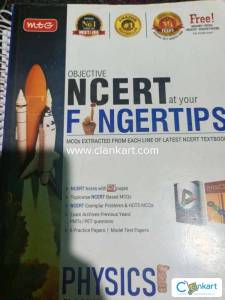
NCERT FINGERTIPS
1. Best-selling study guide and well-structured study resource for NEET, AIIMS, JIPMER. 2. NEET Objective Physics Vol 1. – for class 11 3. The book follows the NCERT pattern for MBBS & BDS entrance preparation along with their school studies. 4. Diagrams, tables, figures etc support theory 5. Practice exercises after every chapter 6. Coverage of last 8 Years Questions of NEET, CBSEE AIPMT and Other Medical Entrances. The “NEET Objective Physics Volume – 01” is a complete comprehensive book designed for the medical students preparing for NEET. As the title suggests the volume -1 covers the complete NEET syllabus along with NCERT Textbook of class 11th into 17 Chapters for the simultaneous preparation of both school & exam. Every chapter is well supported by theories, diagrams, tables, figures. Important points and Notes are given in the topics to enrich students. In order to help, Check Point Exercises are given in between the text of all chapters to make students linked with the topic. Solved Examples are given with the different concepts of chapters to make students learn the problem solving skills. Exercises provided in the chapters are divided into 3 parts. Part – A: Taking it Together deals with objective questions arranged according to level of difficulty for the systematic practice. Part – B: Medical Entrance Special Format Questions – covers all special types of questions, generally asked in NEET & other Medical Entrances, Part – C: Medical Entrances’ Gallery – asked questions in Last 10 years’ (2020-2011) in NEET and other medical entrances. TOC Basic Mathematics, Units, Dimensions and Error Analysis, Vectors, Motion in One Dimension, Motion in a Plane and Projectile Motion, Laws of Motion, Work, Power and Energy, Circulation Motion, Rotation, Gravitation, Simple Harmonic Motion, Elasticity, Fluid Mechanics, Thermometry, Thermal Expansion and Kinetic Theory of Gases, Laws of Thermodynamics, Calorimetry and Heat Transfer, Wave Motion.
Harry Porter-prisonerner of Azkaban
'Welcome to the Knight Bus, emergency transport for the stranded witch or wizard. Just stick out your wand hand, step on board and we can take you anywhere you want to go.'When the KNIGHT BUS crashes through the darkness and SCREECHES to a halt in front of him, it's the start of another far from ordinary year at HOGWARTS for Harry Potter. Sirius Black, ESCAPED mass-murderer and follower of LORD VOLDEMORT, is on the RUN - and they say he is coming after Harry. In his first ever Divination class, Professor Trelawney sees an OMEN of death in Harry's tea leaves... But perhaps most TERRIFYING of all are the DEMENTORS patrolling the school grounds, with their soul-sucking KISS...Jonny Duddle (Cover Illustration), Tomislav Tomić (Map Illustration).
Harry Porter-Chambers of secret
'There is a plot, Harry Potter. A plot to make most terrible things happen at Hogwarts School of Witchcraft and Wizardry this year.'Harry Potter's summer has included the worst birthday ever, doomy warnings from a house-elf called Dobby, and rescue from the Dursleys by his friend Ron Weasley in a magical flying car! Back at Hogwarts School of Witchcraft and Wizardry for his second year, Harry hears strange whispers echo through empty corridors – and then the attacks start. Students are found as though turned to stone... Dobby's sinister predictions seem to be coming true.Jonny Duddle (Cover Illustration), Tomislav Tomić (Map Illustration).
GRB OP Tandon Inorganic Chemistry for Class 12 JEE Mains and Advanced
An advanced-level textbook of inorganic chemistry for the graduate (B.Sc) and postgraduate (M.Sc) students of Indian and foreign universities. This book is a part of four volume series, entitled "A Textbook of Inorganic Chemistry – Volume I, II, III, IV". CONTENTS: Chapter 1. Stereochemistry and Bonding in Main Group Compounds: VSEPR theory, dπ -pπ bonds, Bent rule and energetic of hybridization. Chapter 2. Metal-Ligand Equilibria in Solution: Stepwise and overall formation constants and their interactions, Trends in stepwise constants, Factors affecting stability of metal complexes with reference to the nature of metal ion and ligand, Chelate effect and its thermodynamic origin, Determination of binary formation constants by pH-metry and spectrophotometry. Chapter 3. Reaction Mechanism of Transition Metal Complexes – I: Inert and labile complexes, Mechanisms for ligand replacement reactions, Formation of complexes from aquo ions, Ligand displacement reactions in octahedral complexes- acid hydrolysis, Base hydrolysis, Racemization of tris chelate complexes, Electrophilic attack on ligands. Chapter 4. Reaction Mechanism of Transition Metal Complexes – II: Mechanism of ligand displacement reactions in square planar complexes, The trans effect, Theories of trans effect, Mechanism of electron transfer reactions – types; Outer sphere electron transfer mechanism and inner sphere electron transfer mechanism, Electron exchange. Chapter 5. Isopoly and Heteropoly Acids and Salts: Isopoly and Heteropoly acids and salts of Mo and W: structures of isopoly and heteropoly anions. Chapter 6. Crystal Structures: Structures of some binary and ternary compounds such as fluorite, antifluorite, rutile, antirutile, crystobalite, layer lattices- CdI2, BiI3; ReO3, Mn2O3, corundum, pervoskite, Ilmenite and Calcite. Chapter 7. Metal-Ligand Bonding: Limitation of crystal field theory, Molecular orbital theory, octahedral, tetrahedral or square planar complexes, π-bonding and molecular orbital theory. Chapter 8. Electronic Spectra of Transi