Clankart Logo

Find from over 1000s of used books online

Buy Second Hand Books, Used Books Online In India

Advertisement

Want to see your books here? Have Used Books?
Make some extra cash by selling your old books for actual money in your UPI/Bank account. Go on, it's quick and easy.

Advertisement
Takeover, Restructu, and Corporate Governance

Takeover, Restructu, and Corporate Governance

₹200

Description This book, meant fundamentally for undergraduate- andgraduate-level courses on mergers and acquisitions as well businessand corporate finance, economics and strategy methodically combinesconceptual and enhanced empirical data. It offers students apractical insight into understanding mergers and acquisitions aswell as corporate restructuring in the arrangement of strategicplanning experienced by managers in all business organizations. Chapters on strategic processes, theory of mergers and tender offers, the timing of merger activity, empirical tests of corporate restructuring and divestitures are fully updated. Explains the merger and acquisition process within a broad framework of company's strategic plans. Features Indian cases like Aditya Birla Nuvo, the inorganic growth of Videocon, the mergers and acquisitions of Indian companies and Crompton Greaves's growth strategy PART I. TAKEOVERS AND MERGERS IN PRACTICE The Takeover Process. The Legal and Regulatory Framework. Accounting for M&As. Deal Structuring PART II. M&AS?THEORIES AND EMPIRICAL TESTS Strategic Processes. Theories of Mergers and Tender Offers. The Timing of Merger Activity. Empirical Tests of M&A Performance. PART III. VALUATION?THE STRATEGIC PERSPECTIVE. Alternative Approaches to Valuation. Increasing the Value of the Organization. PART IV. RESTRUCTURING. Corporate Restructuring and Divestitures Empirical Tests of Corporate Restructuring and Divestitures. Financial Restructuring. PART V. M&A STRATEGIES Alliances and Joint Ventures. Employee Stock Ownership and MLPs Going Private and Leveraged Buyouts. International Takeovers and Restructuring. PART VI. STRATEGIES FOR CREATING VALUE. Share Repurchases. Takeover Defenses. Corporate Governance and Performance. Merger Arbitrage. Implementation and Management Guides for M&As. J. Fred Weston is from The Anderson School, University ofCalifornia, Los Angeles Mark L. Mitchell is from Harvard Business School and CNHPar

1 year ago
Advertisement
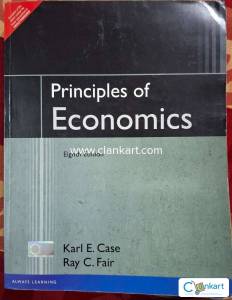
Principles of Economics

Principles of Economics

₹300

Description Case & Fair , present a very precise and simplifiedmicroeconomic model first, before introducing all the exceptionsand subtleties of a more complex economic world. Only after thissimplified model is developed, do the authors give a thoroughtreatment of market imperfections, externalities, public finance,and international economics. (A detailed summary of this approachcan be found in the preface). For Sale in Indiansubcontinent only Presents a very precise and simplified microeconomic model first, before introducing all the exceptions and subtleties of a more complex economic world. A detailed summary about simple demand and supply to aggregate demand & supply approach can be found in the preface. Updated and expanded end of chapter material. PART I: INTRODUCTION TO ECONOMICS. The Scope and Method of Economics. The Economic Problem: Scarcity and Choice. Demand, Supply, and Market Equilibrium. Demand and Supply Applications . Elasticity PART II: FOUNDATIONS OF MICROECONOMICS: CONSUMERS AND FIRMS. Household Behavior and Consumer Choice The Production Process: The Behavior of Profit-Maximizing Firms. Short-Run Costs and Output Decisions. Long-Run Costs and Output Decisions. Input Demand: The Labor and Land Markets. Input Demand: The Capital Market and the Investment Decision. General Equilibrium and the Efficiency of Perfect Competition PART III: MARKET IMPERFECTIONS AND THE ROLE OF GOVERNMENT. Monopoly and Antitrust Policy. Monopolistic Competition and Oligopoly. Externalities, Public Goods, Imperfect Information, and Social Choice. Income Distribution and Poverty. Public Finance: The Economics of Taxation. PART IV: CONCEPTS AND PROBLEMS IN MACROECONOMICS. Introduction to Macroeconomics. Measuring National Output and National Income. Long-Run and Short-Run Concerns: Growth, Productivity, Unemployment, and Inflation. PART V: THE GOODS AND MONEY MARKETS. Aggregate Expenditure and Equilibrium Output. The Government and Fiscal Policy. The Money

1 year ago
Advertisement
Advertisement