Find from over 1000s of used books online
Buy Second Hand Books, Used Books Online In India
New simplified physics class 12 SL Arora
New Simplified Physics: A Reference Book - Class 12 is a set of two volumes, which comprehensively covers the entire Physics syllabus of Class 12th. Students who want to excel in their final examinations should study from this guidebook. Physics is an academic discipline which helps us understand how the universe behaves. It can be broadly categorised into two parts, namely Classical Physics and Modern Physics. The first branch covers laws that are highly applicable in everyday scales. Modern Physics is used to describe laws that have been developed in the early 20th century and onwards. It focuses on quantum mechanics and the interactions and behaviours of matter and energy. 2018
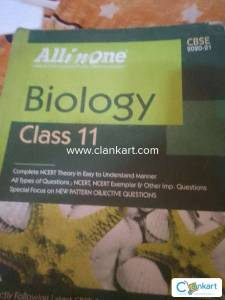
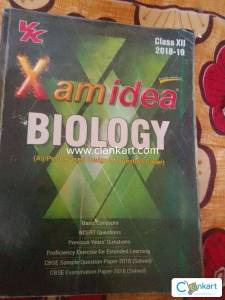
Arihant biology class 11
With newly introduced 2 Term Examination Pattern, CBSE has eased out the pressure of preparation of subjects and cope up with lengthy syllabus. Introducing, Arihant’s CBSE TERM II – 2022 Series, the first of its kind that gives complete emphasize on the rationalize syllabus of Class 9th to 12th. The all new “CBSE Term II 2022 – Biology” of Class 11th provides explanation and guidance to the syllabus required to study efficiently and succeed in the exams. The book provides topical coverage of all the chapters in a complete and comprehensive manner. Covering the 50% of syllabus as per Latest Term wise pattern 2021-22, this book consists of: 1. Complete Theory in each Chapter covering all topics 2. Case-Based, Short and Long Answer Type Question in each chapter 3. Coverage of NCERT, NCERT Examplar & Board Exams’ Questions 4. Complete and Detailed explanations for each question 5. 3 Practice papers base on entire Term II Syllabus. Table of Content Cell Cycle and Cell Division, Photosynthesis in Higher Plants, Respiration in Plants, Plant Growth and Development, Breathing and Exchange of Gases, Body Fluids and Circulation, Excretory Products and their Elimination, Locomotion and Movements, Neural Control and Coordination, Chemical Coordination and Integration, Practice Papers (1-3).
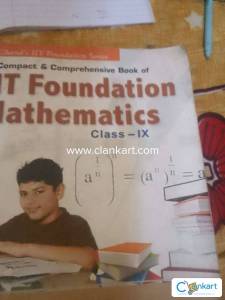
IIT foundation mathematics class 9
Composite Mathematics is a series of books for Pre Primer to Class 8 which conforms to the latest CBSE curriculum. The main aim of writing this series is to help the children understand difficult mathematical concepts in a simple manner in easy language.
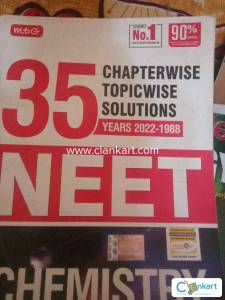
35 years chemistry neet book
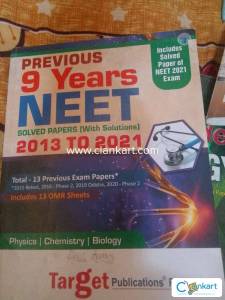
1. 14 Years’ Solved Papers is collection of previous years solved papers of NEET 2. This book covers all CBSE AIPMT and NTA NEET papers 3. Chapterwise and Unitwise approach to analysis questions 4. Each question is well detailed answered to understand the concept as whole 5. Online access to CBSE AIPMT SOLVED PAPER (Screening + Mains) 2008 When preparing for an examination like NEET, the pattern and the question asked in the examination are always intriguing for aspirants. This is where Solved Papers play their major role in helping students to cope up with the attempting criteria of the exam. Presenting the “14 Years’ Solved Papers [2021 – 2008]” that has been designed with a structured approach as per the latest NEET Syllabus requirement. As the title of the book suggests, it contains ample previous year’s papers, which help to identify and self-analyze the preparation level for the exam. Enriched with problem solving tools, this book serves a one stop solution for all 3 subjects; Physics, Chemistry and Biology. Well detailed answers are given for all questions that provide deep conceptual understanding of the problems. This book can be treated as a sufficient tool for learning, active answering style and time management skills. TOC NEET Solved Paper 2021, NEET Solved Paper 2020 (Oct.), NEET Solved Paper 2020 (Sep.), NEET National Paper 2019, NEET Odisha Paper 2021, NEET Solved Paper 2018, NEET Solved Paper 2017, NEET Solved Paper 2016(Phase II), NEET Solved Paper 2016 (Phase - I), CBSE AIPMT 2015 (Cancelled - May), CBSE AIPMT 2015 (Latest - May), CBSE AIPMT 2015 (Latest - July), CBSE AIPMT Solved Paper 2014, NEET Solved Paper 2013, CBSE AIPMT 2012 (Screening + Mains), CBSE AIPMT 2011 (Screening + Mains), CBSE AIPMT 2010 (Screening + Mains).
Mathematics RD sharma class Vi
Learn Python Quickly, A Programmer-Friendly GuideDESCRIPTIONMost Programmer's learning Python are usually comfortable with some or the other programming language and are not interested in going through the typical learning curve of learning the first programming language. Instead, they are looking for something that can get them off the ground quickly. They are looking for similarities and differences in a feature that they have used in other language(s). This book should help them immediately. It guides you from the fundamentals of using module through the use of advanced object orientation. KEY FEATURESStrengthens the foundations, as detailed explanation of programming language concepts are given in simple manner. Lists down all the important points that you need to know related to various topics in an organized manner.Prepares you for coding related interview and theoretical questions.Provides In depth explanation of complex topics and Questions.Focuses on how to think logically to solve a problem.Follows a systematic approach that will help you to prepare for an interview in short duration of time.Exercises are exceptionally useful to complete the reader's understanding of a topic. WHAT WILL YOU LEARNData types, Control flow instructions, console & File Input/OutputStrings, list & tuples, List comprehensionSets & Dictionaries, Functions & LambdasDictionary ComprehensionModules, classes and objects, InheritanceOperator overloading, Exception handlingIterators & Generators, Decorators, Command-line Parsing WHO THIS BOOK IS FORStudents, Programmers, researchers, and software developers who wish to learn the basics of Python programming language. Table of Contents 1. Introduction to Python2. Python Basics 3. Strings4. Decision Control Instruction5. Repetition Control Instruction6. Console Input/Output7. Lists8. Tuples9. Sets10. Dictionaries11. Comprehensions12. Functions13. Recursion14. Functional Programming15. Modules and Packages16. Namespaces17. Classes and Objects18. Intricacies of Classes and Objects19. Con