Find from over 1000s of used books online
Buy Second Hand Books, Used Books Online In India

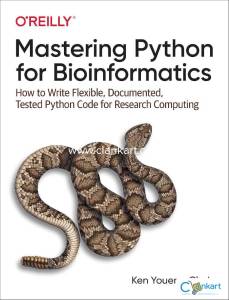
Mastering Python for Bioinformatics
Life scientists today urgently need training in bioinformatics skills. Too many bioinformatics programs are poorly written and barely maintained, usually by students and researchers who've never learned basic programming skills. This practical guide shows postdoc bioinformatics professionals and students how to exploit the best parts of Python to solve problems in biology while creating documented, tested, reproducible software. Ken Youens-Clark, author of Tiny Python Projects (Manning), demonstrates not only how to write effective Python code but also how to use tests to write and refactor scientific programs. You'll learn the latest Python features and tools including linters, formatters, type checkers, and tests to create documented and tested programs. You'll also tackle 14 challenges in Rosalind, a problem-solving platform for learning bioinformatics and programming. Create command-line Python programs to document and validate parameters Write tests to verify refactor programs and confirm they're correct Address bioinformatics ideas using Python data structures and modules such as Biopython Create reproducible shortcuts and workflows using makefiles Parse essential bioinformatics file formats such as FASTA and FASTQ Find patterns of text using regular expressions Use higher-order functions in Python like filter(), map(), and reduce()
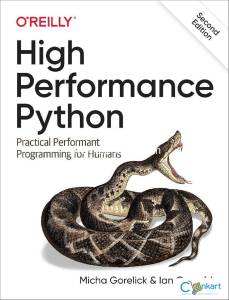
High Performance Python
If you're an experienced Python programmer, High Performance Python will guide you through the various routes of code optimization. You'll learn how to use smarter algorithms and leverage peripheral technologies, such as numpy, cython, cpython, and various multi-threaded and multi-node strategies.There's a lack of good learning and reference material available if you want to learn Python for highly computational tasks. Because of it, fields from physics to biology and systems infrastructure to data science are hitting barriers. They need the fast prototyping nature of Python, but too few people know how to wield it. This book will put you ahead of the curve.
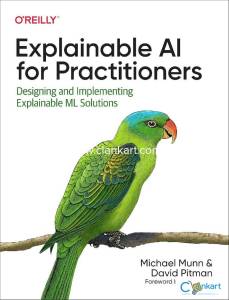
Explainable AI for Practitioners: Designing and Implementing
Most intermediate-level machine learning books focus on how to optimize models by increasing accuracy or decreasing prediction error. But this approach often overlooks the importance of understanding why and how your ML model makes the predictions that it does. Explainability methods provide an essential toolkit for better understanding model behavior, and this practical guide brings together best-in-class techniques for model explainability. Experienced machine learning engineers and data scientists will learn hands-on how these techniques work so that you'll be able to apply these tools more easily in your daily workflow. This essential book provides: A detailed look at some of the most useful and commonly used explainability techniques, highlighting pros and cons to help you choose the best tool for your needs Tips and best practices for implementing these techniques A guide to interacting with explainability and how to avoid common pitfalls The knowledge you need to incorporate explainability in your ML workflow to help build more robust ML systems Advice about explainable AI techniques, including how to apply techniques to models that consume tabular, image, or text data Example implementation code in Python using well-known explainability libraries for models built in Keras and TensorFlow 2.0, PyTorch, and HuggingFace
Learning Microsoft Power Bi: Transforming Data Into Insights
Microsoft Power BI is a data analytics and visualization tool powerful enough for the most demanding data scientists, but accessible enough for everyday use for anyone who needs to get more from data. The market has many books designed to train and equip professional data analysts to use Power BI, but few of them make this tool accessible to anyone who wants to get up to speed on their own. This streamlined intro to Power BI covers all the foundational aspects and features you need to go from "zero to hero" with data and visualizations. Whether you work with large, complex datasets or work in Microsoft Excel, author Jeremey Arnold shows you how to teach yourself Power BI and use it confidently as a regular data analysis and reporting tool. You'll learn how to: Import, manipulate, visualize, and investigate data in Power BI Approach solutions for both self-service and enterprise BI Use Power BI in your organization's business intelligence strategy Produce effective reports and dashboards Create environments for sharing reports and managing data access with your team Determine the right solution for using Power BI offerings based on size, security, and computational needs
Analytics Engineering with SQL and Dbt: Building Meaningful Data Model
With the shift from data warehouses to data lakes, data now lands in repositories before it's been transformed, enabling engineers to model raw data into clean, well-defined datasets. dbt (data build tool) helps you take data further. This practical book shows data analysts, data engineers, BI developers, and data scientists how to create a true self-service transformation platform through the use of dynamic SQL. Authors Rui Machado from Monstarlab and Hélder Russa from Jumia show you how to quickly deliver new data products by focusing more on value delivery and less on architectural and engineering aspects. If you know your business well and have the technical skills to model raw data into clean, well-defined datasets, you'll learn how to design and deliver data models without any technical influence. With this book, you'll learn: What dbt is and how a dbt project is structured How dbt fits into the data engineering and analytics worlds How to collaborate on building data models The main tools and architectures for building useful, functional data models How to fit dbt into data warehousing and laking architecture How to build tests for data transformations
Rich dad poor dad
Book Summary of Rich Dad Poor Dad Table of Contents Iskit Bahut Jarurat Hain Rich Dad, Poor Dad Ameer Log Paise ke Liye Kaam Nahi Karte Paise ki Samajh Kyo Sikhai Jana Chahiye? Apne Kaam se Kaam Rakho Tax ke Itihas aur Corporations ki Takat Ameer Log Paise ke Avishkar Karte Hain Seekhane ke Liye Kaam Kare-Paise ke Liye Kaam Na Kare Badhao ko Paar Karna Shuru Karna Aur Jyada Chahiye? Kewal 7,000 Dollar mein hi Collge ki Shiksha
AI with Microsoft Power Bi: Simpler AI for the Enterprise
Advance your Power BI skills by adding AI to your repertoire at a practice level. With this practical book, business-oriented software engineers and developers will learn the terminologies, practices, and strategy necessary to successfully incorporate AI into your business intelligence estate. Jen Stirrup, CEO of AI and BI leadership consultancy Data Relish, and Thomas Weinandy, research economist at Upside, show you how to use data already available to your organization. Springboarding from the skills that you already possess, this book adds AI to your organization's technical capability and expertise with Microsoft Power BI. By using your conceptual knowledge of BI, you'll learn how to choose the right model for your AI work and identify its value and validity. Use Power BI to build a good data model for AI Demystify the AI terminology that you need to know Identify AI project roles, responsibilities, and teams for AI Use AI models, including supervised machine learning techniques Develop and train models in Azure ML for consumption in Power BI Improve your business AI maturity level with Power BI Use the AI feedback loop to help you get started with the next project