Find from over 1000s of used books online
Buy Second Hand Books, Used Books Online In India
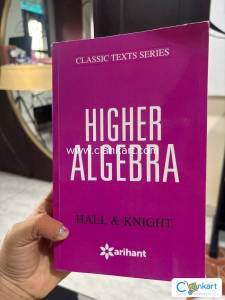
Arihant higher algebra hall& knight
The Classic Texts Series is the only of its kind selection of classic pieces of work that started off as bestseller and continues to be the bestseller even today. These classic texts have been designed so as to work as elementary textbooks which play a crucial role in building the concepts from scratch as in-depth knowledge of concepts is necessary for students preparing for various entrance exams.The present book on Higher Algebra presents all the elements of Higher Algebra in a single book meant to work as textbook for the students beginning their preparation of the varied aspects covered under Higher Algebra. The present book has been divided into 35 chapters namely Ratio Proportion Variation Arithmetical Progression Geometrical Progression Harmonical Progression Theorems Connected with The Progression Scales of Notation Surds Imaginary Quantities The Theory of Quadratic Equations Miscellaneous Equations Permutations Combinations Mathematical Induction Binomial Theorem Positive Integral Index Binomial Theorem Any Index Multinational Theorem Logarithms Exponential Logarithmic Series Interest Annuities Inequalities Limiting Values Vanishing Fractions Convergency Divergency of Series Undetermined Coefficients Partial Fractions Recurring Series Continued Fractions Recurring Series Continued Fractions Indeterminate Equations of the First Degree Recurring Continued Fractions Indeterminate Equations of the Second Degree Summation of Series Theory of Numbers The General Theory of Continued Fractions Probability Determinants Miscellaneous Theorems Examples and Theory of Equations each subdivided into number of topics. The first few chapters in the book have been devoted to a fuller discussion of Ratio Proportions Variation and the Progressions. Both the theoretical text as well as examples have been treated minutely which will help in better understanding of the concepts covered in the book. Theoretical expl
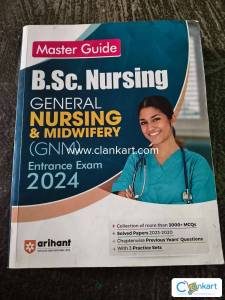
Master guide bsc nursing
1.The book provides the complete theory synced with the latest syllabus 2.The guide is divided into 6 Sections 3.More than 3000 MCQs are provided for quick revision 4.2 Solved papers are given to get the exam pattern 5.3 Crack sets are given for practice There is a great demand for highly skilled nurses around the globe today. Nursing is one of the noblest professions, where students are trained to give medical assistance. Various Medical universities and colleges conduct entrance examinations to give admission in B.Sc. Nursing dealing with General Nursing & Midwifery. The “Master Guide B.Sc. Nursing, General Nursing & Midwifery (GNM) Entrance Examination 2021” presents the entire syllabus in a Chapterwise manner along with a good collection of more than 3000 MCQs. Theories provided in the chapters, emphases on the silent features of the book. To make students familiar with the exam level, the book contains 2 solved papers and 3 practice sets followed by detailed solutions for every problem mentioned using student friendly language. It is a perfect study guide that promotes solid preparation for clearing the upcoming examination. TABLE OF CONTENT Solved Paper 2020-2019, Physics, Chemistry, Botany, Zoology, English, General Awareness, Practice (1-3)
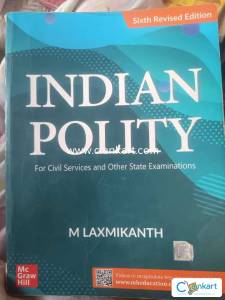
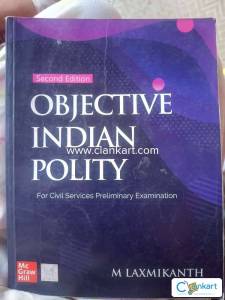
Objective Indian Polity
Presents India's greatest film-maker on the art and craft of films. Speaking of Films brings together some of Ray's most memorable writings on film and film-making. With the masterly precision and clarity that characterize his films, Ray discusses a wide array of subjects: the structure and language of cinema with special reference to his adaptations of Tagore and Bibhuti Bhushan Bandopadhyay, the appropriate use of background music and dialogue in films, the relationship between a film-maker and a film critic, and important developments in cinema like the advent of sound and colour. He also writes about his own experiences, the challenges of working with rank amateurs, and the innovations called for when making a film in the face of technological, financial and logistical constraints. In the process, Ray provides fascinating behind-the-scenes glimpses of the people who worked with him - the intricacies of getting Chhabi Biswas, who had no ear for music, to play a patron of classical music in Jalsaghar, the incredible memory of the seventy-five-year-old Chunibala Devi, Indir Thakrun of Pather Panchali, and her remarkable attention to details.
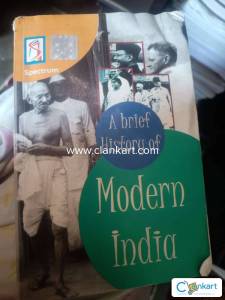
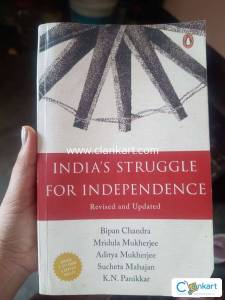
Modern India
Advent of the Europeans in India and the British consolidation of power in India besides incorporating additional information under several chapters. There are also chapters on the challenges that a newly independent nation faced in the wake of a brutal partition. The Nehruvian era is also briefly discussed. A survey of personalities associated with various movements, peasant and tribal movements, tables and charts are also given for quick reference.
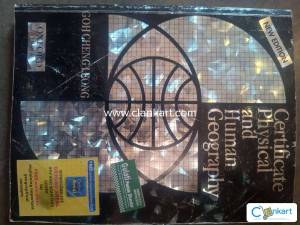
GC Leong ( Certificate Physical and Human geography)
This book is a textbook approach that aims at providing an understanding of our planet's physical topography, climatic and vegetative environment, and the relationship that human beings share across regions. The Physical Geography section deals with topics that span the planet's various topographies like the Earth's Crust, Weathering, Mass Movement and Groundwater; Landforms of Glaciation, The Ocean, Lakes, Coastal Landforms, etc. Each chapter has a questions section to help readers evaluate their understanding of the subject explained in that chapter. Various illustrations and photographs enhance the text, to enable all students to easily understand the concepts. Part two of the book, The Weather, Climate and Vegetation section, covers subjects like different climates and climatic zones like Equatorial, Savanna, Tropical or Arctic climates. Table Of Contents PART I PHYSICAL GEOGRAPHY 1. The Earth and the Universe 1 Exploring the Universe 2. The Earth's Crust 3. Vulcanism and Earthquakes 4. Weathering, Mass Movement and Groundwater 5. Landforms made by Running Water 6. Landforms of Glaciation 7. Arid or Desert Landforms 8. Limestone and Chalk Landforms 9. Lakes 66 General, 10. Coastal Landforms 11. Islands and Coral Reefs 12. The Oceans PART 2 WEATHER, CLIMATE AND VEGETATION 13. Weather 14. Climate 15. The Hot, Wet Equatorial Climate 16. The Tropical Monsoon and Tropical Marine Climates 17. The Savanna or Sudan Climate 18. The Hot Desert and Mid-Latitude Desert Cli-mates 19. The Warm Temperate Western Margin (Mediterranean) Climate 20. The Temperate Continental (Steppe) Climate 21. The Warm Temperate Eastern Margin (China Type) Climate 22. The Cool Temperate Western Margin (British Type) Climate 23, The Cool Temperate Continental (Siberian) Climate 24. The Cool Temperate Eastern Margin (Lauren-tian) Climate 25. The Arctic or Polar Climate .
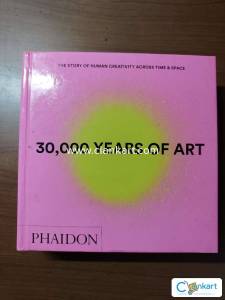
30,000 Years of Art
An accessible, comprehensive, freshly-updated celebration of the vast range of human artistry from 28,000 BC to todayBrought completely up to date for this revised edition and now available in a compact new format, this new edition of Phaidon's groundbreaking book presents art differently from all other compendia by revealing the huge diversity – or in many cases, the similarity – of artistic achievements around the globe. Images of more than 600 works from all periods and regions are arranged in chronological order, each with a short text that puts the work in critical context and explains its contribution to the development of art history.
The fountainhead
The revolutionary literary vision that sowed the seeds of Objectivism, Ayn Rand's groundbreaking philosophy, and brought her immediate worldwide acclaim.This modern classic is the story of intransigent young architect Howard Roark, whose integrity was as unyielding as granite...of Dominique Francon, the exquisitely beautiful woman who loved Roark passionately, but married his worst enemy...and of the fanatic denunciation unleashed by an enraged society against a great creator. As fresh today as it was then, Rand’s provocative novel presents one of the most challenging ideas in all of fiction—that man’s ego is the fountainhead of human progress...“A writer of great power. She has a subtle and ingenious mind and the capacity of writing brilliantly, beautifully, bitterly...This is the only novel of ideas written by an American woman that I can recall.”—The New York Times
The Art of seduction
The season's most talked-about all-purpose personal strategy guide and philosophical compendium," said Newsweek of Robert Greene's bold, elegant, and ingenious manual of modern manipulation, The 48 Laws of Power. Now Greene has once again mined history and literature to distill the essence of seduction, the most highly refined mode of influence, the ultimate power trip. The Art of Seduction is a masterful synthesis of the work of thinkers such as Freud, Ovid, Kierkegaard, and Einstein, as well as the achievements of the greatest seducers throughout history. From Cleopatra to John F. Kennedy, from Andy Warhol to Josephine Bonaparte, The Art of Seduction gets to the heart of the character of the seducer and his or her tactics, triumphs and failures. The seducer's many faces include: the Siren, the Rake, the Ideal Lover, the Dandy, the Natural, the Coquette, the Charmer, and the Charismatic. Twenty-four maneuvers will guide readers through the seduction process, providing cunning, amoral instructions for and analysis of this fascinating, all-pervasive form of power. Just as beautifully packaged and every bit as essential as The 48 Laws of Power, The Art of Seduction is an indispensable primer of persuasion and offers the best lessons on how to take what you want from whomever you want or how to prevent yourself from being taken.
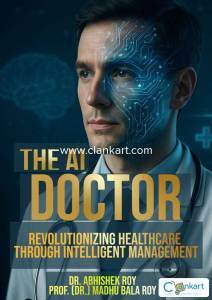
The AI Doctor: Revolutionizing Healthcare Through Intelligent Manageme
Healthcare has always been the most human of professionsdriven by compassion, trust, and the intimate relationship between caregiver and patient. Yet in recent decades, the complexity of medicine has grown beyond what any single individual can fully manage. Hospitals resemble small cities, medical records multiply into mountains of data, and the expectations on doctors, nurses, and administrators continue to expand. Into this environment enters artificial intelligence, not as a replacement for people, but as a partner that can amplify their strengths.The AI Doctor: Revolutionizing Healthcare Through Intelligent Management is written for those who want to understand this profound transformation. It is not a technical manual filled with complex codes and algorithms. Instead, it is a guide that explores how intelligencewhen carefully designed, ethically implemented, and wisely managedcan reshape every aspect of healthcare delivery. This book opens the door to a new era, one where data-driven insights, robotic precision, and digital management systems join hands with the timeless values of medicine: empathy, care, and human dignity.Each chapter takes readers on a journey into a different dimension of this transformation. We begin with the story of how medicine reached this pointfrom the trusted stethoscope that symbolized traditional practice to the supercomputers now capable of analyzing genetic codes in seconds. This historical lens allows us to appreciate both the remarkable progress and the constant challenges that have shaped the profession.From there, we move into the heart of data-driven diagnostics. Imagine a world where diseases are detected earlier than ever before because algorithms can sift through patterns invisible to the human eye. Far from replacing physicians, these tools support them in making more precise, faster, and more reliable decisions. At the same time, the book does not shy away from exploring the risks: bias in algorithms, gaps in data, and the ethical dilemmas that come with predicting human health.Readers will also be introduced to the smart hospital, an environment where management systems run seamlessly in the background. Instead of endless paperwork and administrative backlogs, we picture hospitals that function like living organisms responsive, efficient, and adaptive. In these chapters, the discussion extends beyond patient care to include supply chains, workforce coordination, and the invisible layers of decision-making that keep healthcare running.Surgical robotics and automated procedures add another dimension to this revolution. While machines can bring steadiness, accuracy, and endurance beyond human capacity, the heart of every procedure still relies on the judgment, empathy, and responsibility of the human professional. The book carefully balances excitement about these innovations with a sober reflection on what must remain deeply human.Management is another recurring theme. AI is not simply a clinical tool; it is a powerful force in administration. From scheduling beds to optimizing staff distribution, intelligent systems promise to reduce waste, cut costs, and give healthcare professionals the most precious resource of alltime with their patients. In presenting these possibilities, the book also calls for leaders who understand both technology and humanity, ensuring that digital solutions are applied with wisdom rather than haste.No exploration of AI in healthcare would be complete without addressing ethics. As machines become more involved in life-and-death decisions, how do we preserve fairness, accountability, and trust? This section of the book challenges readers to think beyond the technical and to engage with questions that will shape society itself.