Find from over 1000s of used books online
Buy Second Hand Books, Used Books Online In India

Cambridge IGCSE for Class 8
Develop your learners' skills in creative writing and writing for a purpose. Introduce your learners to creative writing and writing for a purpose. They'll learn about naming words with the Patel family as well as captions and lists on the farm, helping build their extended writing skills as they progress through the units. Each unit focuses on a different text type such as dialogue, recounts, reports or instructions. Model texts in each chapter show learners good examples of each writing type and specific activities are included to help them practise their grammar. Planning tools and an extended writing task develop learners' essential skills including editing, checking, planning and creative thinking.
Physics Galaxy (Mechanics)
Why This Book?Covers all key topics: Kinematics, Laws of Motion, Work-Energy, Rotational Motion, Gravitation & morePacked with solved examples, conceptual tricks, and practice problemsIdeal for self-study and revision trusted by toppers across IndiaPerfect condition, gently used, no markingsBonus: Includes access to online video lectures for deeper understanding!Whether you're building your foundation or sharpening your edge, Physics Galaxy Mechanics is your launchpad to success. Grab it now on Clankart before its gone!
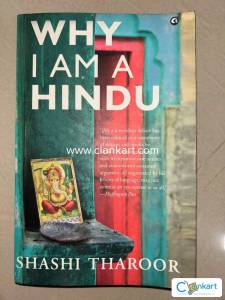
Why Im A Hindu
In Why I Am a Hindu, one of India’s finest public intellectuals gives us a profound book about one of the world’s oldest and greatest religions. Starting with a close examination of his own belief in Hinduism, he ranges far and wide in his study of the faith. He talks about the Great Souls of Hinduism, Adi Shankara, Patanjali, Ramanuja, Swami Vivekananda, Ramakrishna Paramahamsa, and many others who made major contributions to the essence of Hinduism. He delves deep into Hinduism’s most important schools of thought (such as the Advaita Vedanta). He explains, in easily accessible language, important aspects and concepts of Hindu philosophy like the Purusharthas and Bhakti, masterfully summarizes the lessons of the Gita and Vivekananda’s ecumenism, and explores with sympathy the ‘Hinduism of habit’ practised by ordinary believers. He looks at the myriad manifestations of political Hinduism in the modern era, including violence committed in the name of the faith by right-wing organizations and their adherents. He analyzes Hindutva, explains its rise and dwells at length on the philosophy of Deen Dayal Upadhyaya, its most significant ideologue. He is unsparing in his criticism of extremist ‘bhakts’, and unequivocal in his belief that everything that makes India a great and distinctive culture and country will be imperiled if religious ‘fundamentalists’ are allowed to take the upper hand. However, he also makes the point that it is precisely because Hindus form the majority that India has survived as a plural, secular democracy.A book that will be read and debated now and in the future, Why I Am a Hindu is a revelatory and original masterwork.
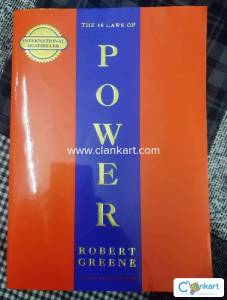
48 Laws of Power
Amoral, cunning, ruthless, and instructive, this piercing work distills three thousand years of the history of power in to forty-eight well explicated laws. As attention-grabbing in its design as it is in its content, this bold volume outlines the laws of power in their unvarnished essence, synthesizing the philosophies of Machiavelli, Sun-tzu, Carl von Clausewitz, and other great thinkers. Some laws teach the need for prudence ("Law 1: Never Outshine the Master"), the virtue of stealth ("Law 3: Conceal Your Intentions"), and many demand the total absence of mercy ("Law 15: Crush Your Enemy Totally"), but like it or not, all have applications in real life. Illustrated through the tactics of Queen Elizabeth I, Henry Kissinger, P. T. Barnum, and other famous figures who have wielded--or been victimized by--power, these laws will fascinate any reader interested in gaining, observing, or defending against ultimate control.
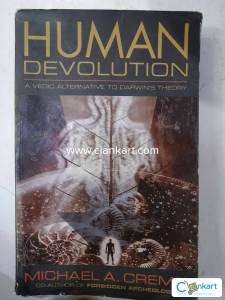
Human devolution
In their controversial bestseller Forbidden Archeology, Cremo and Thompson documented evidence showing that humans have existed on earth for hundreds of millions of years and catalyzed a global inquiry. Such anomalous evidence, contradicting Darwinian evolution, catalyzed a global inquiry: “If we did not evolve from apes then where did we come from?”Human Devolution is Michael A. Cremo’s definitive answer to that question: “We did not evolve up from matter; instead we devolved, or came down, from the realm of pure consciousness, spirit.” Basing his response on modern science and the world’s great wisdom traditions, including the Vedic philosophy of ancient India, Cremo proposes that before we ask the question, “Where did human beings come from?” we should first contemplate, “What is a human being?” For much of the twentieth century, most scientists assumed that a human being is simply a combination of ordinary physical elements. In Human Devolution, Cremo says it is more reasonable to assume that a human being is a combination of three distinct substances: matter, mind, and consciousness (or spirit). He shows how solid scientific evidence for a subtle mind element and a conscious self that can exist apart from the body has been systematically eliminated from mainstream science by a process of “knowledge filtration.”