Find from over 1000s of used books online
Buy Second Hand Books, Used Books Online In India
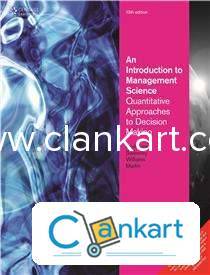
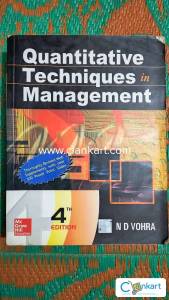
Introduction to Management Science
Key Features Trusted team of expert authors who are respected leaders and active consultants in the fields of business and statistics, provide unerring accuracy throughout the text presentation, problems, and test bank. Proven problem-scenario approach-a hallmark feature of this text-introduces each quantitative technique within an application setting. Students must apply the technique to a problem to generate a business solution or recommendation. Powerful actual examples offers even more real data that emphasizes application as well as solid management science and quantitative methodology. Integrated coverage of software applications most useful in today's business world equips students to use not only the new LINGO 10, but also Excel with quantitative add-ins. Coverage of Management Scientist, LINGO, and Excel with add-ins Crystal Ball, Tree Plan, and Premium Solver for Education appear in appendices and on the Student CD for maximum teaching flexibility. Dynamic, updated Student CD that accompanies the text now includes five chapters focusing on solution algorithms that were previously in the text; Excel worksheets and templates that correspond with text examples and models; the new Excel add-ins Crystal Ball Professional v7.2.1 (time-limited), Premium Solver for Education v6, and Tree Plan v1.64 Excel add-in for Decision Analysis; the new Lingo 10 trial edition software, and The Management Scientist 6.0 About the Book: An Introduction to Management Science: Quantitative Approaches to Decision Making Introduce your students to management science techniques withthe thorough, applications-oriented coverage you can trust from thedefinitive leader in traditional management science texts. Thebest-selling Anderson/Sweeney/Williams/Martin's Introduction toManagement Science: A Quantitative Approach to Decision Making,13E, has helped define the topical coverage presented withintoday's management science course curriculum. This book provides athorough grounding in ma
Fundamentals of Database Systems Author(s) Ramez Elmasri, Shamkant B.
Responding to the requests of database professors nationwide,the leading textbook for the introductory database management course is being fully revised in time for the startof Fall 1999 classes. Fundamentals of Database Systems, Third Edition is updated to reflect the latest developments indatabase research and practice. It combines clear explanations of theory and real systems, broad coverage of modeling and design of databases, and excellent examples with up-to-date introductions to modern database technology. Features of the Third Edition Presents clear and complete discussion of the relational approach including modeling, design, and query languages Reorganized material on data modeling to clearly separate entity relationship modeling, extended entity relationship modeling, and object-oriented modeling NEW! Gives examples of real database systems - Oracle and Microsoft Access - in Ch. 10 NEW and EXPANDED! Provides coverage of the object-oriented and object relational approach to data management including ODMG and SQL3 NEW! Includes discussion of decision support applications of data warehousing and data mining, as well as emerging technologies of web databases, multimedia, and mobile databases NEW! Covers advanced modeling in the areas of active, temporal, and spatial databases NEW! Discusses current database application areas of GIS, genome, and digital libraries
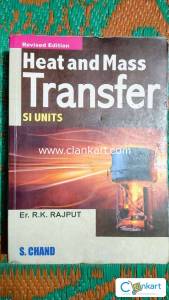
Heat and Mass Transfer Author(s) R.K. Rajput
“Hear and Mass Transfer” is a comprehensive textbook for the students ofMechanical Engineering and a must-buy for the aspirants of different entranceexaminations including GATE and UPSC.Divided into 5 parts, the book delves into the subject beginning from BasicConcepts and goes on to discuss Heat Transfer (by Convection and Radiation)and Mass Transfer. The book also becomes useful as a question bank for studentsas it offers university as well as entrance exam questions with solutions.
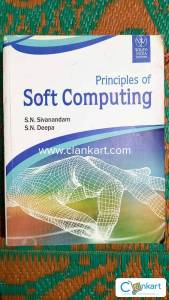
Principles Of Soft Computing Author(s) S.N. Sivanandam S.N. Deepa
In this book the basic concepts of soft computing are dealt in detail with the relevant information and knowledge available for understanding the computing process. The various neural network concepts are explained with examples, highlighting the difference between various architectures. Fuzzy logic techniques have been clearly dealt with suitable examples. Genetic algorithm operators and the various classifications have been discussed in lucid manner, so that a beginner can understand the concepts with minimal effort. The book can be used as a handbook as well as a guide for students of all engineering disciplines, soft computing research scholars, management sector, operational research area, computer applications and for various professionals who work in this area. B. Tech (UG) students of ?CSE ?IT ?ECE College Libraries Research Scholars Operational Research Management SectorIn this book the basic concepts of soft computing are dealt in detail with the relevant information and knowledge available for understanding the computing process. The various neural network concepts are explained with examples, highlighting the difference between various architectures. Fuzzy logic techniques have been clearly dealt with suitable examples. Genetic algorithm operators and the various classifications have been discussed in lucid manner, so that a beginner can understand the concepts with minimal effort. The book can be used as a handbook as well as a guide for students of all engineering disciplines, soft computing research scholars, management sector, operational research area, computer applications and for various professionals who work in this area. Introduction Artificial Neural Network: An Introduction Supervised Learning Network Associative Memory Networks Unsupervised Learning Networks Special Networks Introduction to Fuzzy Logic, Classical Sets and Fuzzy Sets Classical Relations and Fuzzy Relations Membership Functions Defuzzification Fuzzy Arithmetic and Fuzzy Measu
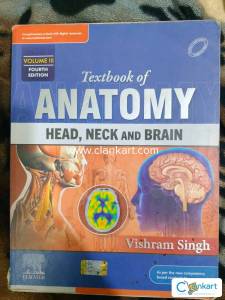
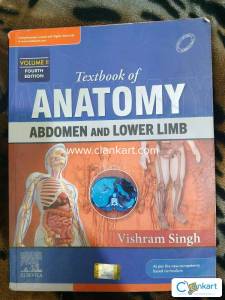
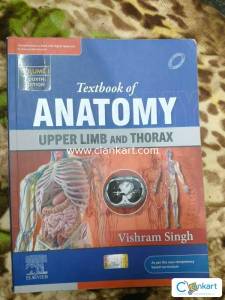
Vishram singh
Third edition of this book is thoroughly revised and updated in accordance with the syllabus of anatomy recommended by the Medical Council of India. It covers in detail the anatomy of upper limb and thorax. The anatomy of heart and lungs is co-related clinically in depth. Following recent trends of anatomy education, the book in addition to basic information provides knowledge on anatomical/embryological/histological/genetic basis of common clinical problems through its features — Clinical Correlation and Clinical Case Study. Written in simple and easy-to-understand language, this profusely illustrated book provides the knowledge of anatomy without extraneous details. The specific learning objectives have been given in the beginning of each chapter to facilitate self-learning by the students. Ideal for UG medical and dental students, NEET PG entrance examinations, USMLE, PLAB, FMGE, etc. Thorough revision of all the chapters Detailed exposition on joints and nerves of the upper limb Surgical anatomy of heart, lungs, trachea and oesophagus Clinical Correlations integrated in the text, highlighting clinical application of anatomical facts, have been updated extensively Golden Facts to Remember at the end of each chapter highlight the salient and important points for the purpose of viva-voce and competitive exams Clinical Case Study at the end of each chapter to initiate interest of students in problem based learning (PBL) Additional information of higher academic value presented in a simple way in N.B. to inculcate interest among readers, especially postgraduates Important facts useful for candidates appearing in various entrance examinations like PGME, USMLE, PLAB, listed under Golden Facts to Remember Multiple Choice Questions at the end of the book for self-assessment of the topics studied Core competencies prescribed by the MCI are covered and competency codes are included in the text Core competencies prescribed by the MCI are covered and competency codes are included in the text
Vishram singh, textbook of anatomy
Third edition of this book is thoroughly revised and updated in accordance with the syllabus of anatomy recommended by the Medical Council of India. It covers in detail the anatomy of upper limb and thorax. The anatomy of heart and lungs is co-related clinically in depth. Following recent trends of anatomy education, the book in addition to basic information provides knowledge on anatomical/embryological/histological/genetic basis of common clinical problems through its features — Clinical Correlation and Clinical Case Study. Written in simple and easy-to-understand language, this profusely illustrated book provides the knowledge of anatomy without extraneous details. The specific learning objectives have been given in the beginning of each chapter to facilitate self-learning by the students. Ideal for UG medical and dental students, NEET PG entrance examinations, USMLE, PLAB, FMGE, etc. - Thorough revision of all the chapters - Detailed exposition on joints and nerves of the upper limb - Surgical anatomy of heart, lungs, trachea and oesophagus - Clinical Correlations integrated in the text, highlighting clinical application of anatomical facts, have been updated extensively - Golden Facts to Remember at the end of each chapter highlight the salient and important points for the purpose of viva-voce and competitive exams - Clinical Case Study at the end of each chapter to initiate interest of students in problem based learning (PBL) - Additional information of higher academic value presented in a simple way in N.B. to inculcate interest among readers, especially postgraduates - Important facts useful for candidates appearing in various entrance examinations like PGME, USMLE, PLAB, listed under Golden Facts to Remember - Multiple Choice Questions at the end of the book for self-assessment of the topics studied - Core competencies prescribed by the MCI are covered and competency codes are included in the text - Core competencies prescribed by the MCI are covered and competency codes are included in the text