Find from over 1000s of used books online
Buy Second Hand Books, Used Books Online In India
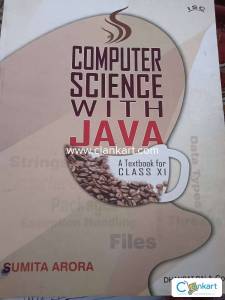
Sumita arora
Written in Accordance with CBSE Syllabus for Board Examination to be Held in 2009 and 2010 This textbook is a sequel to the Textbook of Computer Science for Class XI. It is written in a simple, direct style for maximum clarity. It comprehensively covers the Class XII CBSE syllabus of Computer Science (subject code 083). The goal of the book is to develop the student’s proficiency in fundamentals and make the learning process creative, engrossing and interesting. There are practice exercises and questions throughout the text, designed on the pattern of sample question papers published by CBSE. The approach of this book is to teach the students through extensive “skill and drill” type exercises in order to make them high-ranking achievers in the Board examinations. KEY FEATURES Provides accurate and balanced coverage of topics as prescribed in the CBSE syllabus code 083. Builds a solid programming foundation in C++. Students can prepare a Practical File with solved programming examples given in the text. End-of-chapter questions help teachers prepare assignments for self-practice by the students. End-of-chapter Programming Exercises help students in preparing for the Board practical examination. Solved questions at the end of each chapter prepare students for the Board theory examination. For further guidance on how to use this book effectively, e-mail the author using seema_591@rediffmail.com
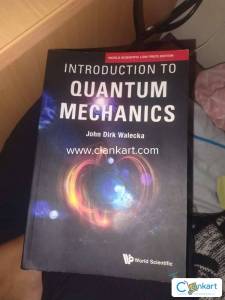
Introduction to Quantum Mechanics
The author has published two texts on classical physics, Introduction to Classical Mechanics and Introduction to Electricity and Magnetism, both meant for initial one-quarter physics courses. The latter is based on a course taught at Stanford several years ago with over 400 students enrolled. These lectures, aimed at the very best students, assume a good concurrent course in calculus; they are otherwise self-contained. Both texts contain an extensive set of accessible problems that enhances and extends the coverage. As an aid to teaching and learning, the solutions to these problems have now been published in additional texts.The present text completes the first-year introduction to physics with a set of lectures on Introduction to Quantum Mechanics, the very successful theory of the microscopic world. The Schroedinger equation is motivated and presented. Several applications are explored, including scattering and transition rates. The applications are extended to include quantum electrodynamics and quantum statistics. There is a discussion of quantum measurements. The lectures then arrive at a formal presentation of quantum theory together with a summary of its postulates. A concluding chapter provides a brief introduction to relativistic quantum mechanics. An extensive set of accessible problems again enhances and extends the coverage.The goal of these three texts is to provide students and teachers alike with a good, understandable, introduction to the fundamentals of classical and quantum physics.
BBA 1st YEAR AI AND DS BOOKS
This book provides detailed information on various instruments, techniques and experiment protocols of biochemistry and molecular biology. It deals with basic as well as advanced information and in-depth methodology in simple language to help students and professionals to perform experiments with ease. This book not only clears the practical concepts of Biochemistry and Molecular Biology at undergraduate and post-graduation levels, but also helps to pass the Ph.D. course work exam conducted by various universities. This book will develop research aptitude to clear the NET examination. This manual gives a comprehensive idea about the various instruments, their working, troubleshooting and their applications. It provides a wide spectrum of 14 chapters covering basic as well as advanced techniques and instrumentation, viz., Gas Chromatography (GC), Mass Spectrometry (MS), Scanning Electron Microscope (SEM), X-Ray Diffraction (XRD) and Fourier Transform Infrared Spectroscopy (FTIR) with detailed protocols. Most of the experiments can be easily performed in the laboratory having basic facilities. Historical background, experiment nature, its principle, step-by-step procedure with diagrammatic representation and important precautions are given in the beginning of each experiment.