Clankart Logo

Find from over 1000s of used books online

Buy Second Hand Books, Used Books Online In India
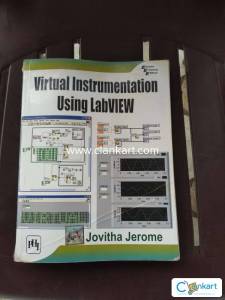
Virtual Instrumentation

Virtual Instrumentation

₹230

This book provides a practical and accessible understanding of the fundamental principles of virtual instrumentation. It explains how to acquire, analyze and present data using LabVIEW (Laboratory Virtual Instrument Engineering Workbench) as the application development environment. The book introduces the students to the graphical system design model and its different phases of functionality such as design, prototyping and deployment. It explains the basic concepts of graphical programming and highlights the features and techniques used in LabVIEW to create Virtual Instruments (VIs). Using the technique of modular programming, the book teaches how to make a VI as a subVI. Arrays, clusters, structures and strings in LabVIEW are covered in detail.The book also includes coverage of emerging graphical system design technologies for real-world applications. In addition, extensive discussions on data acquisition, image acquisition, motion control and LabVIEW tools are presented. This book is designed for undergraduate and postgraduate students of instrumentation and control engineering, electronics and instrumentation engineering, electrical and electronics engineering, electronics and communication engineering, and computer science and engineering. It will be also useful to engineering students of other disciplines where courses in virtual instrumentation are offered. Table of Contents Foreword Preface 1. GRAPHICAL SYSTEM DESIGN 2. INTRODUCTION TO LabVIEW 3. MODULAR PROGRAMMING 4. REPETITION AND LOOPS 5. ARRAYS 6. CLUSTERS 7. PLOTTING DATA 8. STRUCTURES 9. STRINGS AND FILE I/O 10. INSTRUMENT CONTROL 11. DATA ACQUISITION 12. IMAQ VISION 13. MOTION CONTROL 14. LabVIEW TOOLS AND GSD APPLICATIONS Index

7 months ago
Advertisement
Want to see your books here? Have Used Books?
Make some extra cash by selling your old books for actual money in your UPI/Bank account. Go on, it's quick and easy.
CHEMICAL PROCESS CONTROL

CHEMICAL PROCESS CONTROL

₹250 ₹350
29% off

Designed as an undergraduate-level textbook in Chemical Engineering, this student-friendly, thoroughly class-room tested book, now in its second edition, continues to provide an in-depth analysis of chemical engineering thermodynamics. The book has been so organized that it gives comprehensive coverage of basic concepts and applications of the laws of thermodynamics in the initial chapters, while the later chapters focus at length on important areas of study falling under the realm of chemical thermodynamics. The reader is thus introduced to a thorough analysis of the fundamental laws of thermodynamics as well as their applications to practical situations. This is followed by a detailed discussion on relationships among thermodynamic properties and an exhaustive treatment on the thermodynamic properties of solutions. The role of phase equilibrium thermodynamics in design, analysis, and operation of chemical separation methods is also deftly dealt with. Finally, the chemical reaction equilibria are skillfully explained. Besides numerous illustrations, the book contains over 200 worked examples, over 400 exercise problems (all with answers) and several objective-type questions, which enable students to gain an in-depth understanding of the concepts and theory discussed. The book will also be a useful text for students pursuing courses in chemical engineering-related branches such as polymer engineering, petroleum engineering, and safety and environmental engineering. New to This Edition • More Example Problems and Exercise Questions in each chapter • Updated section on Vapour–Liquid Equilibrium in Chapter 8 to highlight the significance of equations of state approach • GATE Questions up to 2012 with answers

7 months ago
Advertisement
VLSI Design book

VLSI Design book

₹200

This text is intended for the undergraduate engineering students in Electrical and Electronics Engineering, Electronics and Communication Engineering, and Electronics and Instrumentation Engineering, and those pursuing postgraduate courses in Applied Electronics and VLSI Design. With the electronic devices and chips becoming smaller and smaller, the sizes of circuits and transistors on the microchips are approaching atomic levels. And so, Very Large-Scale Integration (VLSI) Design refers to the process of placing hundreds of thousands of electronic components on a single chip which nearly all modern computer architectures employ, and this technology has assumed a significant role in today's tech savvy world. This well-organized, up-to-date and compact text explains the basic concepts of MOS technology including the fabrication methods, MOS characteristic behaviour, and design processes for layouts, etc. in a crisp and easy-to-learn style. The latest and most advanced techniques for maximising performance, minimising power consumption, and achieving rapid design turnarounds are discussed with great skill by the authors. Key Features ? Gives an in-depth analysis of MOS structure, device characteristics, modelling and MOS device fabrication techniques. ? Provides detailed description of CMOS design of combinatorial, sequential and arithmetic circuits with emphasis on practical applications. ? Offers an insight into the CMOS testing techniques for the design of VLSI circuits. ? Gives a number of solved problems in VHDL and Verilog languages. ? Provides a number of short answer questions to help the students during examinations.

7 months ago
Advertisement
Advertisement
Advertisement