Find from over 1000s of used books online
Buy Second Hand Books, Used Books Online In India

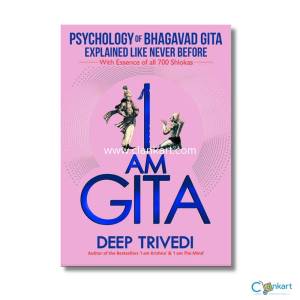
I AM GITA BY DEEP TRIVEDI - PSYCHOLOGY OF BHAGAVAD GITA
THE PSYCHOLOGY OF BHAGAVAD GITA EXPLAINED LIKE NEVER BEFORE!Moments before the Mahabharata war, Arjuna says, ‘I don’t wish to slay my brothers or commit violence just to gain a kingdom; even the scriptures forbid this!’ Are you in agreement with Arjuna? Why did Krishna disagree with Arjuna? Did Krishna incite Arjuna to fight the war or did he show him the right path? Can there be valid reasons for committing violence and waging a war? Who is right—Krishna or Arjuna? Why did it take Krishna all of 18 chapters to convince Arjuna?Certainly, Gita is one but the questions are many! And Gita is the epitome of psychology, as Krishna is the first psychologist of human history; and it is spiritual psychology alone that can accurately answer all the questions related to mind and life. Yet, the psychological aspects of Gita have always been ignored.‘I am Gita’ is the first-ever book on Bhagavad Gita that elucidates the essence of all 700 shlokas along with its psychological and spiritual dimension in totality. In the book, Arjuna poses his questions in first person, and Krishna also answers in first person, which makes the conversation between Krishna and Arjuna come alive. Imparting the thrill of a story, the book, penned in a simple language, will help people of all age groups grasp the true essence of the Gita effortlessly.Deep Trivedi is the author of several bestsellers such as ‘I am Krishna’, ‘I am The Mind’, ‘Everything is Psychology’ and many more. He holds an international record for conducting 168 hours of workshops on the Bhagavad Gita. He has also been awarded with an Honorary Doctorate for his works on the psychology of Bhagavad Gita.This book is available in English, Hindi, Marathi and Gujarati at leading book stores and e-commerce sites.
These hills called home
More than half a century of bloodshed has marked the history of the Naga people who live in the troubled northeastern region of India. Their struggle for an independent Nagaland and their continuing search for identity provides the backdrop for the stories that make up this unusual collection. Describing how ordinary people cope with violence, how they negotiate power and force, how they seek and find safe spaces and enjoyment in the midst of terror, the author details a way of life under threat from the forces of modernization and war. No one the young, the old, the ordinary housewife, the willing partner, the militant who takes to the gun, and the young woman who sings even as she is being raped is untouched by the violence. Theirs are the stories that form the subtext of the struggles that lie at the internal faultlines of the Indian nation-state. These are stories that speak movingly of home, country, nation, nationality, identity, and direct the reader to the urgency of the issues that lie at their heart.
The Alchemist
Like the one-time bestseller Jonathan Livingston Seagull, The Alchemist presents a simple fable, based on simple truths and places it in a highly unique situation. And though we may sniff a bestselling formula, it is certainly not a new one: even the ancient tribal storytellers knew that this is the most successful method of entertaining an audience while slipping in a lesson or two. Brazilian storyteller Paulo Coehlo introduces Santiago, an Andalusian shepherd boy who one night dreams of a distant treasure in the Egyptian pyramids. And so he's off: leaving Spain to literally follow his dream. Along the way he meets many spiritual messengers, who come in unassuming forms such as a camel driver and a well-read Englishman. In one of the Englishman's books, Santiago first learns about the alchemists--men who believed that if a metal were heated for many years, it would free itself of all its individual properties, and what was left would be the "Soul of the World." Of course he does eventually meet an alchemist, and the ensuing student-teacher relationship clarifies much of the boy's misguided agenda, while also emboldening him to stay true to his dreams. "My heart is afraid that it will have to suffer," the boy confides to the alchemist one night as they look up at a moonless night. "Tell your heart that the fear of suffering is worse than the suffering itself," the alchemist replies. "And that no heart has ever suffered when it goes in search of its dreams, because every second of the search is a second's encounter with God and with eternity." --Gail Hudson
The Darkest Legacy
It’s five years since the destruction of the rehabilitation camps that imprisoned Zu and her friends … but the battle is far from over.Seventeen-year-old Suzume ‘Zu’ Kimura has assumed the role of spokesperson for the interim government, fighting for the rights of the kids once persecuted for their powers. But though they are no longer imprisoned, the Psi still face huge prejudice, and a growing tide of misinformation.When Zu is accused of committing a horrifying act, she is forced to go on the run in order to stay alive. Determined to clear her name, Zu travels in search of safety and answers, but soon uncovers a dark truth that threatens the future of all Psi. With enemies everywhere, who can she trust to help her fight back and save the friends who were once her protectors?