Buy used Science and Mathematics Textbooks books online in India
Buy Second Hand Books, Used Books Online In India
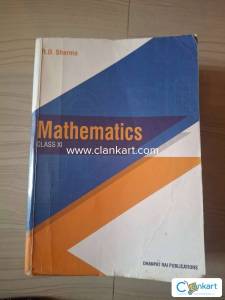
R.D Sharma Mathematics for class 11
Mathematics for Class XI Mathematics is one of the roost important subjects which not only decides the careers of many a young students but also-enhances their ability of analytical and rational thinking.This book contains a large number of well graded solved examples. Students are advised to practice these solved examples on their own without looking at the solutions, they may look at the solutions if they are unable to solve them. This would help them in developing confidence to attempt unsolved exercises. This is very important if one wants to score well in the examination. One should be able to workout unsolved exercises also. New illustrative examples and problems have been added in the exercises in each chapter. In each chapter all concepts and definitions have been discussed in detail in a lucid manner and have also been explained with suitable illustrative examplesKey FeaturesDetailed theory with illustrationsAlgorithmic approachLarge number of graded solved/unsolved examples and exercisesBrief Summary consisting of concepts and formulaeIt is hoped that with all these unique features the book will fulfill the needs of students.About The Author Dr. R.D. Sharma is currently working as Head of Deptt. (Science and Humanities) under the Directorate of Technical Education, Delhi. A Ph. D in Mathematics, he is a double gold medalist, ranking first in the order of merit in both B.Sc (Hons.) and M.Sc. Examinations from the University of Rajasthan, Jaipur.He has undergone rigorous training from HT, Kharagpur in computer-oriented mathematical methods and has a long experience of teaching post graduate, graduate and engineering students. Table Of Contents1. Sets2. Relations 3. Functions 4. Measurement Of Angles 5. Trigonometric Functions 6. Graphs Of Trigonometric Functions 7. Trigonometric Ratios Of Compound Angles 8. Transformation Formula 9. Trigonometric Ratios Of Multiple And Sub multiple Angles 10. Sine And Cosine Formula And Their Applications 11. Trigo
Sl loney trigonometry
The Classic Text Series is the only of its kind selection of classic pieces of work that started off as bestseller and continues to be the bestseller even today. These classic texts have been designed so as to work as elementary textbooks which play a crucial role in building the concepts from scratch as in-depth knowledge of concepts is necessary for students preparing for various entrance examinations.The present book on Plane Trigonometry Part 1 emphasis on presenting the modern treatment of various concepts of Plane Trigonometry. The book has been divided into 21 chapters namely Measurement of angles Sexagesimal and Centesimal Measure Circular or Radian Measure Trigonometrical ratios for angles less than a right angle Simple problems in Heights Distances Applications of algebraic signs to Trigonometry tracing the changes in the ratios Trigonometrical ratios of angles of any size sign General expressions for all angles having an given trigonometrical ratio Trigonometrical ratios of the sum difference of two angles product formulae Trigonometrical ratios of multiple submultiple of angles Identities trigonometrical equations Logarithms Tables of Logarithms The Principle of Proportional parts Relations between the Side Trigonometrical ratios of the Angles of a triangle Solution of triangles given two sides the included angle ambiguous case Heights Distances Properties of a triangle Quadrilaterlas Regular Polygons Inverse circular functions Summation of some simple trigonometrical series Elimination and Projections each covering various concepts of Plane Trigonometry. Theoretical explanation of the concepts in points has been provided at the beginning of each chapter. At the end of each chapter unsolved practice exercises have been provided to help aspirants revise the concepts discussed in the chapter. At the end of chapterwise study miscellaneous examples have also been given. Also five-figure logarithmic and T
Mathematics by R.D. SHARMA for Class 6
Learn Python Quickly, A Programmer-Friendly GuideDESCRIPTIONMost Programmer's learning Python are usually comfortable with some or the other programming language and are not interested in going through the typical learning curve of learning the first programming language. Instead, they are looking for something that can get them off the ground quickly. They are looking for similarities and differences in a feature that they have used in other language(s). This book should help them immediately. It guides you from the fundamentals of using module through the use of advanced object orientation. KEY FEATURESStrengthens the foundations, as detailed explanation of programming language concepts are given in simple manner. Lists down all the important points that you need to know related to various topics in an organized manner.Prepares you for coding related interview and theoretical questions.Provides In depth explanation of complex topics and Questions.Focuses on how to think logically to solve a problem.Follows a systematic approach that will help you to prepare for an interview in short duration of time.Exercises are exceptionally useful to complete the reader's understanding of a topic. WHAT WILL YOU LEARNData types, Control flow instructions, console & File Input/OutputStrings, list & tuples, List comprehensionSets & Dictionaries, Functions & LambdasDictionary ComprehensionModules, classes and objects, InheritanceOperator overloading, Exception handlingIterators & Generators, Decorators, Command-line Parsing WHO THIS BOOK IS FORStudents, Programmers, researchers, and software developers who wish to learn the basics of Python programming language. Table of Contents 1. Introduction to Python2. Python Basics 3. Strings4. Decision Control Instruction5. Repetition Control Instruction6. Console Input/Output7. Lists8. Tuples9. Sets10. Dictionaries11. Comprehensions12. Functions13. Recursion14. Functional Programming15. Modules and Packages16. Namespaces17. Classes and Objects18. Intricacies of Classes and Objects19. Con
Hc verma physics ( bhautiki ki samjh)
From the foreward of this 462 page "Dr. Verma's book has been divided into two parts because of the size of the manuscript. It is a totally different attempt to teach physics, and it will be extremely useful to the undergraduate students. The exposition of each concept is extremely lucid. In carefully formatted chapters, besides problems and short questions, a number of objective questions have also been included. This book can certainly be extremely useful not only as a textbook, but also for preparation of various competitive examinations." Y. R. Waghmare, Professor of Physics, IIT Kanpur
Higher algebra for b.tech foundation
The Classic Texts Series is the only of its kind selection of classic pieces of work that started off as bestseller and continues to be the bestseller even today. These classic texts have been designed so as to work as elementary textbooks which play a crucial role in building the concepts from scratch as in-depth knowledge of concepts is necessary for students preparing for various entrance exams.The present book on Higher Algebra presents all the elements of Higher Algebra in a single book meant to work as textbook for the students beginning their preparation of the varied aspects covered under Higher Algebra. The present book has been divided into 35 chapters namely Ratio Proportion Variation Arithmetical Progression Geometrical Progression Harmonical Progression Theorems Connected with The Progression Scales of Notation Surds Imaginary Quantities The Theory of Quadratic Equations Miscellaneous Equations Permutations Combinations Mathematical Induction Binomial Theorem Positive Integral Index Binomial Theorem Any Index Multinational Theorem Logarithms Exponential Logarithmic Series Interest Annuities Inequalities Limiting Values Vanishing Fractions Convergency Divergency of Series Undetermined Coefficients Partial Fractions Recurring Series Continued Fractions Recurring Series Continued Fractions Indeterminate Equations of the First Degree Recurring Continued Fractions Indeterminate Equations of the Second Degree Summation of Series Theory of Numbers The General Theory of Continued Fractions Probability Determinants Miscellaneous Theorems Examples and Theory of Equations each subdivided into number of topics. The first few chapters in the book have been devoted to a fuller discussion of Ratio Proportions Variation and the Progressions. Both the theoretical text as well as examples have been treated minutely which will help in better understanding of the concepts covered in the book. Theoretical expl
Understanding Analysis Hardcover
This book outlines an elementary, one-semester course that exposes students to both the process of rigor, and the rewards inherent in taking an axiomatic approach to the study of functions of a real variable. The aim of a course in real analysis should be to challenge and improve mathematical intuition rather than to verify it. The philosophy of this book is to focus attention on questions which give analysis its inherent fascination.This new edition is extensively revised and updated with a refocused layout. In addition to the inclusion of extra exercises, the quality and focus of the exercises in this book has improved, which will help motivate the reader. New features include a discussion of infinite products, and expanded sections on metric spaces, the Baire category theorem, multi-variable functions, and the Gamma function.Reviews from the first edition:"This is a dangerous book. Understanding Analysis is so well-written and the development of the theory so well-motivated that exposing students to it could well lead them to expect such excellence in all their textbooks. ... Understanding Analysis is perfectly titled; if your students read it that s what s going to happen. This terrific book will become the text of choice for the single-variable introductory analysis course; take a look at it next time you re preparing that class."-Steve Kennedy, The Mathematical Association of America, 2001"Each chapter begins with a discussion section and ends with an epilogue. The discussion serves to motivate the content of the chapter while the epilogue points tantalisingly to more advanced topics. ... I wish I had written this book! The development of the subject follows the tried-and-true path, but the presentation is engaging and challenging. Abbott focuses attention immediately on the topics which make analysis fascinating ... and makes them accessible to an inexperienced audience."-Scott Sciffer, The Australian Mathematical Society Gazette, 29:3, 2002"