Buy used Business & Economics books online in India
Buy Second Hand Books, Used Books Online In India
RICH DAD POOR DAD
April 2017 marks 20 years since Robert Kiyosaki’s Rich Dad Poor Dad first made waves in the Personal Finance arena.It has since become the #1 Personal Finance book of all time... translated into dozens of languages and sold around the world.Rich Dad Poor Dad is Robert's story of growing up with two dads — his real father and the father of his best friend, his rich dad — and the ways in which both men shaped his thoughts about money and investing. The book explodes the myth that you need to earn a high income to be rich and explains the difference between working for money and having your money work for you.20 Years... 20/20 HindsightIn the 20th Anniversary Edition of this classic, Robert offers an update on what we’ve seen over the past 20 years related to money, investing, and the global economy. Sidebars throughout the book will take readers “fast forward” — from 1997 to today — as Robert assesses how the principles taught by his rich dad have stood the test of time.In many ways, the messages of Rich Dad Poor Dad, messages that were criticized and challenged two decades ago, are more meaningful, relevant and important today than they were 20 years ago.As always, readers can expect that Robert will be candid, insightful... and continue to rock more than a few boats in his retrospective.Will there be a few surprises? Count on it.Rich Dad Poor Dad...• Explodes the myth that you need to earn a high income to become rich• Challenges the belief that your house is an asset• Shows parents why they can't rely on the school system to teach their kids about money• Defines once and for all an asset and a liability• Teaches you what to teach your kids about money for their future financial success
Tr jain statistics for economics book 2023-24
The CBSE board has recently shown a bent towards analysis and interpretation based questions under the label of ‘competency- based questions’. This book is prepared according to revised syllabus and new paper pattern. ‘The Same but Different’: Revised and restructured on positive feedback, the Statistics for Economics Textbook is all geared up to provide its readers step by step comprehension of the subject matter. Novelties of the text include: 1. NEW TYPOLOGY OF QUESTIONS: (Image/Data interpretation, defend and refute type questions etc.) have been incorporated in each chapter. 2. ‘BRAIN TEASER’ BLOCKS: Implication based questions related to current happenings around have been incorporated in each chapter. These help gauge the inferences the students are able to draw from the text and how easily they are able to relate economic theory to the ground level realities. 3. OTHERS: HOTS & Focus Zones DAV Board Question Paper (Solved) Sample Paper By “VK Global Study Group”[A specimen paper woven along the same structure and blueprint as suggested in the CBSE released Sample Question Paper-2023.]
Warren Buffett's Management Secrets
The book is divided into several sections covering Warren Buffett's personal business management: . Managing one's life - focuses on Buffett's insistence on a good education, picking one's heroes early in life, and staying away from things that damage you personally. The authors also discuss Buffett's belief that challenges make life interesting. . Managing One's Career - Buffett believes that you should work at something that you are passionate about. Do what you like and you will find a way to make money. Do what you hate and you will be miserable even if you are rich. . Managing Employees - place honesty on the same level as intelligence as a managerial attribute. How to keep managers inspired and working hard. . Managing the Business - Buffett has learned that companies that have a durable competitive advantage over their competitors consistently earn more money year after year and are the easiest to manage. . Managing of Personal Money - discover the simple rules that Buffett uses for buying other businesses and how he has incorporated them into his own personal investment style.
After Pickett
Thomas Piketty's Capital in the Twenty-First Century is the most widely discussed work of economics in recent history, selling millions of copies in dozens of languages. But are its analyses of inequality and economic growth on target? Where should researchers go from here in exploring the ideas Piketty pushed to the forefront of global conversation? A cast of economists and other social scientists tackle these questions in dialogue with Piketty, in what is sure to be a much-debated book in its own right.After Piketty opens with a discussion by Arthur Goldhammer, the book's translator, of the reasons for Capital's phenomenal success, followed by the published reviews of Nobel laureates Paul Krugman and Robert Solow. The rest of the book is devoted to newly commissioned essays that interrogate Piketty's arguments. Suresh Naidu and other contributors ask whether Piketty said enough about power, slavery, and the complex nature of capital. Laura Tyson and Michael Spence consider the impact of technology on inequality. Heather Boushey, Branko Milanovic, and others consider topics ranging from gender to trends in the global South. Emmanuel Saez lays out an agenda for future research on inequality, while a variety of essayists examine the book's implications for the social sciences more broadly. Piketty replies to these questions in a substantial concluding chapter.An indispensable interdisciplinary work, After Piketty does not shy away from the seemingly intractable problems that made Capital in the Twenty-First Century so compelling for so many.
Impactful communication
Impactful Communication: Communicate to Conquer is an all-inclusive resource package based on the author’s first-hand experience in the field of communication. In today’s world of artificial intelligence and social media where organizations demand sharp communication skills, the book carries tools to effectively deal with the conventional and nonconventional aspects of verbal and nonverbal communication in varied situations and with different stakeholders. It discusses the art of communication by evaluating its barriers and the 7 vital Cs of communication. While highlighting the importance of listening, the book explores the challenges of communication in the era of artificial intelligence, and shares insights into maintaining the personal touch of communication in a highly non-personalized world. Impactful Communication is a user-friendly guide with numerous enlightening illustrations for new professionals and managers entering the corporate world.
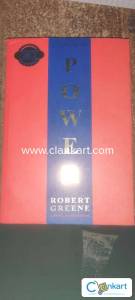
48 Laws of POWER
Amoral, cunning, ruthless, and instructive, this piercing work distills three thousand years of the history of power in to forty-eight well explicated laws. As attention-grabbing in its design as it is in its content, this bold volume outlines the laws of power in their unvarnished essence, synthesizing the philosophies of Machiavelli, Sun-tzu, Carl von Clausewitz, and other great thinkers. Some laws teach the need for prudence ("Law 1: Never Outshine the Master"), the virtue of stealth ("Law 3: Conceal Your Intentions"), and many demand the total absence of mercy ("Law 15: Crush Your Enemy Totally"), but like it or not, all have applications in real life. Illustrated through the tactics of Queen Elizabeth I, Henry Kissinger, P. T. Barnum, and other famous figures who have wielded--or been victimized by--power, these laws will fascinate any reader interested in gaining, observing, or defending against ultimate control.
Be a Next Level Entrepreneur
From Jim Collins, the most influential business thinker of our era, comes an ambitious upgrade of his classic, Beyond Entrepreneurship, that includes all-new findings and world-changing insights.What's the roadmap to create a company that not only survives its infancy but thrives, changing the world for decades to come?Nine years before the publication of his epochal bestseller Good to Great, Jim Collins and his mentor, Bill Lazier, answered this question in their bestselling book, Beyond Entrepreneurship.Beyond Entrepreneurship left a definitive mark on the business community, influencing the young pioneers who were, at that time, creating the technology revolution that was birthing in Silicon Valley. Decades later, successive generations of entrepreneurs still turn to the strategies outlined in Beyond Entrepreneurship to answer the most pressing business questions.Beyond Entrepreneurship 2.0 is a new and improved version of the book that Jim Collins and Bill Lazier wrote years ago. In this upgraded edition, Jim Collins honours his mentor, Bill Lazier, who passed away in 2004, and reexamines the original text of Beyond Entrepreneurship with his 2020 perspective.The book includes the original text of Beyond Entrepreneurship, as well as four new chapters and fifteen new essays. Beyond Entrepreneurship 2.0 pulls together the key concepts across Collins' thirty years of research into one integrated framework called The Map. The result is a singular reading experience, which presents a unified vision of company creation that will fascinate not only Jim's millions of dedicated readers worldwide, but also introduce a new generation to his remarkable work.
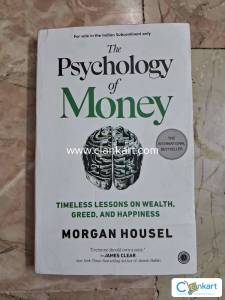
The Psychology of Money
Timeless lessons on wealth, greed, and happiness doing well with money isn’t necessarily about what you know. It’s about how you behave. And behavior is hard to teach, even to really smart people. How to manage money, invest it, and make business decisions are typically considered to involve a lot of mathematical calculations, where data and formulae tell us exactly what to do. But in the real world, people don’t make financial decisions on a spreadsheet. They make them at the dinner table, or in a meeting room, where personal history, your unique view of the world, ego, pride, marketing, and odd incentives are scrambled together. In the psychology of money, the author shares 19 short stories exploring the strange ways people think about money and teaches you how to make better sense of one of life’s most important matters.
The 7 Habits of Highly Effective People by Stephen R. Convey
New York Times bestseller—over 25 million copies soldThe No. 1 Most Influential Business Book of the Twentieth Century“[Thirty] years after it first appeared, the wisdom of The 7 Habits is more relevant than ever. On an individual level people are burning out, and on a collective level we are burning up the planet. So Dr. Covey’s emphasis on self-renewal and his understanding that leadership and creativity require us to tap into our own physical, mental, and spiritual resources are exactly what we need now.” Arianna HuffingtonOne of the most inspiring and impactful books ever written, The 7 Habits of Highly Effective People has captivated readers for nearly three decades. It has transformed the lives of presidents and CEOs, teachers and parents - millions of people of all ages and occupations. Now, this 30th anniversary edition of the timeless classic commemorates the wisdom of the 7 habits with modern additions from Sean Covey.The 7 habits have become famous and are integrated into everyday thinking by millions and millions of people. Why? Because they work!With Sean Covey’s added takeaways on how the habits can be used in our modern age, the wisdom of the 7 habits will be refreshed for a new generation of leaders.They Habit 1: Be ProactiveHabit 2: Begin with the End in MindHabit 3: Put First Things FirstHabit 4: Think Win/WinHabit 5: Seek First to Understand, Then to Be UnderstoodHabit 6: SynergiseHabit 7: Sharpen the SawThis beloved classic presents a principle-centered approach for solving both personal and professional problems. With penetrating insights and practical anecdotes, Stephen R. Covey reveals a step-by-step pathway for living with fairness, integrity, honesty, and human dignity - principles that give us the security to adapt to change and the wisdom and power to take advantage of the opportunities that change creates.Stephen R. Covey dedicated his life to demonstrating how a person can truly control their destiny with profound yet straightforward guidance. As an internationally respected leader
Dream with your eyes open
In Dream With Your Eyes Open, first-generation entrepreneur and UTV-founder Ronnie Screwvala details his vast experiences and the myriad lessons learnt from more than two decades of building some successful (and some not-so-successful) businesses, bringing clarity to a quickly changing business landscape and making an impassioned case for the role of entrepreneurship in India's future.If you’ve ever had an impactful, disruptive product or business idea, been curious about owning your own business, or have already taken the first steps on your entrepreneurial journey, this is the book for you.If you’ve been running your own company for the last seven-odd years, and scale, brand and value-creation are some of the crossroads for you now, keep reading.If you think your parents or family would freak out if you dared to suggest ditching your safe haven—your professional job—to pursue your dreams of owning your own business, relax. Better yet, share this book with them.If you’re an experienced professional ready to take the plunge into starting your own business or committed to growing into an effective leader in the company you work for, read on. This book hopes to demystify failure, inspire success, raise ambitions and help you think big.Dream With Your Eyes Open shares failures and triumphs, thoughts and anecdotes in a simple narrative that could help you gain better insights into entrepreneurship and give you a fighting chance when it comes to realizing your dreams in a David-versus-Goliath world. Only then will we succeed in harnessing the country’s enormous entrepreneurial potential with the most energetic and passionate people in the world, alive with fresh mindsets, optimism and hope.This book is about ‘it can be done’, not ‘I did it’. It’s all possible. Just dream your own dream—and when you do, dream with your eyes open.