Buy used Business & Economics books online in India
Buy Second Hand Books, Used Books Online In India

Indian economy Mc graw hill
India’s struggle for Independence by Bipin Chandra is your go to book for an in-depth and detailed overview on Indian independence movement . Indian freedom struggle is one of the most important parts of its history. A lot has been written and said about it, but there still remains a gap. Rarely do we get to hear accounts of the independence from the entire country and not just one region at one place. This book fits in perfectly in this gap and also provides a narration on the impact this movement had on the people. Bipin Chandra’s book is a well-documented history of India's freedom struggle against the British rule. It is one of the most accurate books which have been painstakingly written after thorough research based on legal and valid verbal and written sources. It maps the first war of independence that started with Mangal Pandey’s mutiny and witnessed the gallant effort of Sri Rani Laxmi Bai. Many of the pages of this book are dedicated to Mahatma Gandhi’s non-cooperation and the civil disobedience movements. It contains detailed description of Subash Chandra Bose’s weapon heavy tactics and his charisma. This book includes all the independence movements and fights, irrespective of their size and impact, covering India in its entirety. Although these movements varied in means and ideas, but they shared a common goal of independence. This book contains oral and written narratives from different parts of the country, making this book historically rich and diverse. The book captures the evolution of Indian independence struggle in full detail and leaves no chapter of this story untouched. This book is a good read for the students of Indian modern history and especially for students who are preparing for UPSC examination and have taken History as their subject.
Entrepreneurship
The 9th Edition of "Entrepreneurship," by Robert Hisrich, Michael Peters and Dean Shepherd has been designed to clearly instruct students on the process of formulating, planning, and implementing a new venture. Students are exposed to detailed descriptions of 'how to' embark on a new venture in a logical manner. Comprehensive cases at the end of the text have been hand-picked by the authors to go hand-in-hand with chapter concepts. The superb author team of Hisrich, Peters, and Shepherd draw from their distinct backgrounds to create a book that addresses the dynamics of today's entrepreneurial challenges. From Bob Hisrich's expertise in global entrepreneurship to Mike Peter's background as a both a real-life entrepreneur and academic to Dean Shepherd's current research on cognition and entrepreneurial mindset, this book balances the crucial line between modern theory and practice.
The psychology of money
Timeless lessons on wealth, greed, and happiness doing well with money isn’t necessarily about what you know. It’s about how you behave. And behavior is hard to teach, even to really smart people. How to manage money, invest it, and make business decisions are typically considered to involve a lot of mathematical calculations, where data and formulae tell us exactly what to do. But in the real world, people don’t make financial decisions on a spreadsheet. They make them at the dinner table, or in a meeting room, where personal history, your unique view of the world, ego, pride, marketing, and odd incentives are scrambled together. In the psychology of money, the author shares 19 short stories exploring the strange ways people think about money and teaches you how to make better sense of one of life’s most important matters.
Market Wizard
How do the world's most successful traders amass tens, hundreds of millions of dollars a year? Are they masters of an occult knowledge, lucky winners in a random market lottery, natural-born virtuosi—Mozarts of the markets? In search of an answer, bestselling author Jack D. Schwager interviewed dozens of top traders across most financial markets. While their responses differed in the details, all of them could be boiled down to the same essential formula: solid methodology + proper mental attitude = trading success. In Market Wizards Schwager lets you hear, in their own words, what those super-traders had to say about their unprecedented successes About the Author Jack D. Schwager is a recognized industry expert in futures and hedge funds and the author of a number of widely acclaimed financial books, including the bestsellers Market Wizards and New Market Wizards. He is currently the co-portfolio manager for the ADM Investor Services Diversified Strategies Fund, a portfolio of futures and FX managed accounts. He is also an advisor to Marketopper, an India-based quantitative trading firm, supervising a major project that will adapt their trading technology to trade a global futures portfolio.
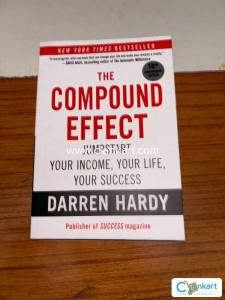
The Compound Effect
No gimmicks. No Hyperbole. No Magic Bullet. The Compound Effect is based on the principle that decisions shape your destiny. Little, everyday decisions will either take you to the life you desire or to disaster by default. Darren Hardy, publisher of Success Magazine, presents The Compound Effect, a distillation of the fundamental principles that have guided the most phenomenal achievements in business, relationships, and beyond. This easy-to-use, step-by-step operating system allows you to multiply your success, chart your progress, and achieve any desire. If you’re serious about living an extraordinary life, use the power of The Compound Effect to create the success you want.
How Google Works
Librarian note: An alternate cover for this ISBN can be found here.Both Eric Schmidt and Jonathan Rosenberg came to Google as seasoned Silicon Valley business executives, but over the course of a decade they came to see the wisdom in Coach John Wooden's observation that 'it's what you learn after you know it all that counts'. As they helped grow Google from a young start-up to a global icon, they relearned everything they knew about management. How Google Works is the sum of those experiences distilled into a fun, easy-to-read primer on corporate culture, strategy, talent, decision-making, communication, innovation, and dealing with disruption.The authors explain how the confluence of three seismic changes - the internet, mobile, and cloud computing - has shifted the balance of power from companies to consumers. The companies that will thrive in this ever-changing landscape will be the ones that create superior products and attract a new breed of multifaceted employees whom the authors dub 'smart creatives'. The management maxims ('Consensus requires dissension', 'Exile knaves but fight for divas', 'Think 10X, not 10%') are illustrated with previously unreported anecdotes from Google's corporate history.'Back in 2010, Eric and I created an internal class for Google managers,' says Rosenberg. 'The class slides all read 'Google confidential' until an employee suggested we uphold the spirit of openness and share them with the world. This book codifies the recipe for our secret sauce: how Google innovates and how it empowers employees to succeed.'
Self-help book
Amoral, cunning, ruthless, and instructive, this piercing work distills three thousand years of the history of power in to forty-eight well explicated laws. As attention-grabbing in its design as it is in its content, this bold volume outlines the laws of power in their unvarnished essence, synthesizing the philosophies of Machiavelli, Sun-tzu, Carl von Clausewitz, and other great thinkers. Some laws teach the need for prudence ("Law 1: Never Outshine the Master"), the virtue of stealth ("Law 3: Conceal Your Intentions"), and many demand the total absence of mercy ("Law 15: Crush Your Enemy Totally"), but like it or not, all have applications in real life. Illustrated through the tactics of Queen Elizabeth I, Henry Kissinger, P. T. Barnum, and other famous figures who have wielded--or been victimized by--power, these laws will fascinate any reader interested in gaining, observing, or defending against ultimate control.
Stay Hungry Stay Foolish
The inspiring stories of 25 IIM Ahmedabad graduates who chose the rough road of entrepreneurship. They are diverse in age, in outlook and the industries they made a mark in. But they have one thing in common: they believed in the power of their dreams. This book seeks to inspire young graduates to look beyond placements and salaries. To believe in their dreams.
Rich Dad Poor Dad
April 2017 marks 20 years since Robert Kiyosaki’s Rich Dad Poor Dad first made waves in the Personal Finance arena.It has since become the #1 Personal Finance book of all time... translated into dozens of languages and sold around the world.Rich Dad Poor Dad is Robert's story of growing up with two dads — his real father and the father of his best friend, his rich dad — and the ways in which both men shaped his thoughts about money and investing. The book explodes the myth that you need to earn a high income to be rich and explains the difference between working for money and having your money work for you.20 Years... 20/20 HindsightIn the 20th Anniversary Edition of this classic, Robert offers an update on what we’ve seen over the past 20 years related to money, investing, and the global economy. Sidebars throughout the book will take readers “fast forward” — from 1997 to today — as Robert assesses how the principles taught by his rich dad have stood the test of time.In many ways, the messages of Rich Dad Poor Dad, messages that were criticized and challenged two decades ago, are more meaningful, relevant and important today than they were 20 years ago.As always, readers can expect that Robert will be candid, insightful... and continue to rock more than a few boats in his retrospective.Will there be a few surprises? Count on it.Rich Dad Poor Dad...• Explodes the myth that you need to earn a high income to become rich• Challenges the belief that your house is an asset• Shows parents why they can't rely on the school system to teach their kids about money• Defines once and for all an asset and a liability• Teaches you what to teach your kids about money for their future financial success
Indian economy since independence
"The annual edition of Dr. Uma Kapila's Indian Economy since Independence has become a staple, annually updated, reference for University students throughout the country, for aspirants for the civil service and other examinations, and for all those interested in a single comprehensive source of information, and analysis by a galaxy of scholars, on the Indian economy. This twenty-fifth anniversary edition marks a milestone in a remarkable journey, begun in 1988 by a revered teacher of long standing from Delhi University.
Psychology of Money
The Psychology of Money' Tamil Edition. TIMELESS LESSONS ON WEALTH, GREED, AND HAPPINESS Doing well with money isn’t necessarily about what you know. It’s about how you behave. And behavior is hard to teach, even to really smart people. How to manage money, invest it, and make business decisions are typically considered to involve a lot of mathematical calculations, where data and formulae tell us exactly what to do. But in the real world, people don’t make financial decisions on a spreadsheet. They make them at the dinner table, or in a meeting room, where personal history, your unique view of the world, ego, pride, marketing, and odd incentives are scrambled together. In The Psychology of Money, the author shares 19 short stories exploring the strange ways people think about money and teaches you how to make better sense of one of life’s most important matters.
Rich dad poor dad
Rich Dad Poor Dad is Robert's story of growing up with two dads — his real father and the father of his best friend, his rich dad — and the ways in which both men shaped his thoughts about money and investing. The book explodes the myth that you need to earn a high income to be rich and explains the difference between working for money and having your money work for you.