Buy used Business & Economics books online in India
Buy Second Hand Books, Used Books Online In India
Death by Meeting
"Casey McDaniel had never been so nervous in his life." "In just ten minutes, The Meeting, as it would forever be known, would begin. Casey had every reason to believe that his performance over the next two hours would determine the fate of his career, his financial future, and the company he had built from scratch."""How could my life have unraveled so quickly?" he wondered."In his latest page-turning work of business fiction, best-selling author Patrick Lencioni provides readers with another powerful and thought-provoking book, this one centered around a cure for the most painful yet underestimated problem of modern business: bad meetings. And what he suggests is both simple and revolutionary.Casey McDaniel, the founder and CEO of Yip Software, is in the midst of a problem he created, but one he doesn't know how to solve. And he doesn't know where or who to turn to for advice. His staff can't help him; they're as dumbfounded as he is by their tortuous meetings.Then an unlikely advisor, Will Peterson, enters Casey's world. When he proposes an unconventional, even radical, approach to solving the meeting problem, Casey is just desperate enough to listen.As in his other books, Lencioni provides a framework for his groundbreaking model, and makes it applicable to the real world. "Death by Meeting" is nothing short of a blueprint for leaders who want to eliminate waste and frustration among their teams, and create environments of engagement and passion.
Class 11 statist
The CBSE board has recently shown a bent towards analysis and interpretation based questions under the label of ‘competency- based questions’. This book is prepared according to revised syllabus and new paper pattern. ‘The Same but Different’: Revised and restructured on positive feedback, the Statistics for Economics Textbook is all geared up to provide its readers step by step comprehension of the subject matter. Novelties of the text include: 1. NEW TYPOLOGY OF QUESTIONS: (Image/Data interpretation, defend and refute type questions etc.) have been incorporated in each chapter. 2. ‘BRAIN TEASER’ BLOCKS: Implication based questions related to current happenings around have been incorporated in each chapter. These help gauge the inferences the students are able to draw from the text and how easily they are able to relate economic theory to the ground level realities. 3. OTHERS: HOTS & Focus Zones DAV Board Question Paper (Solved) Sample Paper By “VK Global Study Group”[A specimen paper woven along the same structure and blueprint as suggested in the CBSE released Sample Question Paper-2023.]
Class 11th business studies poonam gandhi
This book has been specifically designed to meet the academic requirements of the new syllabus issued by the CBSE Board. It is divided into two parts-Part A covers the syllabus of Foundations of Business and Part B- covers Finance and Trade. For a better understanding of the topic, Keywords and Flow Charts are provided after each topic. The use of diagrams, tables, etc, has been made to make the subject matter self-explanatory. It Includes Objective Type Questions and Case Studies based on the most recent CBSE guidelines. Understanding-based questions, HOTS and Case Studies are included to help students expand their knowledge. Previous Year's Questions are also included to help students prepare for the Board Exam. QUICK REVISION and FLOW CHART to help you quickly review all of the topics. There are also Project Guidelines and a Project Sample.
Deep work by Cal Newport
Deep work is the ability to focus without distraction on a cognitively demanding task. It's a skill that allows you to quickly master complicated information and produce better results in less time. Deep Work will make you better at what you do and provide the sense of true fulfillment that comes from craftsmanship. In short, deep work is like a super power in our increasingly competitive twenty-first century economy. And yet, most people have lost the ability to go deep-spending their days instead in a frantic blur of e-mail and social media, not even realizing there's a better way.In Deep Work, author and professor Cal Newport flips the narrative on impact in a connected age. Instead of arguing distraction is bad, he instead celebrates the power of its opposite. Dividing this book into two parts, he first makes the case that in almost any profession, cultivating a deep work ethic will produce massive benefits. He then presents a rigorous training regimen, presented as a series of four "rules," for transforming your mind and habits to support this skill.1. Work Deeply2. Embrace Boredom3. Quit Social Media4. Drain the ShallowsA mix of cultural criticism and actionable advice, Deep Work takes the reader on a journey through memorable stories-from Carl Jung building a stone tower in the woods to focus his mind, to a social media pioneer buying a round-trip business class ticket to Tokyo to write a book free from distraction in the air-and no-nonsense advice, such as the claim that most serious professionals should quit social media and that you should practice being bored. Deep Work is an indispensable guide to anyone seeking focused success in a distracted world.
The 48 laws of Power
Amoral, cunning, ruthless, and instructive, this piercing work distills three thousand years of the history of power in to forty-eight well explicated laws. As attention-grabbing in its design as it is in its content, this bold volume outlines the laws of power in their unvarnished essence, synthesizing the philosophies of Machiavelli, Sun-tzu, Carl von Clausewitz, and other great thinkers. Some laws teach the need for prudence ("Law 1: Never Outshine the Master"), the virtue of stealth ("Law 3: Conceal Your Intentions"), and many demand the total absence of mercy ("Law 15: Crush Your Enemy Totally"), but like it or not, all have applications in real life. Illustrated through the tactics of Queen Elizabeth I, Henry Kissinger, P. T. Barnum, and other famous figures who have wielded--or been victimized by--power, these laws will fascinate any reader interested in gaining, observing, or defending against ultimate control.
Mastery by Robert Greene
The ultimate form of power is mastery. Robert Greene has spent a lifetime studying the laws of power: now he shares the secret path to greatness travelled by history's most powerful people. Each one of us has within us the potential to be a Master if we choose to follow them along a challenging but clear course that is described here for the first time.
Stay hungry stay foolish
The inspiring stories of 25 IIM Ahmedabad graduates who chose the rough road of entrepreneurship. They are diverse in age, in outlook and the industries they made a mark in. But they have one thing in common: they believed in the power of their dreams. This book seeks to inspire young graduates to look beyond placements and salaries. To believe in their dreams.
Good Economics For Hard Times
Figuring out how to deal with today's critical economic problems is perhaps the great challenge of our time. Much greater than space travel or perhaps even the next revolutionary medical breakthrough, what is at stake is the whole idea of the good life as we have known it.Immigration and inequality, globalization and technological disruption, slowing growth and accelerating climate change--these are sources of great anxiety across the world, from New Delhi and Dakar to Paris and Washington, DC. The resources to address these challenges are there--what we lack are ideas that will help us jump the wall of disagreement and distrust that divides us. If we succeed, history will remember our era with gratitude; if we fail, the potential losses are incalculable.In this revolutionary book, renowned MIT economists Abhijit V. Banerjee and Esther Duflo take on this challenge, building on cutting-edge research in economics explained with lucidity and grace. Original, provocative, and urgent, Good Economics for Hard Times makes a persuasive case for an intelligent interventionism and a society built on compassion and respect and show how economics, when done right, can help us solve the thorniest social and political problems of the day. It is an extraordinary achievement, one that shines a light to help us appreciate and understand our precariously balanced world.
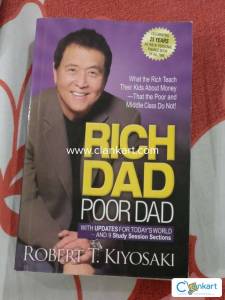
Rich Dad Poor Dad by Robert T. Kiyosaki
April 2017 marks 20 years since Robert Kiyosaki’s Rich Dad Poor Dad first made waves in the Personal Finance arena.It has since become the #1 Personal Finance book of all time... translated into dozens of languages and sold around the world.Rich Dad Poor Dad is Robert's story of growing up with two dads — his real father and the father of his best friend, his rich dad — and the ways in which both men shaped his thoughts about money and investing. The book explodes the myth that you need to earn a high income to be rich and explains the difference between working for money and having your money work for you.20 Years... 20/20 HindsightIn the 20th Anniversary Edition of this classic, Robert offers an update on what we’ve seen over the past 20 years related to money, investing, and the global economy. Sidebars throughout the book will take readers “fast forward” — from 1997 to today — as Robert assesses how the principles taught by his rich dad have stood the test of time.In many ways, the messages of Rich Dad Poor Dad, messages that were criticized and challenged two decades ago, are more meaningful, relevant and important today than they were 20 years ago.As always, readers can expect that Robert will be candid, insightful... and continue to rock more than a few boats in his retrospective.Will there be a few surprises? Count on it.Rich Dad Poor Dad...• Explodes the myth that you need to earn a high income to become rich• Challenges the belief that your house is an asset• Shows parents why they can't rely on the school system to teach their kids about money• Defines once and for all an asset and a liability• Teaches you what to teach your kids about money for their future financial success
Corporate Chanakya
Chanakya, who lived in 3rd Century BC, was a leadership guru par excellence. His ideas on how to identify leaders and groom them to govern a country has been well documented in his book Kautilya’s Arthashastra. This book contains 6000 aphorisms or sutras. In the present book the author simplifies the age old formula of success for leaders of the corporate world. Divided into 3 sections of Leadership, Management and Training Corporate Chanakya includes tips on various topics like – organizing and conducting effective meetings, dealing with tricky situations, managing time, decision making and responsibilities and powers of a leader.
The Psychology of Money
Timeless lessons on wealth, greed, and happiness doing well with money isn’t necessarily about what you know. It’s about how you behave. And behavior is hard to teach, even to really smart people. How to manage money, invest it, and make business decisions are typically considered to involve a lot of mathematical calculations, where data and formulae tell us exactly what to do. But in the real world, people don’t make financial decisions on a spreadsheet. They make them at the dinner table, or in a meeting room, where personal history, your unique view of the world, ego, pride, marketing, and odd incentives are scrambled together. In the psychology of money, the author shares 19 short stories exploring the strange ways people think about money and teaches you how to make better sense of one of life’s most important matters.
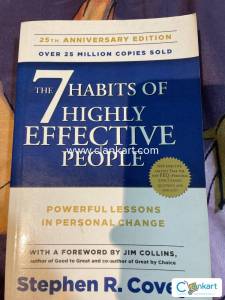
The 7 habits of highly effective people
In The 7 Habits of Highly Effective People, author Stephen R. Covey presents a holistic, integrated, principle-centered approach for solving personal and professional problems. With penetrating insights and pointed anecdotes, Covey reveals a step-by-step pathway for living with fairness, integrity, service, and human dignity -- principles that give us the security to adapt to change and the wisdom and power to take advantage of the opportunities that change creates.
Novel book
Book Summary of Rich Dad Poor Dad Table of Contents Iskit Bahut Jarurat Hain Rich Dad, Poor Dad Ameer Log Paise ke Liye Kaam Nahi Karte Paise ki Samajh Kyo Sikhai Jana Chahiye? Apne Kaam se Kaam Rakho Tax ke Itihas aur Corporations ki Takat Ameer Log Paise ke Avishkar Karte Hain Seekhane ke Liye Kaam Kare-Paise ke Liye Kaam Na Kare Badhao ko Paar Karna Shuru Karna Aur Jyada Chahiye? Kewal 7,000 Dollar mein hi Collge ki Shiksha