Buy used Bachelor of Technology (B.Tech) books online in India
Buy Second Hand Books, Used Books Online In India
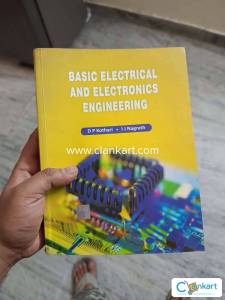
Excellent Book For Practical knowledge
This book was initially published in 1972 and has been a highly accurate and easily comprehensible university level text throughout the modern period of electronics and computer revolution.Starting with semiconductor diodes and diode applications, the book systematically progresses from one chapter to another. It provides a thorough understanding of fundamental concepts like diodes and transistors before tackling the higher level topics like Bipolar Junction Transistor (BJT) devices, and Field-Effect Transistor (FET) devices.In addition to that, it deals with various other topics like Feedback and Oscillator Circuits, Power Supplies, other Two-Terminal Devices, and PNPN and other devices. It also reflects on the growing importance of operational amplifiers in today's market. Along with the basics of designing FET amplifier networks, all the typical configurations of JFET and MOSFET circuits has also been examined.The authors take a systems approach to their subject, ensuring students comprehend fundamental concepts before they tackle advanced topics as compound configurations, power supplies, and oscilloscopes. The circuit files are also provided. For each device examined, the text covers most configurations and applications and also included are discussions of the full range of related topics typically addressed in the course, with clear, precise explanations and plenty of examples to back them up.
Microprocessor Book by Ramesh Goankar
About the Book: Microprocessor Architecture, Programming and Applications with the 8085 This book provides a comprehensive treatment of the microprocessor, covering both hardware and software based on the 8085 Microprocessor family. This book was first published in 1984 and it has been in the field for nearly three decades. The microprocessor concepts that were at the cutting edge of the technology in the 1970s and 80s have become fundamentals of the computer field. It is gratifying to see such acceptance of the integrated approach to teaching microprocessor concepts.
operating system concepts
Written in an easy-to-understand style, this textbook, now in its third edition, continues to discuss in detail important concepts and major developments in network security and management. It is designed for a one-semester course for undergraduate students of Computer Science, Information Technology, and undergraduate and postgraduate students of Computer Applications. Students are first exposed to network security principles, organizational policy and security infrastructure, and then drawn into some of the deeper issues of cryptographic algorithms and protocols underlying network security applications. Encryption methods, secret key and public key cryptography, digital signature and other security mechanisms are emphasized. Smart card, biometrics, virtual private networks, trusted operating systems, pretty good privacy, database security, and intrusion detection systems are comprehensively covered. An in-depth analysis of technical issues involved in security management, risk management and security and law is presented. In the third edition, two new chapters—one on Information Systems Security and the other on Web Security—and many new sections such as digital signature, Kerberos, public key infrastructure, software security and electronic mail security have been included. Additional matter has also been added in many existing sections. KEY FEATURES : Extensive use of block diagrams throughout helps explain and clarify the concepts discussed. About 250 questions and answers at the end of the book facilitate fruitful revision of the topics covered. Includes a glossary of important terms. KEY FEATURES : Extensive use of block diagrams throughout helps explain and clarify the concepts discussed. About 250 questions and answers at the end of the book facilitate fruitful revision of the topics covered. Includes a glossary of important terms.
java the complete reference
About the Book: Java the Complete Reference In Java: The Complete Reference, Eighth Edition, bestselling programming author Herb Schildt shows you everything you need to develop, compile, debug, and run Java programs. Updated for Java Platform, Standard Edition 7 (Java SE 7), this comprehensive volume covers the entire Java language, including its syntax, keywords, and fundamental programming principles. You'll also find information on key elements of the Java API library. JavaBeans, servlets, applets, and Swing are examined and real-world examples demonstrate Java in action. In addition, new Java SE 7 features such as try-with-resources, strings in switch, type inference with the diamond operator, NIO.2, and the Fork/Join Framework are discussed in detail. Coverage includes: Data types and operators Control statements Classes and objects Constructors and methods Method overloading and overriding Interfaces and packages Inheritance Exception handling Generics Much, much more Contents: Part I The Java Language 1 The History and Evolution of Java 2 An Overview of Java 3 Data Types, Variables, and Arrays 4 Operators 5 Control Statements 6 Introducing Classes 7 A Closer Look at Methods and Classes 8 Inheritance 9 Packages and Interfaces 10 Exception Handling 11 Multithreaded Programming 12 Enumerations, Autoboxing, and Annotations (Metadata) 13 I/O, Applets, and Other Topics 14 Generics Part II The Java Library 15 String Handling 16 Exploring java.lang 17 java.util Part 1: The Collections Framework 18 java.util Part 2: More Utility Classes 19 Input/Output: Exploring java.io 20 Exploring NIO 21 Networking 22 The Applet Class 23 Event Handling 24 Introducing the AWT: Working with Windows, Graphics, and Text 25 Using AWT Controls, Layout Managers, and Menus 26 Images 27 The Concurrency Utilities 28 Regular Expressions and Other Packages Part III Software Development Using Java 29 Java Beans 30 Introducing Swing 31 Exploring
Digital and Analog Communication Systems by K. Sam Shanmugam
Provides a detailed, unified treatment of theoretical and practical aspects of digital and analog communication systems, with emphasis on digital communication systems. Integrates theory--keeping theoretical details to a minimum--with over 60 practical, worked examples illustrating real-life methods. Emphasizes deriving design equations that relate performance of functional blocks to design parameters. Illustrates how to trade off between power, band-width and equipment complexity while maintaining an acceptable quality of performance. Material is modularized so that appropriate portions can be selected to teach several different courses. Includes over 300 problems and an annotated bibliography in each chapter.