Buy used Bachelor of Technology (B.Tech) books online in India
Buy Second Hand Books, Used Books Online In India
Manufacturing Technology
The printing of the seventh edition of the book has provided the author with an opportunity to completely go through the text.Minor Additions and Improvements have been carried out,wherever needed.All the figure work has been redone on computer,with the result that all the figures are clear and sharp.The author is really thankful to M/s S.Chand & Company Ltd. for doing an excellent job in publishing the latest edition of the book.
Data Structures using C and C++
Formal languages and automata theory is the study of abstract machines and how these can be used for solving problems. The book has a simple and exhaustive approach to topics like automata theory, formal languages and theory of computation. These descriptions are followed by numerous relevant examples related to the topic. A brief introductory chapter on compilers explaining its relation to theory of computation is also given.
Let us C++ by Yashwant Kanetkar
Highlights Core Features Like Encapsulation, Polymorphism, Inheritance, Virtual Functions, Templates, Exception Handling, STL and more DESCRIPTION Most best-selling software including MS Office, Internet Explorer, Photoshop, AutoCAD, Google Earth, Firefox etc. are written in C++. So, for anyone who aspires to write good software, C++ has become the language of choice. One has to know the concepts of Object-Oriented Programming and how to use them in C++, to make a mark in the programming world. Let Us C++ teaches you C++ in Yashavant KanetkarÕs inimitable style. You would find Let Us C++ easy, yet incredibly thorough. Every discussion is highlighted by clear, direct examples. It will not only serve as your tutorial, but it is likely to be the first thing that you would reach for when faced with a confusing issue. KEY FEATURES Strengthens the foundations, as a detailed explanation of programming language concepts are given.Ê ÊÊÊ Lists down all the important points that you need to know related to various topics in an organized manner. Provides In-depth explanation of complex topics. Focuses on how to think logically to solve a problem. WHAT WILL YOU LEARN Classes & Objects, Free Store Management, Stream I/O, References, Virtual Tables and vptr, Templates, Polymorphism, Namespaces, Exception Handling, Inheritance, Smart Pointers, STL WHO THIS BOOK IS FOR Students, Programmers, researchers, and software developers who wish to learn the basics of C++ programming language. Table of Content 1. Intro to OOP 2. Graduating to C++ 3. Functions 4. Classes and Objects 5. Class Intricacies 6. Inheritance 7. Polymorphism 8. Input/ Output in C++ 9. Advanced Features of C++ 10. Templates 11. Exception Handling 12. Standard Template Library
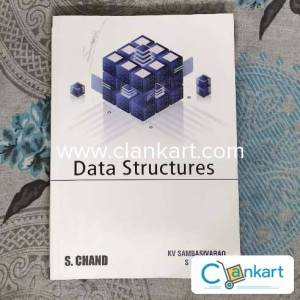
Data Structures using C
This second edition of Data Structures Using C has been developed to provide a comprehensive and consistent coverage of both the abstract concepts of data structures as well as the implementation of these concepts using C language. It begins with a thorough overview of the concepts of C programming followed by introduction of different data structures and methods to analyse the complexity of different algorithms. It then connects these concepts and applies them to the study of various data structures such as arrays, strings, linked lists, stacks, queues, trees, heaps, and graphs. The book utilizes a systematic approach wherein the design of each of the data structures is followed by algorithms of different operations that can be performed on them, and the analysis of these algorithms in terms of their running times. Each chapter includes a variety of end-chapter exercises in the form of MCQs with answers, review questions, and programming exercises to help readers test their knowledge.
Database System concept Fifth edition
Intended for a first course in databases at the junior or senior undergraduate, or first-year graduate, level, this text contains advanced material with concepts presented as intuitive descriptions, based on the example of a bank enterprise. It aims to present these concepts in a general setting that is not tied to any particular database system.
Engineering drawing
"Advanced Engineering Mathematics" is written for the students of all engineering disciplines. Topics such as Partial Differentiation, Differential Equations, Complex Numbers, Statistics, Probability, Fuzzy Sets and Linear Programming which are an important part of all major universities have been well-explained. Filled with examples and in-text exercises, the book successfully helps the student to practice and retain the understanding of otherwise difficult concepts.
Python For Everybody
Python for Everybody is designed to introduce students to programming and software development through the lens of exploring data.You can think of the Python programming language as your tool to solve data problems that are beyond the capability of a spreadsheet. Python is an easy to use and easy to learn programming language that is freely available on Macintosh, Windows, or Linux computers. So once you learn Python you can use it for the rest of your career without needing to purchase any software.There are free downloadable electronic copies of this book in various formats and supporting materials for the book at www.pythonlearn.com. The course materials are available to you under a Creative Commons License so you can adapt them to teach your own Python course.
Engineering Math for College Students
About the Book: Probability and Random Processes: 6th Edition Over 100 Part A questions with answers ; Over 300 solved problems and 200 exercise problems ; Hints have been provided with exercise problems wherever necessary ; A supplement that includes frequently asked questions with the solutions is also provided ; Content Preface About the Authors Probability Basic Ideas 1. Random Variables 2. Two Dimensional Random Variables 3. Random Processes 4. Correlation and Spectral Densities 5. Linear System with Random Inputs Formulae to Remember Model Question Paper About the Author: P Sivaramakrishna Das Professor P. Sivaramakrishna Das started his career as Assistant Professor of mathematics at Ramakrishna Mission Vivekananda College, Chennai, his alma mater, and retired as Head of the Department of Mathematics from the same college after putting in 36 years of service. Currently, he is Professor of Mathematics and Head of the Department of Science and Humanities, K. C. G. College of Technology, Chennai (a unit of Hindustan group of colleges).Professor C. Vijayakumari began her career as Assistant Professor of Mathematics at Government Arts College for Women, Thanjavur, and has taught at various government Arts and Science colleges across Tamil Nadu before retiring as Professor of Mathematics, Queen Marys College, Chennai, after putting in 40 years of service. As visiting professor of mathematics, Prof. Vijayakumari has taught students at two engineering colleges in Chennai. An accomplished teacher of Mathematics and Statistics at both undergraduate and postgraduate levels, she has also guided several students in their M.Phil. courses.Along with her husband, Prof. P. Sivaramakrishna Das, she has written several books on Engineering Mathematics.
Textbook of Production Engineering
This thoroughly revised book, now in its second edition, gives a complete coverage of the fundamental concepts and applications of Production Engineering. It provides a comprehensive introduction to the topics taught in production engineering, such as metal cutting, metal forming, machine tools, and measurement and manufacturing techniques. In this edition, a new chapter (Chapter 29) on Grinding and other abrasive metal removal processes and many new sections are included with ample illustrations that help students understand the concepts in a clear way. The book is essentially meant for mechanical engineering and production engineering students at BE/B.Tech. level. The concepts and processes of metal working and the design of press tools, various modern methods of manufacturing, such as ultrasonic machining (USM), electrochemical deburring (ECD), and hot machining are also covered. A variety of worked-out examples and end-of-chapter review questions are provided to strengthen the grasp as well as to test the comprehension of the underlying concepts and principles. The text is extensively illustrated to aid the students in gaining a thorough understanding of various production processes and the principles behind them.