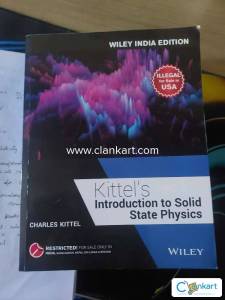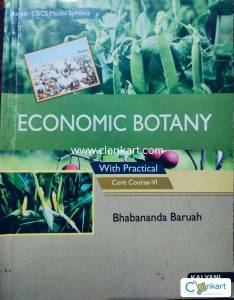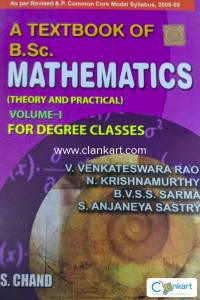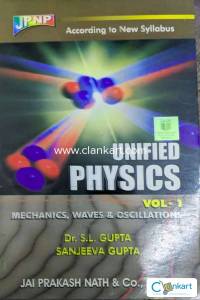
Buy used Bachelor of Science (B.Sc) books online in India
Buy Second Hand Books, Used Books Online In India
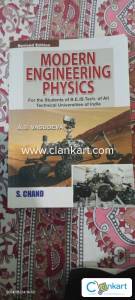
Modern Engineering Physics
The book in its present form is due to my interaction with the students for quite a long time.It had been my long-cherished desire to write a book covering most of the topics that form the syllabii of the Engineering and Science students at the degree level.Many students,although able to understand the various topics of the books,may not be able to put their knowledge to use.For this purpose a number of questions and problems are given at the end of each chapter.
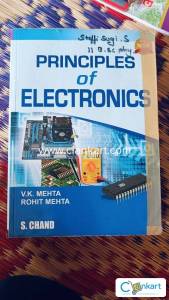
Principles of Electronics
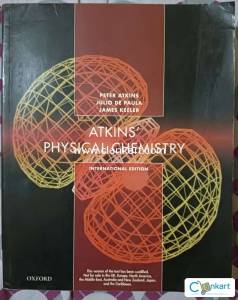
Please READ DESCRIPTION Before Buying. The item is Brand New Paperback International/South Asian Edition textbook with 100 % identical Contents as US Edition. Shipped Same Day. Will be dispatched fast. 100% Satisfaction. Great Customer Service, Buy with Confidence, Front Cover May Differ. Ships to PO or APO. May have printed "NOT FOR SALE OUTSIDE of INDIA" or Territorial Disclaimer.
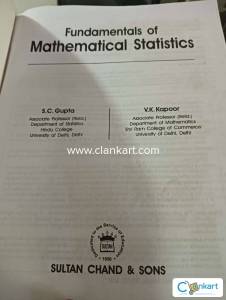
Fundamentals of mathematical statistics
Knowledge updating is a never-ending process and so should be the revision of an effective textbook. The book originally written fifty years ago has, during the intervening period, been revised and reprinted several times. The authors have, however, been thinking, for the last few years that the book needed not only a thorough revision but rather a substantial rewriting. They now take great pleasure in presenting to the readers the twelfth, thoroughly revised and enlarged, Golden Jubilee edition of the book. The subject-matter in the entire book has been re-written in the light of numerous criticisms and suggestions received from the users of the earlier editions in India and abroad. The basis of this revision has been the emergence of new literature on the subject, the constructive feedback from students and teaching fraternity, as well as those changes that have been made in the syllabi and/or the pattern of examination papers of numerous universities. Knowledge updating is a never-ending process and so should be the revision of an effective textbook. The book originally written fifty years ago has, during the intervening period, been revised and reprinted several times. The authors have, however, been thinking, for the last few years that the book needed not only a thorough revision but rather a substantial rewriting. They now take great pleasure in presenting to the readers the twelfth, thoroughly revised and enlarged, Golden Jubilee edition of the book. The subject-matter in the entire book has been re-written in the light of numerous criticisms and suggestions received from the users of the earlier editions in India and abroad. The basis of this revision has been the emergence of new literature on the subject, the constructive feedback from students and teaching fraternity, as well as those changes that have been made in the syllabi and/or the pattern of examination papers of numerous universities. Knowledge updating is a never-ending process and so should be the revision of an effective textbook. The book
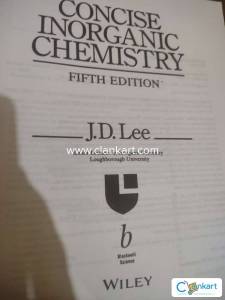
Concise Inorganic Chemistry
This textbook is divided into six parts: theoretical concepts and hydrogen, the s-block, the p-block, the d-block, the f-block, and other topics (the nucleus and spectra). It also focuses on the commercial exploitation of inorganic chemicals and the treatment of the inorganic aspects of environmental chemistry has also been extended.· Atomic structure and the Periodic table· Introduction to bonding· The ionic bond· The covalent bond· The metallic bond· General properties of the elements· Coordination compounds· Hydrogen and the hydrides· Group 1 - The alkali metals· The chlor-alkali industry· Group 2 - The alkaline earth elements· The group 13 elements· The group 14 elements· The group 15 elements· Group 16 - the chalcogens· Group 17 - the halogens· Group 18 - the noble gases· An introduction to the transition elements· Group 3 - The scandium group· Group 4 - The titanium group· Group 5 - The vanadium group· Group 6 - The chromium group· Group 7 - The manganese group· Group 8 - The iron group· Group 9 - The cobalt group· Group 10 - The nickel Group· Group 11 - The copper group: Coinage metals· Group 12 - The zinc group· The lanthanide series· The actinides· The atomic nucleus· Spectra
Biochemistry for bsc ugc
In this latest Seventh Edition , five New Chapters (No. 28, 29, 33, 36 and 37) have been added to enhance the scope and utility of the book: three chapters pertain to Bioenergetics and Metabolism (Biosynthesis of Nucleotides, Degradation of Nucleotides, Mineral Metabolism) and two to Nutrition Biochemistry (Principles of Nutrition, Elements of Nutrition). In fact, all the previously-existing 35 chapters have been thoroughly revised, enlarged and updated in the light of recent advancements and the ongoing researches being conducted the world over.
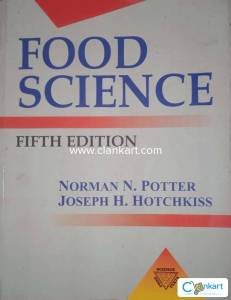
Food science
Now in its fifth edition, Food Science remains the most popular and reliable text for introductory courses in food science and technology. This new edition retains the basic format and pedagogical features of previous editions and provides an up-to-date foundation upon which more advanced and specialized knowledge can be built. This essential volume introduces and surveys the broad and complex interrelationships among food ingredients, processing, packaging, distribution and storage, and explores how these factors influence food quality and safety. Reflecting recent advances and emerging technologies in the area, this new edition includes updated commodity and ingredient chapters to emphasize the growing importance of analogs, macro-substitutions, fat fiber and sugar substitutes and replacement products, especially as they affect new product development and increasing concerns for a healthier diet. Revised processing chapters include changing attitudes toward food irradiation, greater use of microwave cooking and microwaveable products, controlled and modified atmosphere packaging and expanding technologies such a extrusion cooking, ohmic heating and supercritical fluid extraction, new information that addresses concerns about the responsible management of food technology, considering environmental, social and economic consequences, as well as the increasing globalization of the food industry. Discussions of food safety an consumer protection including newer phychrotropic pathogens; HAACP techniques for product safety and quality; new information on food additives; pesticides and hormones; and the latest information on nutrition labeling and food regulation. An outstanding text for students with little or no previous instruction in food science and technology, Food Science is also a valuable reference for professionals in food processing, as well as for those working in fields that service, regulate or otherwise interface with the food industry.