Buy used Bachelor of Computer Applications (BCA) books online in India
Buy Second Hand Books, Used Books Online In India
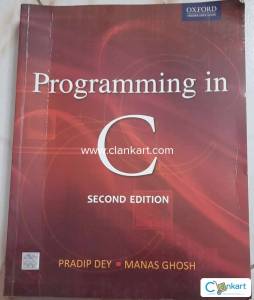
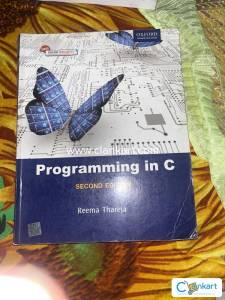
Computing fundamentals and programming in C
The complete spectrum of computing fundamentals starting from abc of computer to internet usage has been well covered in simple and readers loving style, The language used in the book is lucid, is easy to understand, and facilities easy grasping of concepts, The chapter have been logically arranged in sequence, The book is written in a reader-friendly manner both the students and the teachers, Most of the contents presented in the book are in the form of bullets, organized sequentially. This form of presentation, rather than in a paragraph form, facilities the reader to view, understand and remember the points better, The explanation is supported by diagrams, pictures and images wherever required, Sufficient exercises have been included for practice in addition to the solved examples in every chapter related to C programming, Concepts of pointers, structures, Union and file management have been extensively detailed to help advance learners, Adequate exercises have been given at the end of the every chapter, Pedagogy followed for sequencing the contents on C programming supported by adequate programming examples is likely to help the reader to become proficient very soon, 200 problems on C programming & their solutions, 250 Additional descriptive questions on C programming.
Mastering Python for Bioinformatics
Life scientists today urgently need training in bioinformatics skills. Too many bioinformatics programs are poorly written and barely maintained, usually by students and researchers who've never learned basic programming skills. This practical guide shows postdoc bioinformatics professionals and students how to exploit the best parts of Python to solve problems in biology while creating documented, tested, reproducible software. Ken Youens-Clark, author of Tiny Python Projects (Manning), demonstrates not only how to write effective Python code but also how to use tests to write and refactor scientific programs. You'll learn the latest Python features and tools including linters, formatters, type checkers, and tests to create documented and tested programs. You'll also tackle 14 challenges in Rosalind, a problem-solving platform for learning bioinformatics and programming. Create command-line Python programs to document and validate parameters Write tests to verify refactor programs and confirm they're correct Address bioinformatics ideas using Python data structures and modules such as Biopython Create reproducible shortcuts and workflows using makefiles Parse essential bioinformatics file formats such as FASTA and FASTQ Find patterns of text using regular expressions Use higher-order functions in Python like filter(), map(), and reduce()
High Performance Python
If you're an experienced Python programmer, High Performance Python will guide you through the various routes of code optimization. You'll learn how to use smarter algorithms and leverage peripheral technologies, such as numpy, cython, cpython, and various multi-threaded and multi-node strategies.There's a lack of good learning and reference material available if you want to learn Python for highly computational tasks. Because of it, fields from physics to biology and systems infrastructure to data science are hitting barriers. They need the fast prototyping nature of Python, but too few people know how to wield it. This book will put you ahead of the curve.
Explainable AI for Practitioners: Designing and Implementing
Most intermediate-level machine learning books focus on how to optimize models by increasing accuracy or decreasing prediction error. But this approach often overlooks the importance of understanding why and how your ML model makes the predictions that it does. Explainability methods provide an essential toolkit for better understanding model behavior, and this practical guide brings together best-in-class techniques for model explainability. Experienced machine learning engineers and data scientists will learn hands-on how these techniques work so that you'll be able to apply these tools more easily in your daily workflow. This essential book provides: A detailed look at some of the most useful and commonly used explainability techniques, highlighting pros and cons to help you choose the best tool for your needs Tips and best practices for implementing these techniques A guide to interacting with explainability and how to avoid common pitfalls The knowledge you need to incorporate explainability in your ML workflow to help build more robust ML systems Advice about explainable AI techniques, including how to apply techniques to models that consume tabular, image, or text data Example implementation code in Python using well-known explainability libraries for models built in Keras and TensorFlow 2.0, PyTorch, and HuggingFace
Learning Microsoft Power Bi: Transforming Data Into Insights
Microsoft Power BI is a data analytics and visualization tool powerful enough for the most demanding data scientists, but accessible enough for everyday use for anyone who needs to get more from data. The market has many books designed to train and equip professional data analysts to use Power BI, but few of them make this tool accessible to anyone who wants to get up to speed on their own. This streamlined intro to Power BI covers all the foundational aspects and features you need to go from "zero to hero" with data and visualizations. Whether you work with large, complex datasets or work in Microsoft Excel, author Jeremey Arnold shows you how to teach yourself Power BI and use it confidently as a regular data analysis and reporting tool. You'll learn how to: Import, manipulate, visualize, and investigate data in Power BI Approach solutions for both self-service and enterprise BI Use Power BI in your organization's business intelligence strategy Produce effective reports and dashboards Create environments for sharing reports and managing data access with your team Determine the right solution for using Power BI offerings based on size, security, and computational needs
AI with Microsoft Power Bi: Simpler AI for the Enterprise
Advance your Power BI skills by adding AI to your repertoire at a practice level. With this practical book, business-oriented software engineers and developers will learn the terminologies, practices, and strategy necessary to successfully incorporate AI into your business intelligence estate. Jen Stirrup, CEO of AI and BI leadership consultancy Data Relish, and Thomas Weinandy, research economist at Upside, show you how to use data already available to your organization. Springboarding from the skills that you already possess, this book adds AI to your organization's technical capability and expertise with Microsoft Power BI. By using your conceptual knowledge of BI, you'll learn how to choose the right model for your AI work and identify its value and validity. Use Power BI to build a good data model for AI Demystify the AI terminology that you need to know Identify AI project roles, responsibilities, and teams for AI Use AI models, including supervised machine learning techniques Develop and train models in Azure ML for consumption in Power BI Improve your business AI maturity level with Power BI Use the AI feedback loop to help you get started with the next project
Introduction to algorithms 2nd edition Thomas, charles, L.Rivest,Cliff
A comprehensive update of the leading algorithms text, with new material on matchings in bipartite graphs, online algorithms, machine learning, and other topics.Some books on algorithms are rigorous but incomplete; others cover masses of material but lack rigor. Introduction to Algorithms uniquely combines rigor and comprehensiveness. It covers a broad range of algorithms in depth, yet makes their design and analysis accessible to all levels of readers, with self-contained chapters and algorithms in pseudocode. Since the publication of the first edition, Introduction to Algorithms has become the leading algorithms text in universities worldwide as well as the standard reference for professionals. This fourth edition has been updated throughout.New for the fourth edition New chapters on matchings in bipartite graphs, online algorithms, and machine learningNew material on topics including solving recurrence equations, hash tables, potential functions, and suffix arrays140 new exercises and 22 new problemsReader feedback-informed improvements to old problemsClearer, more personal, and gender-neutral writing styleColor added to improve visual presentationNotes, bibliography, and index updated to reflect developments in the fieldWebsite with new supplementary materialWarning: Avoid counterfeit copies of Introduction to Algorithms by buying only from reputable retailers. Counterfeit and pirated copies are incomplete and contain errors.
Operating system concepts
Written in an easy-to-understand style, this textbook, now in its third edition, continues to discuss in detail important concepts and major developments in network security and management. It is designed for a one-semester course for undergraduate students of Computer Science, Information Technology, and undergraduate and postgraduate students of Computer Applications. Students are first exposed to network security principles, organizational policy and security infrastructure, and then drawn into some of the deeper issues of cryptographic algorithms and protocols underlying network security applications. Encryption methods, secret key and public key cryptography, digital signature and other security mechanisms are emphasized. Smart card, biometrics, virtual private networks, trusted operating systems, pretty good privacy, database security, and intrusion detection systems are comprehensively covered. An in-depth analysis of technical issues involved in security management, risk management and security and law is presented. In the third edition, two new chapters—one on Information Systems Security and the other on Web Security—and many new sections such as digital signature, Kerberos, public key infrastructure, software security and electronic mail security have been included. Additional matter has also been added in many existing sections. KEY FEATURES : Extensive use of block diagrams throughout helps explain and clarify the concepts discussed. About 250 questions and answers at the end of the book facilitate fruitful revision of the topics covered. Includes a glossary of important terms. KEY FEATURES : Extensive use of block diagrams throughout helps explain and clarify the concepts discussed. About 250 questions and answers at the end of the book facilitate fruitful revision of the topics covered. Includes a glossary of important terms.
Computer system Architecture third edition
Focused primarily on hardware design and organization and the impact of software on the architecture this volume first covers the basic organization, design, and programming of a simple digital computer, then explores the separate functional units in detail.Key FeaturesDevelops an elementary computer to demonstrate by example the organization and design of digital computers.Uses a simple register transfer language to specify various computer operations.Table of ContentsDigital Logic Circuits.Digital Components.Data Representation.Register Transfer and Microoperations.Basic Computer Organization and Design.Programming the Basic Computer.Microprogrammed Control.Central Progressing Unit (CPU).Pipeline and Vector Processing.Computer Arithmetic.Input-Output Organization.Memory Organization.Multiprocessors.Index.
Programming
Learn the basics of most favoured dynamic language for application development Key Features Major reorganisation of chapters with a view to improve comprehension of concepts involved Comprehensive coverage of all the concepts of Core Java Simple language, crystal clear approach, user-friendly book Concepts are duly supported by several examples and self-explanatory analogies. Description Java Language is very popularly used for creating applications for PC, Laptop, Tablet, Web and Mobile world Learning a language that can work on so many different platforms can be a challenge. This is where you would find this book immediately useful. It follows a simple and easy narration style. It doesn't assume any programming background. It begins with the basics and steadily builds the pace so that the reader finds it easy to handle complex topics towards the end. Each chapter has been designed to create a deep and lasting impression on the reader's mind. Object-Oriented Programming has been covered in detail to give a strong foundation for Java Programming. Well thought out and fully working example programs and carefully crafted exercises of this book, cover every aspect of Java programming. What will you learn Data types & Control Instructions Classes & Objects Arrays & Strings Inheritance & Polymorphism Interfaces, Packages Exception Handling, Effective IO Multithreading & Synchronization Generics, Collection classes, GUI Using Swing Database Connectivity Using JDBC Who this book is for This book will prove to be a "must have" for beginners as well as experienced professionals as it is a stepping stone for learning Java technology. Table of Contents 1. An Overview of Java 2. Getting Started 3. Java Data Types and Instructions 4. Decision Control Instruction 5. Loop Control Instruction 6. Case-Control Instruction 7. Functions 8. Advanced Features of Functions 9. Introduction to OOP 10. Classes and Objects 11. Arrays 12. Strings and Enums 13. Inheritance 14. Polymorphism 15. Exception Handling 16. Effective Input/ Output 1
Wonderful book to learn cloujure
The Clojure language is a practical alternative for everyday programming that offers expressivity rivaling other dynamic languages like Ruby and Python, but allows you to seamlessly take advantage of Java libraries, services, and all of the resources of the JVM ecosystem. This book helps you learn the fundamentals of Clojure with examples relating it to the languages you know already, in the domains and topics you work with every day. See how this JVM language can help eliminate unnecessary complexity from your programming practice and open up new options for solving the most challenging problems. Clojure Programming demonstrates the language's flexibility by showing how it can be used for common tasks like web programming and working with databases, up through more demanding applications that require safe, effective concurrency and parallelism, data and statistical analysis, and more. This in-depth look helps tie together the full Clojure development experience, from how to organize your project and an introduction to Clojure build tooling, to a tutorial on how to make the most of Clojure’s REPL during development, and how to deploy your finished application in a cloud environment.Learn how to use Clojure without losing your investment in the Java platform Understand the advantages of Clojure as an efficient Lisp for the JVM See how Clojure is used today in several practical domains Discover how Clojure eliminates the need for many verbose and complicated design patterns Deploy large web applications across tens or hundreds of cloud nodes with Clojure