Buy used History & Archaeology Books online in India
Buy Second Hand Books, Used Books Online In India
Autobiography of nelson mandela
Nelson Mandela is one of the great moral and political leaders of our time: an international hero whose lifelong dedication to the fight against racial oppression in South Africa won him the Nobel Peace Prize and the presidency of his country. Since his triumphant release in 1990 from more than a quarter-century of imprisonment, Mandela has been at the center of the most compelling and inspiring political drama in the world. As president of the African National Congress and head of South Africa's antiapartheid movement, he was instrumental in moving the nation toward multiracial government and majority rule. He is revered everywhere as a vital force in the fight for human rights and racial equality. LONG WALK TO FREEDOM is his moving and exhilarating autobiography, destined to take its place among the finest memoirs of history's greatest figures. Here for the first time, Nelson Rolihlahla Mandela tells the extraordinary story of his life--an epic of struggle, setback, renewed hope, and ultimate triumph.
1001 ideas that changed the way you think
Original MRP: 2295/-. 1001 Ideas That Changed the Way we Think is a comprehensive guide to the most interesting and imaginative thoughts from the finest minds in history. Ranging from the ancient wisdom of Confucius and Plato to today's cutting edge thinkers, it offers a wealth of simulation and amusement for everyone with a curious mind.
The Great Wall
It is a wonder of the world. Every year, hundreds of thousands of tourists journey to the Great Wall of China, and a myriad of photographs have made it familiar to millions more. Yet its story remains mysterious and steeped in myth.In this riveting account, John Man travels the entire length of the Great Wall and across two millennia to find the truth behind the legend. Along the way, he delves into the remarkable and complex history of Chinas tribal past through its war with the Mongols to its present-day status as a resurgent superpower.
History of Modern India
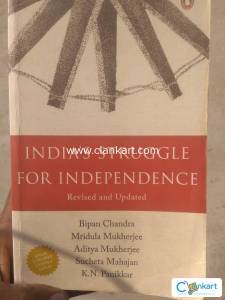
The SAGE Series in Modern Indian History consists of well-researched volumes with a wider scope and is intended to bring together the growing volume of historical studies that share a broad common historiographic focus. The approach that the authors have tried to evolve looks sympathetically, though critically, at the Indian national liberation struggle and other popular movements such as those of labour, peasants, lower castes, tribal peoples and women. The series also looks at colonialism as a structure and a system, and analyzes changes in economy, society and culture in the colonial context as also in the context of independent India. It focuses on communalism and casteism as major features of modern Indian development. The volumes in the series will tend to reflect this approach as also its changing and developing features. At the broadest plane this approach is committed to the Enlightenment values of rationalism, humanism, democracy and secularism. This set includes: Volume 1: Independence and Partition: The Erosion of Colonial Power in India by Sucheta Mahajan Volume 2: A Narrative of Communal Politics: Uttar Pradesh, 1937–39 by Salil Misra Volume 3: Imperialism, Nationalism and the Making of the Indian Capitalist Class, 1920–1947 by Aditya Mukherjee Volume 4: From Movement to Government: The Congress in the United Provinces, 1937–42 by Visalakshi Menon Volume 5: Peasants in India’s Non-Violent Revolution: Practice and Theory by Mridula Mukherjee Volume 6: Communalism in Bengal: From Famine to Noakhali, 1943–47 by Rakesh Batabyal Volume 7: Political Mobilization and Identity in Western India, 1934–47 by Shri Krishan Volume 8: The Garrison State: Military, Government and Society in Colonial Punjab, 1849–1947 by Tan Tai Yong Volume 9: Colonializing Agriculture: The Myth of Punjab Exceptionalism by Mridula Mukherjee Volume 10: Region, Nation, “Heartland”: Uttar Pradesh in India’s Body-Politic by Gyanesh Kudaisya Volume 11: National Movement and Politics in Orissa, 1920–29 by Pritish Acharya Volume 12: Commun
Modern History textbook
This book covers the major topics of modern world history in a clear and concise style. After a general introduction, themes are developed in more detail, with headings, key words, and phrases underlined. With its easy to follow cross-referencing and helpful problem-solving approach, this text is the ideal introduction to higher level study of modern world history.
What Gandhi Didnt See: Being Indian in South Africa
From the vantage point of her own personal history--a fourth-generation Indian South African of mixed lineage--indentured as well as trader class, part Hindu, part Muslim--Dala explores the nuts and bolts of being Indian in South Africa today. From 1684 till the present, the Indian diaspora in South Africa has had a long history. But in the country of their origin, they remain synonymous with three points of identity: indenture, apartheid and Mahatma Gandhi. In this series of essays, Zainab Priya Dala deftly lifts the veil on some of the many other facets of South African Indians, starting with the question: How relevant is Gandhi to them today? It is a question Dala answers with searing honesty, just as she tackles the questions of the 'new racism'--between Black Africans and Indians--and the 'new apartheid'--money; the tussle between the 'canefields' where she grew up, and the 'Casbah', or the glittering town of Durban; and what the changing patterns in the names the Indian community chooses to adopt reflect. In writing that is fluid, incisive and sensitive, she explores the new democratic South Africa that took birth long after Gandhi returned to the subcontinent, and the fight against apartheid was fought and won. In this new 'Rainbow Nation', the people of Indian origin are striving to keep their ties to Indian culture whilst building a stronger South African identity. Zainab Priya Dala describes some of the scenarios that result from this dichotomy.
Wanderers, Kings, Merchants - The story of India through its languages
One of India's most incredible and enviable cultural aspects is that every Indian is bilingual, if not multilingual. Delving into the fascinating early history of South Asia, this original book reveals how migration, both external and internal, has shaped all Indians from ancient times. Through a first-of-its-kind and incisive study of languages, such as the story of early Sanskrit, the rise of Urdu, language formation in the North-east, it presents the astounding argument that all Indians are of mixed origins. It explores the surprising rise of English after Independence and how it may be endangering India's native languages.
India that is Bharat by J Sai Deepak
India, That Is Bharat, the first book of a comprehensive trilogy, explores the influence of European 'colonial consciousness' (or 'coloniality'), in particular its religious and racial roots, on Bharat as the successor state to the Indic civilisation and the origins of the Indian Constitution. It lays the foundation for its sequels by covering the period between the Age of Discovery, marked by Christopher Columbus' expedition in 1492, and the reshaping of Bharat through a British-made constitution-the Government of India Act of 1919. This includes international developments leading to the founding of the League of Nations by Western powers that tangibly impacted this journey.Further, this work also traces the origins of seemingly universal constructs such as 'toleration', 'secularism' and 'humanism' to Christian political theology. Their subsequent role in subverting the indigenous Indic consciousness through a secularised and universalised Reformation, that is, constitutionalism, is examined. It also puts forth the concept of Middle Eastern coloniality, which preceded its European variant and allies with it in the context of Bharat to advance their shared antipathy towards the Indic worldview. In order to liberate Bharat's distinctive indigeneity, 'decoloniality' is presented as a civilisational imperative in the spheres of nature, religion, culture, history, education, language and, crucially, in the realm of constitutionalism.
Writing on the Wall, India Checkmates America 2017
The Book Raises Vital Questions Of War And Peace And Identifies The Key Players Who Will Determine What Conditions Shall Prevail In The 21St Century South Asia. It Traces The Evolution Of Modern Armies And Assesses, How Well Prepared The Indian Army Is To Face The Challenges Ahead. The Author S Reviews Of The Years 2001 And 2002, When He Was In Command Of The Indian Army, Will Be Read With Considerable Interest, As India And Pakistan Came To The Brink Of War, In 2002. He Examines The Concept Of War For Validity And Ability To Solve Problems In The Modern Era And Concludes That Some Form Of A Warfare Will Continue. He Presents A Scenario Of A Future War And Draws Lessons From The Plans And Actions Of The Belligerants. He Also Deals With Intelligence, At Length, Cross-Border Terrorism And Media Management. His Pleading For The Concept Of Chief Of The Defence Staff (Cds) Will Be Of Special Interests For The Policy Makers, Defence Administrators And Readers At Large. His Views On Political Control Of The Army And The Linkage Between Foreign Policy And National Security Will Evoke Considerable Interest And Perhaps Some Controversy. The Chapters Dealing With The Soldiers Of India And Pakistan, Provide An Insight Into Their Psyche. The Chapter`Piece De Resistance , Of The Book I.E. `Is Peace Breaking Out In South Asia? Has Been Dealt With Balance And Candour And Will Provide The People And The Leaders Of Both India And Pakistan With Some Food For Thought.
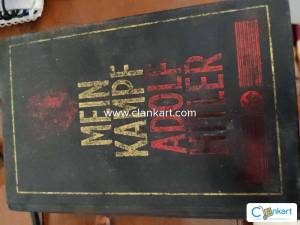
Mein Kamf by Adolf hitler
Alternate cover edition of this book.Madman, tyrant, animal—history has given Adolf Hitler many names. In Mein Kampf (My Struggle), often called the Nazi bible, Hitler describes his life, frustrations, ideals, and dreams. Born to an impoverished couple in a small town in Austria, the young Adolf grew up with the fervent desire to become a painter. The death of his parents and outright rejection from art schools in Vienna forced him into underpaid work as a laborer. During the First World War, Hitler served in the infantry and was decorated for bravery. After the war, he became actively involved with socialist political groups and quickly rose to power, establishing himself as Chairman of the National Socialist German Worker's party. In 1924, Hitler led a coalition of nationalist groups in a bid to overthrow the Bavarian government in Munich. The infamous Munich "Beer-hall putsch" was unsuccessful, and Hitler was arrested. During the nine months he was in prison, an embittered and frustrated Hitler dictated a personal manifesto to his loyal follower Rudolph Hess. He vented his sentiments against communism and the Jewish people in this document, which was to become Mein Kampf, the controversial book that is seen as the blue-print for Hitler's political and military campaign. In Mein Kampf, Hitler describes his strategy for rebuilding Germany and conquering Europe. It is a glimpse into the mind of a man who destabilized world peace and pursued the genocide now known as the Holocaust.