Buy used History & Archaeology Books online in India
Buy Second Hand Books, Used Books Online In India
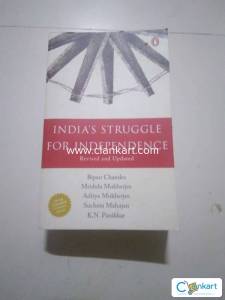
A Time of Madness
During the chaos of Partition in 1947, something dreadful happened in the city of Jalandhar in Punjab. As a result of this, Salman Rashid’s family fled Jalandhar for Pakistan, the newly created country across the border.They were among the nearly two million people uprooted from their homes in the greatest transmigration in history. Besides those who fled, other members of the family became part of a grimmer statistic: they featured among the more than one million unfortunate souls who paid with their lives for the division of India and creation of Pakistan.After living in the shadow of his family’s tragedy for decades, in 2008, Rashid made the journey back to his ancestral village to uncover the truth. A Time of Madness tells the story of what he discovered with great poignancy and grace. It is a tale of unspeakable brutality but it is also a testament to the uniquely human traits of forgiveness, redemption and the resilience of the human spirit.
Spectrum Modern India
This book is one of our bestsellers and is an effort to bring together various aspects of the turbulent period—from arrival of Europeans to India’s freedom from colonial rule—in a concise, all-inclusive, and systematic manner. It offers a chronological narrative of the period to make the development of historical events easy to understand and grasp. It effectively discusses important and major milestones as well as several relevant but little-known details of modern history, and also presents analytical comments on the historical events.Readers will also find a brief evaluation of the challenges faced by the country immediately after independence and the notable developments that took place under the various democratically elected governments. The important developments of the Nehruvian era as well as the post-Nehruvian time post-1964 are, thus, covered. Each chapter ends with a summary for an easy and quick revision.
Children's story book
The cleverness of Birbal, the most famous minister in the Mughal emporer Akbar's court, is legendary. Whenever Emporer Akbar had a problem to solve, or a philosophic question to ask, it was Birbal he turned to. And Birbal would provide him with thought-provoking or bizzarre answers, which resolved the monarch's dilemma. So whether it was why the palms of people's hands are hairless, or if a mango tree could stand witness in court, or whether all sons-in-law should be hanged, Birbal could suggest an intelligent and funny solution to these problems. This made him Akbar's favourite, which in turn earned Birbal the envy of the other courtiers. This collection of twenty-one fabulously funny stories contains all the wit and wisdom that make the stories of Birbal so widely read and loved.
History of modern india
The SAGE Series in Modern Indian History consists of well-researched volumes with a wider scope and is intended to bring together the growing volume of historical studies that share a broad common historiographic focus. The approach that the authors have tried to evolve looks sympathetically, though critically, at the Indian national liberation struggle and other popular movements such as those of labour, peasants, lower castes, tribal peoples and women. The series also looks at colonialism as a structure and a system, and analyzes changes in economy, society and culture in the colonial context as also in the context of independent India. It focuses on communalism and casteism as major features of modern Indian development. The volumes in the series will tend to reflect this approach as also its changing and developing features. At the broadest plane this approach is committed to the Enlightenment values of rationalism, humanism, democracy and secularism. This set includes: Volume 1: Independence and Partition: The Erosion of Colonial Power in India by Sucheta Mahajan Volume 2: A Narrative of Communal Politics: Uttar Pradesh, 1937–39 by Salil Misra Volume 3: Imperialism, Nationalism and the Making of the Indian Capitalist Class, 1920–1947 by Aditya Mukherjee Volume 4: From Movement to Government: The Congress in the United Provinces, 1937–42 by Visalakshi Menon Volume 5: Peasants in India’s Non-Violent Revolution: Practice and Theory by Mridula Mukherjee Volume 6: Communalism in Bengal: From Famine to Noakhali, 1943–47 by Rakesh Batabyal Volume 7: Political Mobilization and Identity in Western India, 1934–47 by Shri Krishan Volume 8: The Garrison State: Military, Government and Society in Colonial Punjab, 1849–1947 by Tan Tai Yong Volume 9: Colonializing Agriculture: The Myth of Punjab Exceptionalism by Mridula Mukherjee Volume 10: Region, Nation, “Heartland”: Uttar Pradesh in India’s Body-Politic by Gyanesh Kudaisya Volume 11: National Movement and Politics in Orissa, 1920–29 by Pritish Acharya Volume 12: Commun
Non fiction Bestseller
So who really spearheaded India’s Freedom Struggle? Millions of ordinary people—farmers, labourers, homemakers, forest produce gatherers, artisans and others—stood up to the British. People who never went on to be ministers, governors, presidents, or hold other high public office.They had this in common: their opposition to Empire was uncompromising.In The Last Heroes, these foot soldiers of Indian freedom tell us their stories. The men, women and children featured in this book are Adivasis, Dalits, OBCs, Brahmins, Muslims, Sikhs and Hindus. They hail from different regions, speak different languages and include atheists and believers, Leftists, Gandhians and Ambedkarites.The people featured pose the intriguing question: What is freedom? They saw that as going beyond Independence. And almost all of them continued their fight for freedoms long after 1947.The post-1947 generations need their stories.To learn what they understood. That freedom and independence are not the same thing. And to learn to make those come together.
Jinnah: His Successes, Failures and Role in History
Mohammad Ali Jinnah has been both celebrated and reviled for his role in the Partition of India, and the controversies surrounding his actions have only increased in the seven decades and more since his death. Ishtiaq Ahmed places Jinnah's actions under intense scrutiny to ascertain the Quaid-i-Azam's successes and failures and the meaning and significance of his legacy. Using a wealth of contemporary records and archival material, Dr Ahmed traces Jinnah's journey from Indian nationalist to Muslim communitarian, and from a Muslim nationalist to, finally, Pakistan's all-powerful head of state. How did the ambassador of Hindu-Muslim unity become the inflexible votary of the two-nation theory? Did Jinnah envision Pakistan as a theocratic state? What was his position on Gandhi and federalism? Asking these crucial questions against the backdrop of the turbulent struggle against colonialism, this book is a path-breaking examination of one of the most controversial figures of the twentieth century.
Hitler and Stalin Hardcover book
An award-winning historian plumbs the depths of Hitler and Stalin's vicious regimes, and shows the extent to which they brutalized the world around them. Two 20th century tyrants stand apart from all the rest in terms of their ruthlessness and the degree to which they changed the world around them. Briefly allies during World War II, Adolph Hitler and Josef Stalin then tried to exterminate each other in sweeping campaigns unlike anything the modern world had ever seen, affecting soldiers and civilians alike. Millions of miles of Eastern Europe were ruined in their fight to the death, millions of lives sacrificed.Laurence Rees has met more people who had direct experience of working for Hitler and Stalin than any other historian. Using their evidence he has pieced together a compelling comparative portrait of evil, in which idealism is polluted by bloody pragmatism, and human suffering is used casually as a political tool. It's a jaw-dropping description of two regimes stripped of moral anchors and doomed to destroy each other, and those caught up in the vicious magnetism of their leadership.
Krishna book
A vivid journey back to the time of Krishna, his holy city, and the Mahabharata War • Recounts ecstatic celebrations, Krishna’s love for his wives and sons, and events surrounding the Mahabharata War • Offers potent spiritual lessons from Krishna’s teachings and stresses Krishna’s ability to contain all opposites and stand above duality • Provides a historical timeline and real dates for the Mahabharata War and the sinking of Krishna’s city beneath the sea Located on the west coast of India in the state of Gujarat, the city of Dwaraka is considered one of the seven holy cities of India. Archaeological discoveries of ruins and artifacts off the city’s coast have now conclusively proven what many have long believed: Modern Dwaraka is built on the same site as the famed city of the same name from the Puranas and the Mahabharata, the “Golden City” of Lord Krishna. Transporting us back five thousand years to the time of Krishnavatara, the age in which Krishna lived, Vanamali leads us on a journey alongside Lord Krishna as he reigns over the ancient port city of Dwaraka and helps the Pandavas through the Mahabharata War. Recounting ecstatic celebrations, Krishna’s love for his wives and sons, and events surrounding the epic war, the author stresses Krishna’s ability to contain all opposites and stand above duality like a lotus leaf floating on a running stream. Offering potent spiritual lessons throughout her story, she shows how the truly spiritual individual is able to unreservedly accept all dimensions of life and rise above all dualities of existence, war and peace, love and hate, sex and abstinence, action and meditation. She also provides a historical timeline for the Mahabharata War and the sinking of Krishna’s city beneath the sea--3126 BCE and 3090 BCE, respectively--and shows how the Mahabharata War occurred under circumstances quite similar to those of the present day, both politically and astrologically. Through her vivid tale and her personal connection with Krishna across many lifetimes, Vanamali shows ho
A LITTLE HISTORY OF THE WORLD
In 1935, with a doctorate in art history and no prospect of a job, the 26-year-old Ernst Gombrich was invited by a publishing acquaintance to attempt a history of the world for younger readers. Amazingly, he completed the task in an intense six weeks, and Eine kurze Weltgeschichte für junge Leser was published in Vienna to immediate success, and is now available in seventeen languages across the world.Toward the end of his long life, Gombrich embarked upon a revision and, at last, an English translation. A Little History of the World presents his lively and involving history to English-language readers for the first time.Superbly designed and freshly illustrated, this is a book to be savored and collected. In forty concise chapters, Gombrich tells the story of man from the stone age to the atomic bomb. In between emerges a colorful picture of wars and conquests, grand works of art, and the spread and limitations of science. This is a text dominated not by dates and facts, but by the sweep of mankind's experience across the centuries, a guide to humanity's achievements and an acute witness to its frailties.The product of a generous and humane sensibility, this timeless account makes intelligible the full span of human history.
Ancient Egypt
Kids will feel as if they stepped right into the past as Abdul the guide leads them through the marvels of Ancient Egypt. The tour takes in everything, from the Pyramids to fascinating artifacts from 5,000 years ago, from the River Nile to the famous temple at Abu Simbel. A pull of the tab reveals a pyramid’s interior; the details of a dhow, or ancient sailboat; and more.
First man the life of Neil A Armstrong
"First Man" offers the only authorized glimpse into the life of America’s most famous astronaut, Neil Armstrong – the man whose “one small step” changed history.Based on over 50 hours of interviews with the intensely private Armstrong, who also gave Hansen exclusive access to private documents and family sources, this “magnificent panorama of the second half of the American twentieth century” (Publishers Weekly, Starred Review) is an unparalleled biography of an American icon.When Apollo 11 touched down on the moon’s surface in 1969, the first man on the moon became a legend. Hansen vividly recreates Armstrong's career in flying, from his seventy-eight combat missions as a naval aviator flying over North Korea to his formative transatmospheric flights in the rocket-powered X-15 to his piloting Gemini VIII to the first-ever docking in space. For a pilot who cared more about flying to the Moon than he did about walking on it, Hansen asserts, Armstrong's storied vocation exacted a dear personal toll, paid in kind by his wife and children. In the years since the Moon landing, rumors swirled around Armstrong concerning his dreams of space travel, his religious beliefs, and his private life. This book reveals the man behind the myth. In a penetrating exploration of American hero worship, Hansen addresses the complex legacy of the First Man, as an astronaut and as an individual. In "First Man", the personal, technological, epic, and iconic blend to form the portrait of a great but reluctant hero who will forever be known as "history's most famous space traveler".