Buy used Engineering Books online in India
Buy Second Hand Books, Used Books Online In India
Used Science and Engineering Books
This introduction to compilers is the direct descendant of the well-known book by Aho and Ullman, Principles of Compiler Design. The authors present updated coverage of compilers based on research and techniques that have been developed in the field over the past few years. The book provides a thorough introduction to compiler design and covers topics such as context-free grammars, fine state machines, and syntax-directed translation.
Used Science and Engineering Books
"Written in an admirably cleancut and economical style." — Mathematical Review. A thorough, systematic first course in elementary differential equations for undergraduates in mathematics and science, requiring only basic calculus for a background, and including many exercises designed to develop students' technique in solving equations. With problems and answers. Index.
Used Science and Engineering Books
This comprehensive and well-organized book, now in its Third Edition, continues to provide the students with the fundamental concepts, the underlying principles, various well-known mathematical techniques and methods such as Laplace and Fourier transform techniques, the variable separable method, and Green’s function method to solve partial differential equations.The text is supported by a number of worked-out examples and miscellaneous examples to enable the students to assimilate the fundamental concepts and the techniques for solving partial differential equations with various initial and boundary conditions. Besides, chapter-end exercises are also provided with hints to reinforce the students’ skill.It is designed primarily to serve as a textbook for senior undergraduate and postgraduate students pursuing courses in applied mathematics, physics and engineering.What is new to this edition ?Adds new sections on linear partial differential equations with constant coefficients and non-linear model equations.Offers additional worked-out examples and exercises to illustrate the concepts discussed.
Numerical methods in engineering science
This book provides a clear and precise exposition of modern numerical techniques. It is designed as a suitable text-book for engineering and science students upto the postgraduate level. Each method is illustrated by a number of solved examples.Inside the book1.Approximation and Errors in Computation2.Solutions of Algebraic and Transcendental Equations3.Solutions of Simultaneous Algebraic Equations4.Matrix Inversion and Eigen-Value Problems5.Empirical Laws and Curve-fitting6.Finite Difference 7.Interpolation8.Numerical Differentiation and Integration 9.Difference Equations10.Numerical Solutions of Ordinary Differential Equations11.Numerical Solutions of Partial Differential Equations12.Linear Programming13.Review of Computers14.Numerical Methods using C, C++, MATLAB
Object-Oriented Programming in C++
Description Object OrientedProgramming in C++ is a comprehensive solution for teachingobject-oriented programming using the features of ANSI/ISO C++. Itcovers the basic concepts of object-oriented programming, why thoseconcepts exist and how to make them work effectively. The FourthEdition is updated and revised to include more UML coverage,inter-file communication, and use-cases analysis to explainsoftware design. The book covers object-oriented programmingthrough task-oriented examples and figures to conceptualize thetechniques and approaches used. It also contains questions andexercises to reinforce the concepts students have learned. For Sale in Indiansubcontinent only Comprehensive Coverage?Offers extensive coverage on C++ programming concepts. Provides students with the fundamentals of C++. Object-Oriented Programming?Uses the C++ language. Explains object-oriented programming to students through the C++ language. Emphasis on why these concepts exist and how to utilize them to create efficient applications. Teaches students the background behind the concepts and how to make them work more effectively. Tutorial-style. Gives the students a "hands-on" approach to object-oriented programming. Increased coverage of UML?Illustrates program structure and flow. Helps students comprehend important concepts. The Big Picture. C++ Programming Basics. Loops and Decisions. Structures. Functions. Objects and Classes. Arrays and Strings. Operator Overloading. Inheritance. Pointers. Virtual Functions and Other Subtleties. Streams and Files. Multifile Programs. Templates and Exceptions. The Standard Template Library. Object-Oriented Software Development.
Digital signal processing - 7th Edition
Digital Signal Processors (DSP) take real-world signals like voice, audio, video, temperature, pressure, or position that have been digitized and then mathematically manipulate them. A DSP is designed for performing mathematical functions like "add", "subtract", "multiply" and "divide" very quickly.
Neural networks book
This Book provides a solid and practical introductions to neural networkscomputational models inspired by the brain. The authors explain the basic concepts and technology underlying such models, then show how these models can be applied to the solution of diverse problems in science and engineering. The book's aim is not to explore every corner of current and future research, but to focus on what works and to present techniques useful for solving real problems.
Microwave Engineering (Fourth Edition) By David M Pozar
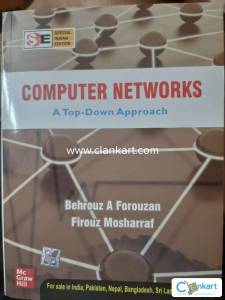
Primarily intended as a text for undergraduate courses in Electronics and Communications Engineering, Computer Science, IT courses, and Computer Applications, this up-to-date and accessible text gives an indepth analysis of data communications and computer networks in an easy-to-read style. Though a new title, it is a completely revised and fully updated version of the author’s earlier book Data Communications. The rapid strides made during the last decade in the fields of data communication and networking, and the close link between these two subjects have prompted the author to add several chapters on computer networks in this text. The book gives a masterly analysis of topics ranging from the principles of data transmission to computer networking applications. It also provides standard protocols, thereby enabling to bridge the gap between theory and practice. What’s more, it correlates the network protocols to the concepts, which are explained with the help of numerous examples to facilitate students’ understanding of the subject. This well-organized text presents the latest developments in the field and details current topics of interest such as Multicasting, MPLS, IPv6, Gigabit Ethernets, IPSec, SSL, Auto-negotiation, Wireless LANs, Network security, Differentiated services, and ADSL. Besides students, the practicing professionals would find the book to be a valuable resource. The book, in its second edition introduces a full chapter on Quality of Service, highlighting the meaning, parameters and functions required for quality of service. This book is recommended in Kaziranga University, Nagaland, IIT Guwahati, Assam and West Bengal University of Technology (WBUT), West Bengal for B.Tech. Key Features • The book is self-contained and student friendly. • The sequential organization lends flexibility in designing courses on the subject. • Large number of examples, diagrams and tables illustrate the concepts discussed in the text. • Numerous exercises (with answers), a list of acronyms, and references to protoc
Control System Electrical Engineering
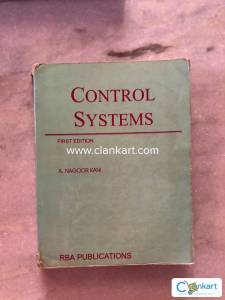
Description Control Systems: Theory and Applications is designed to meet therequirements of undergraduate programs in electrical,instrumentation, electronics and communication, and other alliedengineering disciplines. This book presents a comprehensivetreatment of the fundamentals of control system theory with anemphasis on its practical applications. It covers a range of topicsfrom the conventional to the modern and from the non-linear to thebasic digital control systems, along with an introduction on theapplications of fuzzy logic in control systems. It also provides anexhaustive coverage on continuous-time and discrete-time systemsand the time-domain and frequency-domain analysis of controlsystems. The user-friendly approach and rich pedagogy will helpstudents to enhance their problem-solving skills and enable them toapply the theories to the design and analysis of controlsystems. New topics like servometers and signal flow graphs for networks and P/PI/PID controllers included Comprehensive coverage of a wide variety of control components such as accelerometers; cross-field machines; magnetic and electronic amplifiers; thermal, fluid, chemical and pneumatic systems; design of compensators; and Kalman's and Gilbert's tests A dedicated section on significant points for revision and recapitulation of concepts at the end of each chapter New sections on MATLAB programs at the end of chapters provided to ensure that the theoretical and practical aspects are linked Rigorous additional solved examples provided for more practice after every chapter Enhanced pedagogy: 42 solved questions 368 unsolved questions 326 figures and illustrations 500+ MCQs 45+ MATLAB programs New topics like servometers and signal flow graphs for networks and P/PI/PID controllers included Comprehensive coverage of a wide variety of control components such as accelerometers; cross-field machines; magnetic and electronic amplifiers; thermal, fluid, chemical and pneumatic systems; design of compe
Control System Electrical Engineering
This comprehensive text on control systems is designed for undergraduate students pursuing courses in electronics and communication engineering, electrical and electronics engineering, telecommunication engineering, electronics and instrumentation engineering, mechanical engineering, and biomedical engineering. Appropriate for self-study, the book will also be useful for AMIE and IETE students.Written in a student-friendly readable manner, the book, now in its Second Edition, explains the basic fundamentals and concepts of control systems in a clearly understandable form. It is a balanced survey of theory aimed to provide the students with an in-depth insight into system behaviour and control of continuous-time control systems. All the solved and unsolved problems in this book are classroom tested, designed to illustrate the topics in a clear and thorough way.New to this Edition One new chapter on Digital control systems Complete answers with figures Root locus plots and Nyquist plots redrawn as per MATLAB output MATLAB programs at the end of each chapter Glossary at the end of chaptersKey Features Includes several fully worked-out examples to help students master the concepts involved. Provides short questions with answers at the end of each chapter to help students prepare for exams confidently. Offers fill in the blanks and objective type questions with answers at the end of each chapter to quiz students on key learning points. Gives chapter-end review questions and problems to assist students in reinforcing their knowledge.#PrefaceSymbols, Notations And Abbreviations1. Introduction to Control Systems2. Mathematical Models of Physical Systems3. Block Diagram and Signal Flow Graphs4. Time Response Analysis5. Routh Stability Criterion6. Root Locus Technique7. Frequency Response Analysis8. Nyquist Plot9. Compensation10. State-Space Analysis11. Digital Control SystemsGlossary�� AnswersIndex#top