Buy used Engineering Books online in India
Buy Second Hand Books, Used Books Online In India
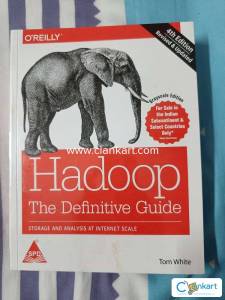
Big data - Hadoop guide
Hadoop: The Definitive Guide helps you harness the power of your data. Ideal for processing large datasets, the Apache Hadoop framework is an open source implementation of the MapReduce algorithm on which Google built its empire. This comprehensive resource demonstrates how to use Hadoop to build reliable, scalable, distributed systems: programmers will find details for analyzing large datasets, and administrators will learn how to set up and run Hadoop clusters. Complete with case studies that illustrate how Hadoop solves specific problems, this book helps you: Use the Hadoop Distributed File System (HDFS) for storing large datasets, and run distributed computations over those datasets using MapReduce Become familiar with Hadoop's data and I/O building blocks for compression, data integrity, serialization, and persistence Discover common pitfalls and advanced features for writing real-world MapReduce programs Design, build, and administer a dedicated Hadoop cluster, or run Hadoop in the cloud Use Pig, a high-level query language for large-scale data processing Take advantage of HBase, Hadoop's database for structured and semi-structured data Learn ZooKeeper, a toolkit of coordination primitives for building distributed systems If you have lots of data -- whether it's gigabytes or petabytes -- Hadoop is the perfect solution. Hadoop: The Definitive Guide is the most thorough book available on the subject. "Now you have the opportunity to learn about Hadoop from a master-not only of the technology, but also of common sense and plain talk." -- Doug Cutting, Hadoop Founder, Yahoo!
Artificial Intelligence : A Modern Approach - 4th edition
For one or two-semester, undergraduate or graduate-level courses in Artificial Intelligence. The long-anticipated revision of this best-selling text offers the most comprehensive, up-to-date introduction to the theory and practice of artificial intelligence. *NEW-Nontechnical learning material-Accompanies each part of the book. *NEW-The Internet as a sample application for intelligent systems-Added in several places including logical agents, planning, and natural language. *NEW-Increased coverage of material - Includes expanded coverage of: default reasoning and truth maintenance systems, including multi-agent/distributed AI and game theory; probabilistic approaches to learning including EM; more detailed descriptions of probabilistic inference algorithms. *NEW-Updated and expanded exercises-75% of the exercises are revised, with 100 new exercises. *NEW-On-line Java software. *Makes it easy for students to do projects on the web using intelligent agents. *A unified, agent-based approach to AI-Organizes the material around the task of building intelligent agents. *Comprehensive, up-to-date coverage-Includes a unified view of the field organized around the rational decision making pa
Book for sale
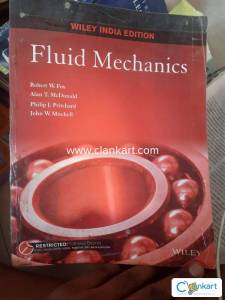
Key Features "Explores the fundamental concepts, physical concepts and first principles of fluid mechanics Integrates 30% new problems that make the material more relevant Offers an expanded discussion of pipe networks and a new section on oblique shocks and expansion waves Presents new, simplified examples with more detailed explanations to make concepts easier to understand" About the Book: Fluid Mechanics: Si Version: 8th Edition "The authors show how to develop an orderly plan to solve problems: starting from basic equations then clearly stating assumptions and finally relating results to expected physical behavior." "One of the bestselling books in the field, Introduction to Fluid Mechanics continues to provide readers with a balanced and comprehensive approach to mastering critical concepts. The new eighth edition once again incorporates a proven problem-solving methodology that will help them develop an orderly plan to finding the right solution. It starts with basic equations, then clearly states assumptions and finally, relates results to expected physical behavior. Many of the steps involved in analysis are simplified by using Excel." Content "Fundamental Concepts Fluid Statics Basic Equations in Integral form for a Control Volume Introduction to Differential Analysis of Fluid Motion Incompressible Inviscid Flow Dimensional Analysis and Similitude Internal incompressible viscous flow External incompressible viscous flow Fluid Machinery Flow in Open Channels Introduction to Compressible Flow Compressible Flow" About the Author: Fox, McDonald, Pritchard "Robert W. Fox, Purdue University; Alan T. McDonald, Purdue University Philip J. Pritchard, Manhattan College"
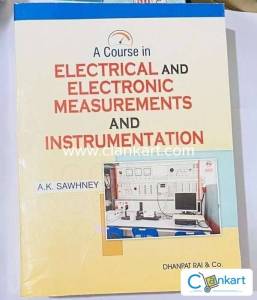
Measurements & instrumentation by Ak sawhney
The book is fact covers a very wide spectrum of the field of Electrical and Electronic Measurements and instrumentation and is a complete reference in itself. The contents of the book have been drastically modified re-arranged and updated to acquaint the reader of modern trends in the field of measurements and Instrumentation.
Software Project Management
This edition aims to facilitate an updated study of software project management with respect to contemporary developments in the field. A distinguishing feature of the book is the presence of numerous examples of important principles through a running case study. About The Author: Bob Hughes, Programme Leader, School of Computing Mathematical and Information Sciences, University of Brighton, UK Mike Cotterell, Formerly Senior Lecturer in Information Management, University of Brighton, UK Rajib Mall, Professor, Department of Computer Science and Engineering, Indian Institute of Technology, Kharagpur, India
Digital signal processing
Various measures of information are discussed in first chapter. Information rate, entropy and mark off models are presented. Second and third chapter deals with source coding. Shannon's encoding algorithm, discrete communication channels, mutual information, Shannon's first theorem are also presented. Huffman coding and Shannon-Fano coding is also discussed. Continuous channels are discussed in fourth chapter. Channel coding theorem and channel capacity theorems are also presented. Block codes are discussed in chapter fifth, sixth and seventh. Linear block codes, Hamming codes, syndrome decoding is presented in detail. Structure and properties of cyclic codes, encoding and syndrome decoding for cyclic codes is also discussed. Additional cyclic codes such as RS codes, Golay codes, burst error correction is also discussed. Last chapter presents convolutional codes. Time domain, transform domain approach, code tree, code trellis, state diagram, Viterbi decoding is discussed in detail.