Buy used Engineering Books online in India
Buy Second Hand Books, Used Books Online In India
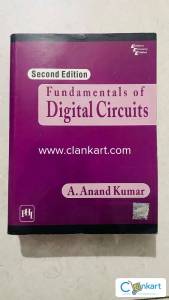
Fundamentals of Digital Circuits 4th edition
The Fourth edition of this well-received text continues to provide coherent and comprehensive coverage of digital circuits. It is designed for the undergraduate students pursuing courses in areas of engineering disciplines such as Electrical and Electronics, Electronics and Communication, Electronics and Instrumentation, Telecommunications, Medical Electronics, Computer Science and Engineering, Electronics, and Computers and Information Technology. It is also useful as a text for MCA, M.Sc. (Electronics) and M.Sc. (Computer Science) students. Appropriate for self study, the book is useful even for AMIE and grad IETE students. Written in a student-friendly style, the book provides an excellent introduction to digital concepts and basic design techniques of digital circuits. It discusses Boolean algebra concepts and their application to digital circuitry, and elaborates on both combinational and sequential circuits. It provides numerous fully worked-out, laboratory tested examples to give students a solid grounding in the related design concepts. It includes a number of short questions with answers, review questions, fill in the blanks with answers, multiple choice questions with answers and exercise problems at the end of each chapter.
Transport Phenomena
This introductory text discusses the essential concepts of three funda-mental transport processes, namely, momentum transfer, heat transfer, and mass transfer. Apart from chemical engineering, transport processes play an increasingly important role today in the fields of biotechnology, nanotechnology and microelectronics. The book covers the basic laws of momentum, heat and mass transfer. All the three transport processes are explained using two approaches—first by flux expressions and second by shell balances. These concepts are applied to formulate the physical problems of momentum, heat and mass transfer. Simple physical processes from the chemical engineering field are selected to understand the mechanism of these transfer operations. Though these problems are solved for unidirectional flow and laminar flow conditions only, turbulent flow conditions are also discussed. Boundary conditions and Prandtl mixing models for turbulent flow conditions are explained as well. The unsteady-state conditions for momentum, heat and mass transfer have also been highlighted with the help of simple cases. Finally, the approach of anology has also been adopted in the book to understand these three molecular transport processes. Different analogies such as Reynolds, Prandtl, von Kármán and Chilton–Colburn are discussed in detail. This book is designed for the undergraduate students of chemical engineering and covers the syllabi on Transport Phenomena as currently prescribed in most institutes and universities.
Chemical Engineering Thermodynamics
About the Book: Textbook of Chemical Engineering Thermodynamics Designed as an undergraduate level textbook in Chemical Engineering, this student friendly, thoroughly class-room tested book, now in its second edition, continues to provide an in-depth analysis of chemical engineering thermodynamics. The book has been so organized that it gives comprehensive coverage of basic concepts and applications of the laws of thermodynamics in the initial chapters, while the later chapters focus at length on important areas of study falling under the realm of chemical thermodynamics. The reader is thus introduced to a thorough analysis of the fundamental laws of thermodynamics as well as their applications to practical situations. This is followed by a detailed discussion on relationships among thermodynamic properties and an exhaustive treatment on the thermodynamic properties of solutions. The role of phase equilibrium thermodynamics in design, analysis, and operation of chemical separation methods is also deftly dealt with. Finally, the chemical reaction equilibria are skillfully explained. Besides numerous illustrations, the book contains over 200 worked examples, over 400 exercise problems (all with answers) and several objective-type questions, which enable students to gain an in-depth understanding of the concepts and theory discussed. The book will also be a useful text for students pursuing courses in chemical engineering-related branches such as polymer engineering, petroleum engineering, and safety and environmental engineering. Contents: Preface Preface to the First Edition 1. Introduction and Basic Concepts 2. First Law of Thermodynamics 3. P-V-T Behaviour and Heat Effects 4. Second Law of Thermodynamics 5. Some Applications of the Laws Thermodynamics 6. Thermodynamic Properties of Pure Fluids 7. Properties of Solutions 8. Phase Equilibria 9. Chemical Reaction Equilibria Appendixes Answers to Problems Index About the Author: K.V. Narayanan K.V. Narayanan, PhD,
Fuel and Combustion
Fuels and Combustion is a systematic and comprehensive work on a subject that forms an integral part of the undergraduate degree courses in chemical, mechanical, metallurgical, and aeronautical engineering. While emphasizing the fundamental principles, the book provides a balanced treatment of energy resources, processing of fuels, fundamentals of combustion, and combustion appliances. The book takes a different approach by dealing with the topics in an Indian context. The third edition of the book has a completely new introduction, layout, and design, and new statistics have been added to provide up-to-date information.
Outline of Chemical Technology
Chemical Engineering is the branch of science that merges the use of physics, chemistry and life science with economics and mathematics for conversion of chemicals and raw materials into other products. Dryden's Outlines Of Chemical Technology For The 21st Century 3rd Edition covers topics like Inorganic Chemical Industries, Natural Product Industries, Orientation, Polymerization Fundamentals, Metallurgical Industries, Synthetic Organic Chemical Industries, Toxic Chemicals and Pollution Controls. It also has detailed information on the highly ranked Indian chemical industries and has detailed notes for teachers.The revised edition has been developed over a long time while the previous editions had been based on the lectures delivered by the author at IIT-Kanpur. Additional topics on composite materials and industrial pollution controls have been added in the book by M. Gopal Rao and Marshall Sittig. The book has chapters like Inorganic Chemical Industries, Orientation, Natural Product Industries, Polymerization Fundamentals, Synthetic Organic Chemical Industries, Metallurgical Industries, Application of Computers to the Chemical Industries and Toxic Chemicals and Pollution Controls.The book was published in the year 2010.
Mass Transfer And Separation
This textbook is targetted to undergraduate students in chemical engineering, chemical technology, and biochemical engineering for courses in mass transfer, separation processes, transport processes, and unit operations. The principles of mass transfer, both diffusional and convective have been comprehensively discussed. The application of these principles to separation processes is explained. The more common separation processes used in the chemical industries are individually described in separate chapters. The book also provides a good understanding of the construction, the operating principles, and the selection criteria of separation equipment. Recent developments in equipment have been included as far as possible. The procedure of equipment design and sizing has been illustrated by simple examples. An overview of different applications and aspects of membrane separation has also been provided. ‘Humidification and water cooling’, necessary in every process indus-try, is also described. Finally, elementary principles of ‘unsteady state diffusion’ and mass transfer accompanied by a chemical reaction are covered. SALIENT FEATURES : • A balanced coverage of theoretical principles and applications. • Important recent developments in mass transfer equipment and practice are included. • A large number of solved problems of varying levels of complexities showing the applications of the theory are included. • Many end-chapter exercises. • Chapter-wise multiple choice questions. • An Instructors manual for the teachers.
Chemical Engineering Objective
This book is meant for diploma students of chemical engineering and petroleum engineering both for their academic programmes as well as for competitive examination. This book Contains 18 chapters covering the entire syllabus of diploma course in chemical engineering and petrochemical engineering. This book in its present form has been designed to serve as an encyclopedia of chemical engineering so as to be ready reckoner apart from being useful for all types of written tests and interviews faced by chemical engineering and petrochemical engineering diploma students of the country. Since branch related subjects of petrochemical engineering are same as that of chemical engineering diploma students, so this book will be equally useful for diploma in petrochemical engineering students.