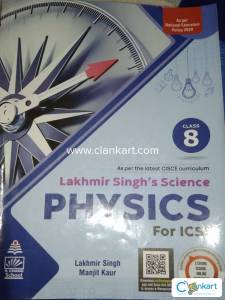
Buy used Class 8 Books online in India
Buy Second Hand Books, Used Books Online In India

GRB inorganic chemistry 2nd year
An advanced-level textbook of inorganic chemistry for the graduate (B.Sc) and postgraduate (M.Sc) students of Indian and foreign universities. This book is a part of four volume series, entitled "A Textbook of Inorganic Chemistry – Volume I, II, III, IV". CONTENTS: Chapter 1. Stereochemistry and Bonding in Main Group Compounds: VSEPR theory, dπ -pπ bonds, Bent rule and energetic of hybridization. Chapter 2. Metal-Ligand Equilibria in Solution: Stepwise and overall formation constants and their interactions, Trends in stepwise constants, Factors affecting stability of metal complexes with reference to the nature of metal ion and ligand, Chelate effect and its thermodynamic origin, Determination of binary formation constants by pH-metry and spectrophotometry. Chapter 3. Reaction Mechanism of Transition Metal Complexes – I: Inert and labile complexes, Mechanisms for ligand replacement reactions, Formation of complexes from aquo ions, Ligand displacement reactions in octahedral complexes- acid hydrolysis, Base hydrolysis, Racemization of tris chelate complexes, Electrophilic attack on ligands. Chapter 4. Reaction Mechanism of Transition Metal Complexes – II: Mechanism of ligand displacement reactions in square planar complexes, The trans effect, Theories of trans effect, Mechanism of electron transfer reactions – types; Outer sphere electron transfer mechanism and inner sphere electron transfer mechanism, Electron exchange. Chapter 5. Isopoly and Heteropoly Acids and Salts: Isopoly and Heteropoly acids and salts of Mo and W: structures of isopoly and heteropoly anions. Chapter 6. Crystal Structures: Structures of some binary and ternary compounds such as fluorite, antifluorite, rutile, antirutile, crystobalite, layer lattices- CdI2, BiI3; ReO3, Mn2O3, corundum, pervoskite, Ilmenite and Calcite. Chapter 7. Metal-Ligand Bonding: Limitation of crystal field theory, Molecular orbital theory, octahedral, tetrahedral or square planar complexes, π-bonding and molecular orbital theory. Chapter 8. Electronic Spectra of Transi
UPSC Anthropology Books and other books Low Price Top Authors
A comprehensive text on the theoretical nature of light. Span across wave, electromagnetic and particle nature of light with elaborate explanations. Contents1 View and Vision 1.1 About Camera & Photography 1.2 More about Eye 1.3 What and How we See 2 Light propagation: Catch the Runner 2.1 Refraction:When light reduces its velocity 2.2 Prism & Colour 3 Light as a Wave 3.1 How can we say light is a wave?3.2 Young's Double Slit Experiment3.3 RepresentingLight as a Wave3.4 Young's Double Slit Calculations3.5 Interferometry 3.6 Multiple Beam Interference 3.7 Diffraction 4 Light as Electromagnetic Radiation 4.1 Maxwell'sEquation. 4.2 Maxwell's Equations in Vacuum4.3 Maxwell's Equation in Matter 4.4 Maxwell's Equations to Wave Equation 4.5 Electromagnetic Waves in Space 4.6 Energy of Electromagnetic Wave4.7 Electromagnetic field and Maxwell's Equation4.8 Polarization in Electromagnetic wave4.9 Polarization Affecting Components 4.10Matrix Representation of Polarized Light4.11TE and TM Polarization5 Light As Particles5.1 Light Wave to Light Particle5.2 Photon Statistics.5.3 Electromagnetic Field Quantization5.4 Quantum Optical Representation of Electromagnetic field
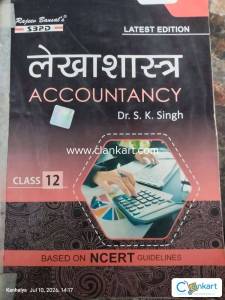
Accountancy for class 12
Problems and Solutions in Accountancy Class XII Part : A - Accounting for Not-for-Profit Organisations and Partnership Firms 1. Accounting for Not-for-Profit Organisations, 2. Accounting for Partnership Firms—Fundamentals, 3. Goodwill : Meaning, Nature, Factors Affecting and Methods of Valuation, 4. Reconstitution of Partnership–change in Profit-Sharing Ratio among the Existing Partners, 5. Admission of a Partner, 6. Retirement of a Partner, 7. Death of a Partner, 8. Dissolution of Partnership Firm. Part : B - Company Accounts and Analysis of Financial Accounting 1. Accounting for Share Capital : Share and Share Capital, 2. Accounting for Share Capital : Issue of Shares, 3. Forfeiture and Re-Issue of Share, 4. ssue of Debentures, 5. Redemption of Debentures, 6. Financial Statements of a Company : Balance Sheet and Statement of Profit and Loss, 7. Tools for Financial Statement Analysis : Comparative Statements, 8. Common-Size Statements, 9. Accounting Ratios, 10. Cash Flow Statement.
Arihant Differential Calculus for jee mains and advanced
1. Skill in Mathematics’ series is prepared for JEE Main and Advanced papers 2. It is a highly recommended textbook to develop a strong grounding in Differential Calculus 3. The book covers the entire syllabus into 8 chapters 4. Each chapter includes a wide range of questions that are asked in the examinations Good foundational grip is required in the Differential Calculus, while you are preparing for JEE Mains & Advanced or any other engineering. Bringing up the series “Skills in Mathematics for JEE Main & Advanced for Differential Calculus” that is carefully revised with the sessionwise theory and exercise; to help candidates to learn & tackle the mathematical problems. The book has 8 Chapters covering the whole syllabus for the JEE Mains and Advanced as prescribed. Each chapter is divided into sessions giving complete clarity to concepts. Apart from sessionwise theory, JEE Type examples and Chapter Exercise contain huge amount of questions that are provided in every chapter under Practice Part. Prepared under great expertise, it is a highly recommended textbook to develop a strong grounding in Algebra to perform best in JEE and various engineering entrances. TOC: Essential Mathematical Tools, Differentiation, Functions, Graphical Transformations, Limits, Continuity and Differentiability, dy/dx As a Rate Measurer & Tangents, Normals, Monotonicity, Maxima and Minima.