Buy used Class 7 Books online in India
Buy Second Hand Books, Used Books Online In India
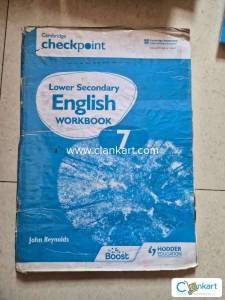
Cambridge lower secondary english learners book
The Cambridge Checkpoint English suite provides a comprehensive, structured resource which covers the Secondary 1 framework for English and seamlessly progresses into the next key stage (covered by our Cambridge IGCSE® First Language English series). This lively stage 8 Coursebook contains 12 themed units providing comprehensive coverage of the revised Cambridge Secondary 1 syllabus. As the core component in this suite, this title includes coverage of the five content areas (Phonics, Spelling and Vocabulary, Grammar and Punctuation, Reading, Writing, and Speaking and Listening). Additional features include rigorous language practice and teaching of key concepts, engaging activities to develop reading and writing skills, integrated speaking and listening tasks and a wide range of fiction and non-fiction texts from around the world. A skill-building, write-in workbook and a Teacher's Resource CD-ROM are available separately.
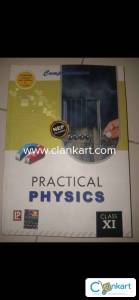
Comprehensive physics practical class 11
Table Of Contents: Chapter 1.????General Introduction SECTION A Chapter 2.????Measurement of Length Chapter 3.????Measurement of Mass Chapter 4.????Measurement of Time Chapter 5.????Vector Addition Chapter 6.????Motion under Gravity and Acceleration Due to Gravity Chapter 7.????Friction Chapter 8.????Motion of a Body Down an Inclined Plane SECTION B Chapter 9.????Elasticity Chapter 10.??Atmospheric Pressure Chapter 11.??Surface Tension Chapter 12.??Viscosity Chapter 13.??Thermal Expansion of Solids Chapter 14.??Thermal Expansion of Liquids Chapter 15.??Thermal Radiation Chapter 16.??Wave Motion and Velocity of Waves Chapter 17.??Vibration of Strings and Air Columns Chapter 18.??Heat ?????? Appendix ?????? Logarithmic and Other Tables Subjects: Comprehensive Textbooks (Without CCE Pattern),Physics
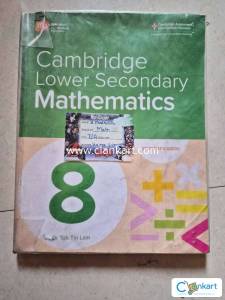
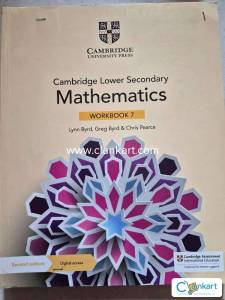
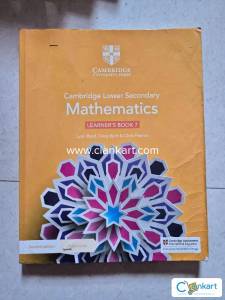
Cambridge lower secindary mathematic workbook stage 7
Written by well-respected authors, the Cambridge Checkpoint Mathematics suite provides a comprehensive structured resource which covers the full Cambridge Secondary 1 Mathematics framework in three stages. This brightly illustrated Coursebook for Stage 8 offers a comprehensive introduction to all topics covered in the syllabus. Worked examples show students how to tackle different problems, and plenty of exercise questions prepare students for the different types of questions they will face in their Progression test. Coverage of the Problem Solving framework is integrated throughout the course, with questions relating to the Problem Solving framework statements highlighted in the Coursebook. There is an accompanying Practice Book and Teacher's Resource CD-ROM available separately.
Python programming
Learn Python Quickly, A Programmer-Friendly Guide DESCRIPTION Most ProgrammerÕs learning Python are usually comfortable with some or the other programming language and are not interested in going through the typical learning curve of learning the first programming language. Instead, they are looking for something that can get them off the ground quickly. They are looking for similarities and differences in a feature that they have used in other language(s). This book should help them immediately. It guides you from the fundamentals of using module through the use of advanced object orientation. KEY FEATURES Strengthens the foundations, as detailed explanation of programming language concepts are given in simple manner.Ê Lists down all the important points that you need to know related to various topics in an organized manner. Prepares you for coding related interview and theoretical questions. Provides In depth explanation of complex topics and Questions. Focuses on how to think logically to solve a problem. Follows a systematic approach that will help you to prepare for an interview in short duration of time. Exercises are exceptionally useful to complete the readerÕs understanding of a topic. Ê WHAT WILL YOU LEARN Data types, Control flow instructions, consoleÊ& File Input/Output Strings, list & tuples, List comprehension Sets & Dictionaries, Functions & Lambdas Dictionary Comprehension Modules, classes and objects, Inheritance Operator overloading, Exception handling Iterators & Generators, Decorators, Command-line Parsing Ê WHO THIS BOOK IS FOR Students, Programmers, researchers, and software developers who wish to learn the basics of Python programming language. Ê Table of ContentsÊ 1. Introduction to Python 2. Python BasicsÊÊÊÊ 3. Strings 4. Decision Control Instruction 5. Repetition Control Instruction 6. Console Input/Output 7. Lists 8. Tuples 9. Sets 10. Dictionaries 11. Comprehensions 12. Functions 13. Recursion 14. Functional Programming 15. Modules and Packages 16. Namespaces 17. Classes and Objects 1
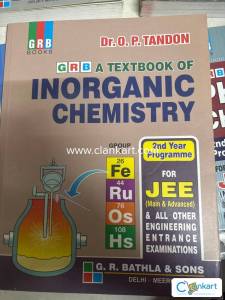
GRB inorganic chemistry 2nd year
An advanced-level textbook of inorganic chemistry for the graduate (B.Sc) and postgraduate (M.Sc) students of Indian and foreign universities. This book is a part of four volume series, entitled "A Textbook of Inorganic Chemistry – Volume I, II, III, IV". CONTENTS: Chapter 1. Stereochemistry and Bonding in Main Group Compounds: VSEPR theory, dπ -pπ bonds, Bent rule and energetic of hybridization. Chapter 2. Metal-Ligand Equilibria in Solution: Stepwise and overall formation constants and their interactions, Trends in stepwise constants, Factors affecting stability of metal complexes with reference to the nature of metal ion and ligand, Chelate effect and its thermodynamic origin, Determination of binary formation constants by pH-metry and spectrophotometry. Chapter 3. Reaction Mechanism of Transition Metal Complexes – I: Inert and labile complexes, Mechanisms for ligand replacement reactions, Formation of complexes from aquo ions, Ligand displacement reactions in octahedral complexes- acid hydrolysis, Base hydrolysis, Racemization of tris chelate complexes, Electrophilic attack on ligands. Chapter 4. Reaction Mechanism of Transition Metal Complexes – II: Mechanism of ligand displacement reactions in square planar complexes, The trans effect, Theories of trans effect, Mechanism of electron transfer reactions – types; Outer sphere electron transfer mechanism and inner sphere electron transfer mechanism, Electron exchange. Chapter 5. Isopoly and Heteropoly Acids and Salts: Isopoly and Heteropoly acids and salts of Mo and W: structures of isopoly and heteropoly anions. Chapter 6. Crystal Structures: Structures of some binary and ternary compounds such as fluorite, antifluorite, rutile, antirutile, crystobalite, layer lattices- CdI2, BiI3; ReO3, Mn2O3, corundum, pervoskite, Ilmenite and Calcite. Chapter 7. Metal-Ligand Bonding: Limitation of crystal field theory, Molecular orbital theory, octahedral, tetrahedral or square planar complexes, π-bonding and molecular orbital theory. Chapter 8. Electronic Spectra of Transi
UPSC Anthropology Books and other books Low Price Top Authors
A comprehensive text on the theoretical nature of light. Span across wave, electromagnetic and particle nature of light with elaborate explanations. Contents1 View and Vision 1.1 About Camera & Photography 1.2 More about Eye 1.3 What and How we See 2 Light propagation: Catch the Runner 2.1 Refraction:When light reduces its velocity 2.2 Prism & Colour 3 Light as a Wave 3.1 How can we say light is a wave?3.2 Young's Double Slit Experiment3.3 RepresentingLight as a Wave3.4 Young's Double Slit Calculations3.5 Interferometry 3.6 Multiple Beam Interference 3.7 Diffraction 4 Light as Electromagnetic Radiation 4.1 Maxwell'sEquation. 4.2 Maxwell's Equations in Vacuum4.3 Maxwell's Equation in Matter 4.4 Maxwell's Equations to Wave Equation 4.5 Electromagnetic Waves in Space 4.6 Energy of Electromagnetic Wave4.7 Electromagnetic field and Maxwell's Equation4.8 Polarization in Electromagnetic wave4.9 Polarization Affecting Components 4.10Matrix Representation of Polarized Light4.11TE and TM Polarization5 Light As Particles5.1 Light Wave to Light Particle5.2 Photon Statistics.5.3 Electromagnetic Field Quantization5.4 Quantum Optical Representation of Electromagnetic field
Operations and Supply Chain Management (MBA)
The book deals with the powerful concept of Business Process Reengineering (BPR) employed to bring about dramatic improvement in key business processes. It compares other important management concepts with BPR like Kaizen, TQM, Quality Function Deployment (QFD), ISO Standards and Enterprise Resource Planning (ERP). The book also deals with the management of change at length for a clear understanding of several aspects of change needed for the successful implementation of BPR in an organization.1. Business Process Reengineering and Kaizen 2. Definition and Illustrations of Business Process Reengineering 3. Business Process Reengineering and Other Management Concepts 4. Implementation of Business Process Reengineering5. Reengineering Structure 6. Common Pitfalls in Business Process Reengineering 7. Change Management in Business Process Reengineering