Buy used Business & Economics online in India
Buy Second Hand Books, Used Books Online In India
INDIAN ECONOMY
India’s struggle for Independence by Bipin Chandra is your go to book for an in-depth and detailed overview on Indian independence movement . Indian freedom struggle is one of the most important parts of its history. A lot has been written and said about it, but there still remains a gap. Rarely do we get to hear accounts of the independence from the entire country and not just one region at one place. This book fits in perfectly in this gap and also provides a narration on the impact this movement had on the people. Bipin Chandra’s book is a well-documented history of India's freedom struggle against the British rule. It is one of the most accurate books which have been painstakingly written after thorough research based on legal and valid verbal and written sources. It maps the first war of independence that started with Mangal Pandey’s mutiny and witnessed the gallant effort of Sri Rani Laxmi Bai. Many of the pages of this book are dedicated to Mahatma Gandhi’s non-cooperation and the civil disobedience movements. It contains detailed description of Subash Chandra Bose’s weapon heavy tactics and his charisma. This book includes all the independence movements and fights, irrespective of their size and impact, covering India in its entirety. Although these movements varied in means and ideas, but they shared a common goal of independence. This book contains oral and written narratives from different parts of the country, making this book historically rich and diverse. The book captures the evolution of Indian independence struggle in full detail and leaves no chapter of this story untouched. This book is a good read for the students of Indian modern history and especially for students who are preparing for UPSC examination and have taken History as their subject.
The 48 laws of power
Amoral, cunning, ruthless, and instructive, this piercing work distills three thousand years of the history of power in to forty-eight well explicated laws. As attention-grabbing in its design as it is in its content, this bold volume outlines the laws of power in their unvarnished essence, synthesizing the philosophies of Machiavelli, Sun-tzu, Carl von Clausewitz, and other great thinkers. Some laws teach the need for prudence ("Law 1: Never Outshine the Master"), the virtue of stealth ("Law 3: Conceal Your Intentions"), and many demand the total absence of mercy ("Law 15: Crush Your Enemy Totally"), but like it or not, all have applications in real life. Illustrated through the tactics of Queen Elizabeth I, Henry Kissinger, P. T. Barnum, and other famous figures who have wielded--or been victimized by--power, these laws will fascinate any reader interested in gaining, observing, or defending against ultimate control.
The SCAM Debashis Basu
The most thrilling non-fiction business book ever written in India. A fast, colourful narrative, knitting together the life and times of all stock market players involved in two of India's biggest stock market scams. The Scam, a chronicle of two of the most famous scams in the Indian stock markets, is now back in a digital avatar. The story told by Sucheta Dalal and Debashis Basu, can't find a more credible and informed couple of storytellers for these events. First published in April 1993, the book was an immediate bestseller but had been out of print for a while. This 8th edition of the scam includes the original Harshad Mehta Scam and the Ketan Parekh Scam, while also delving into the JPC Fiasco and the Global Trust Bank Scam. The basic question that the book deals with is, "what really happened in the two great Indian scams?" The answer to this question, detailed in the book, brings up another important one, "Have we learnt anything since, so that such things don't happen again?"
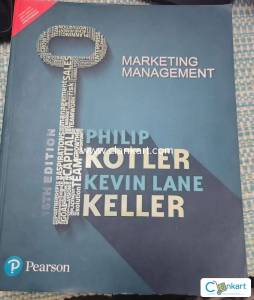
Marketing 5.0
Rediscover the fundamentals of marketing from the best in the businessIn Marketing 5.0, the celebrated promoter of the "Four P's of Marketing," Philip Kotler, explains how marketers can use technology to address customers' needs and make a difference in the world.In a new age when marketers are struggling with the digital transformation of business and the changing behavior of customers, this book provides marketers with a way to integrate technological and business model evolution with the dramatic shifts in consumer behavior that have happened in the last decade.Following the pattern presented in his bestselling Marketing X.0 series, Philip Kotler covers the crucial topics necessary to understand modern marketing, including:- Artificial Intelligence for marketing automation- Agile marketing- "Segments of one" marketing- Contextual technology- Facial recognition and voice tech for marketing- The future of Customer Experience (CX)- Transmedia storytelling- The "Whatever-Whenever-Wherever" service delivery- "Everything-As-A-Service" business model- Internet of Things and blockchain for marketing- Virtual and augmented reality marketing- Corporate activismPerfect for traditional and digital marketers, as well as students and teachers of marketing and business, Marketing 5.0 reinvigorates the field of marketing with actionable recommendations and unique insights.
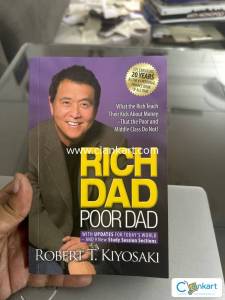
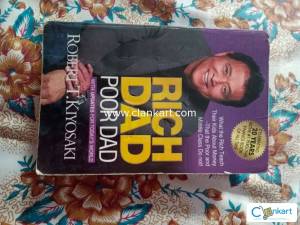
Rich Dad Poor Dad
Rich Dad Poor Dad is Robert's story of growing up with two dads — his real father and the father of his best friend, his rich dad — and the ways in which both men shaped his thoughts about money and investing. The book explodes the myth that you need to earn a high income to be rich and explains the difference between working for money and having your money work for you.
RICH DAD POOR DAD
April 2017 marks 20 years since Robert Kiyosaki’s Rich Dad Poor Dad first made waves in the Personal Finance arena.It has since become the #1 Personal Finance book of all time... translated into dozens of languages and sold around the world.Rich Dad Poor Dad is Robert's story of growing up with two dads — his real father and the father of his best friend, his rich dad — and the ways in which both men shaped his thoughts about money and investing. The book explodes the myth that you need to earn a high income to be rich and explains the difference between working for money and having your money work for you.20 Years... 20/20 HindsightIn the 20th Anniversary Edition of this classic, Robert offers an update on what we’ve seen over the past 20 years related to money, investing, and the global economy. Sidebars throughout the book will take readers “fast forward” — from 1997 to today — as Robert assesses how the principles taught by his rich dad have stood the test of time.In many ways, the messages of Rich Dad Poor Dad, messages that were criticized and challenged two decades ago, are more meaningful, relevant and important today than they were 20 years ago.As always, readers can expect that Robert will be candid, insightful... and continue to rock more than a few boats in his retrospective.Will there be a few surprises? Count on it.Rich Dad Poor Dad...• Explodes the myth that you need to earn a high income to become rich• Challenges the belief that your house is an asset• Shows parents why they can't rely on the school system to teach their kids about money• Defines once and for all an asset and a liability• Teaches you what to teach your kids about money for their future financial success
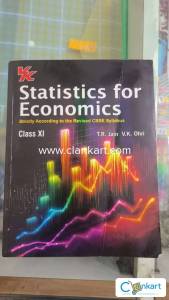
Tr jain statistics for economics book 2023-24
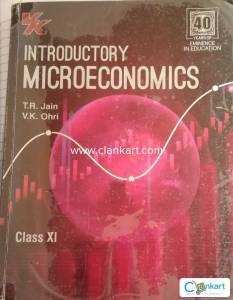
The CBSE board has recently shown a bent towards analysis and interpretation based questions under the label of ‘competency- based questions’. This book is prepared according to revised syllabus and new paper pattern. ‘The Same but Different’: Revised and restructured on positive feedback, the Statistics for Economics Textbook is all geared up to provide its readers step by step comprehension of the subject matter. Novelties of the text include: 1. NEW TYPOLOGY OF QUESTIONS: (Image/Data interpretation, defend and refute type questions etc.) have been incorporated in each chapter. 2. ‘BRAIN TEASER’ BLOCKS: Implication based questions related to current happenings around have been incorporated in each chapter. These help gauge the inferences the students are able to draw from the text and how easily they are able to relate economic theory to the ground level realities. 3. OTHERS: HOTS & Focus Zones DAV Board Question Paper (Solved) Sample Paper By “VK Global Study Group”[A specimen paper woven along the same structure and blueprint as suggested in the CBSE released Sample Question Paper-2023.]
Warren Buffett's Management Secrets
The book is divided into several sections covering Warren Buffett's personal business management: . Managing one's life - focuses on Buffett's insistence on a good education, picking one's heroes early in life, and staying away from things that damage you personally. The authors also discuss Buffett's belief that challenges make life interesting. . Managing One's Career - Buffett believes that you should work at something that you are passionate about. Do what you like and you will find a way to make money. Do what you hate and you will be miserable even if you are rich. . Managing Employees - place honesty on the same level as intelligence as a managerial attribute. How to keep managers inspired and working hard. . Managing the Business - Buffett has learned that companies that have a durable competitive advantage over their competitors consistently earn more money year after year and are the easiest to manage. . Managing of Personal Money - discover the simple rules that Buffett uses for buying other businesses and how he has incorporated them into his own personal investment style.
After Pickett
Thomas Piketty's Capital in the Twenty-First Century is the most widely discussed work of economics in recent history, selling millions of copies in dozens of languages. But are its analyses of inequality and economic growth on target? Where should researchers go from here in exploring the ideas Piketty pushed to the forefront of global conversation? A cast of economists and other social scientists tackle these questions in dialogue with Piketty, in what is sure to be a much-debated book in its own right.After Piketty opens with a discussion by Arthur Goldhammer, the book's translator, of the reasons for Capital's phenomenal success, followed by the published reviews of Nobel laureates Paul Krugman and Robert Solow. The rest of the book is devoted to newly commissioned essays that interrogate Piketty's arguments. Suresh Naidu and other contributors ask whether Piketty said enough about power, slavery, and the complex nature of capital. Laura Tyson and Michael Spence consider the impact of technology on inequality. Heather Boushey, Branko Milanovic, and others consider topics ranging from gender to trends in the global South. Emmanuel Saez lays out an agenda for future research on inequality, while a variety of essayists examine the book's implications for the social sciences more broadly. Piketty replies to these questions in a substantial concluding chapter.An indispensable interdisciplinary work, After Piketty does not shy away from the seemingly intractable problems that made Capital in the Twenty-First Century so compelling for so many.